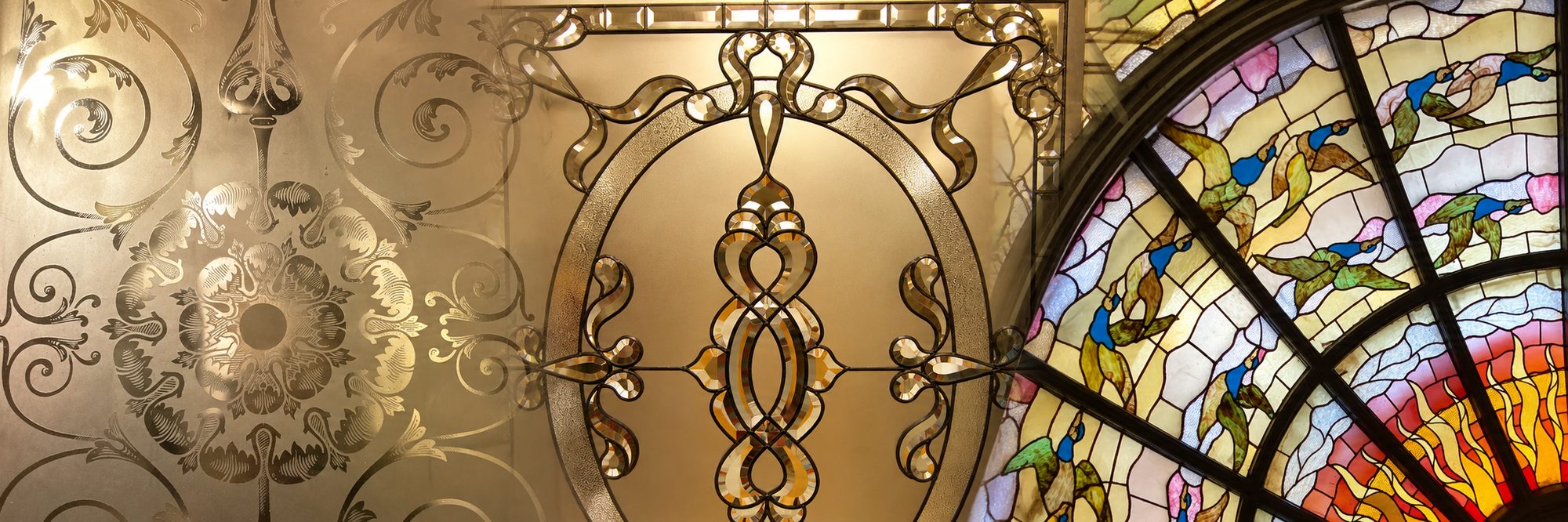

A plain-English guide to the words used in stained glass, decorative glass and glass making, from the studio and the kiln to the church and the shop front. Where a word has its own page on this site, it is linked. Terms in bold that are also links have a full page of their own, with more detail and related reading. Terms in a definition that appear elsewhere in the glossary are linked too.
A
Acid embossing. A deeper, longer acid treatment that leaves a more pronounced relief than a light satin etch. See Acid etching.
Acid etching. Frosting or patterning glass with hydrofluoric acid, usually as a cream or a bath, so the treated surface turns smooth and satin-like. The chemical action leaves a softer, more even finish than Sandblasting. Acid etched glass. History: The History of Acid Etched Glass.
Acid polishing. An industrial dip in acid that smooths and brightens cut or pressed glass after it has been ground, giving it a clear, polished surface without further hand work.
Annealing. Cooling glass slowly and evenly after it has been formed, so that the stresses built up inside it can relax. Glass that has not been annealed properly can crack hours or days later. See Firing Temperatures and Schedules for Fused and Kiln Formed Glass.
Annealing point. The temperature at which stress inside a piece of glass relaxes within a few minutes. For ordinary soda-lime glass it lies somewhere around 500 to 550°C. Kiln schedules hold the glass near this point before cooling. See Strain point. See Firing Temperatures and Schedules for Fused and Kiln Formed Glass.
Antique glass. Mouth-blown sheet glass made by traditional methods. It has the small bubbles, ripples and variations in thickness that machine-made glass lacks, and it is what most traditional stained glass is made from. See Muff glass and Crown glass.
Apse. The curved or polygonal end of a church, usually at the east end, where the main altar stands. It often holds a group of tall windows.
Arris. The sharp edge where two faces of a piece of glass meet. Arrising means taking this edge off with an abrasive so that it can be handled safely.
Art glass. A general term for coloured and textured sheet glass made for decorative work such as stained glass and fusing, as opposed to ordinary clear window glass.
Arts and Crafts. A movement from the late 1800s that valued hand-made work and honest materials. It shaped British stained glass in the early twentieth century, with designers such as Christopher Whall.
Aventurine. Glass that sparkles because tiny metallic crystals, traditionally copper, are suspended inside it. It was made in Murano from the 1600s.
B
Batch. The mixture of raw materials, mainly sand, soda ash and lime, that is melted to make glass. Broken glass added to it is called Cullet.
Bead. A narrow ridge of solder, or a thin moulded strip. In soldering, a smooth, slightly raised bead is the finish a good joint should have.
Bevel. A flat edge ground and polished at an angle around the rim of a piece of glass, so that it bends light into small rainbows. See Bevelled glass. See How Bevelled Glass Is Made.
Bevel cluster. A group of small bevels, often of different shapes, set together in a leaded or zinc framework to make a pattern. Clusters were popular for Edwardian front doors. See How Bevelled Glass Is Made.
Bevelled glass. Glass whose edges have been ground and polished to an angle. Bevels are made as single panes or as small pieces, and are often assembled in lead or zinc into decorative door and window panels. Decorative bevelled glass. History: The History of Brilliant Cut and Bevelled Glass.
Blowing. Forming glass by inflating a gather of molten glass on the end of a hollow iron pipe. See Blowpipe and Gather.
Blowpipe. The long hollow iron tube used to gather molten glass and blow it into shape.
Bohemian glass. Glass made in the Bohemian region, now part of the Czech Republic, known for cut glass and for rich colour, including ruby and cobalt blue.
Borosilicate. A glass containing boron oxide that expands very little when heated. It handles temperature changes well and is used for laboratory ware, ovenware and flameworking, but it is not compatible with soda-lime glass in fusing. See COE.
Brass came. Came made of brass rather than lead, harder and brighter, used where a metal line has to be stiffer or a different look is wanted. See Came.
Breaking pliers. Pliers with flat, wide jaws used to grip and snap off a piece of scored glass. See How to Cut Glass.
Brilliant cutting. Decorative cutting of glass with V-shaped and rounded wheels, producing sharp grooves, fans and stars that catch the light. Common on Victorian and Edwardian doors, windows and mirrors. Brilliant cut glass. History: The History of Brilliant Cut and Bevelled Glass.
Bubble. A trapped pocket of gas in glass. A few are expected in antique glass, where they are valued, but in machine-made glass they are normally a flaw. See Seeds.
Bubble squeeze. A hold at a temperature a little below the fusing point, usually about 650 to 675°C (1200 to 1250°F) for many fusing glasses, that lets air trapped between layers escape before the edges seal. See Firing Temperatures and Schedules for Fused and Kiln Formed Glass.
Bullion. The thick centre of a disc of Crown glass, where the blowpipe was attached. It is also called a bullseye, and was once used as a decorative round in windows. History: How window glass was made.
Bullseye. See Bullion. See also Roundels and Bullseyes in Leaded Lights.
Burnishing. Rubbing came or foil flat with a smooth tool so that it sticks to the glass and closes up neatly. See Lathekin. See How to Grind Glass and Apply Copper Foil.
Butt joint. A joint where two pieces meet end to end without overlapping. In leadwork, came ends are butted against each other and then soldered.
C
Cabochon. A smooth, domed piece of glass, polished or moulded, set into a window like a gemstone. See Jewel.
Came. A grooved strip of metal, traditionally lead, used to hold pieces of glass together in a panel. Came is made in H-section, which has a channel on each side, and U-section, which has one and is used at the edges. It is also made from zinc, brass and copper. See Lead came, Zinc came and Leaded lights. Leaded lights. See How to Make a Leaded Panel.
Came knife. A heavy knife with a curved or angled blade used to cut lead came. Glaziers have also used a hacking knife, which is shaped differently and has a weighted end for tapping glass into place. See Hacking knife. See How to Cut Lead Came.
Cameo glass. Glass made of two or more layers, usually a light layer over a dark one, where the outer layer is carved, etched or sandblasted away to leave a raised design in relief. See Cased glass.
Carborundum. Silicon carbide, a very hard abrasive used in grinding wheels and as the grit in many Sandblasting machines. It is also sold as a loose grit and as sanding stones for smoothing glass.
Cartoon. A full-size drawing of a window design, with every lead line and colour marked. Glass is cut to fit the pieces on the cartoon, and the finished panel is laid over it as it is assembled. See How to Make a Leaded Panel.
Cased glass. Glass made of two or more layers of different colours. Cutting or grinding through the outer layer reveals the one below, a technique used in Cameo glass. See Flashed glass.
Casement window. A window hinged along one side, opening outwards or inwards like a door. Metal casements were commonly glazed with small leaded panes.
Cast glass. Glass formed by pouring or pressing molten glass into a mould. See Kiln casting and Lost-wax casting.
Cathedral glass. Smooth transparent coloured sheet glass. The name is used mainly in North America, and has nothing to do with cathedrals, although the clear coloured glass has long been used in ecclesiastical windows.
Cement. In leaded lights, a putty-like mix of oil, whiting and sometimes pigment brushed under the flanges of the came to fill gaps, stiffen the panel and make it weatherproof. It is brushed in, left to set, and the excess is cleaned away with whiting. See Whiting. See How to Make a Leaded Panel.
Chancel. The part of a church around the altar, often at the east end and containing the choir. It usually has the church’s most important window.
Chipped glass. See Glue chipping.
Clear glass. Glass with no added colour. It is used in leaded lights, in bevelled glass and as a base for Overlay stained glass.
Clerestory. The upper level of a large church wall, rising above the aisle roofs, with a row of windows that let light into the central nave.
COE. Short for coefficient of expansion, a number that describes how much a glass expands as it is heated. Glasses can be fused together safely only if their COE values are close, and fusing glass is sold as, for example, COE 90 or COE 96. See Compatible glass. See Firing Temperatures and Schedules for Fused and Kiln Formed Glass.
Coefficient of expansion. See COE.
Cold working. Shaping, grinding, polishing, drilling, sandblasting or engraving glass once it is cold, as opposed to Hot working.
Compatible glass. Glasses with matching expansion rates, so that they can be fused together without cracking as they cool. See COE.
Contour fuse. A fuse that softens the surface and rounds the edges while keeping some of the relief of the pieces. It is hotter than a Tack fuse and cooler than a Full fuse.
Copper foil. Thin adhesive-backed copper tape wrapped around the edge of each piece of glass, then soldered. It allows finer lines and three-dimensional work such as lamps, and it is the basis of the Tiffany method. See Tiffany method. See How to Grind Glass and Apply Copper Foil. See Copper Foil Stained Glass.
Crackle glass. Glass with a network of fine cracks created on purpose, usually by plunging a hot gather into water and re-heating it, or by chilling the surface so it fractures.
Crizzling. A network of tiny cracks that develops on the surface of some old glass when it loses moisture. See Glass disease.
Crown glass. The main window glass of Britain until the 1800s. A blown bubble of glass was opened and spun into a flat disc, which was then cut into panes. The centre, with the thick pontil mark, was the Bullion. Crown glass has a lustrous surface with faint curved lines. History: How window glass was made.
Cullet. Broken or waste glass that is added to a new melt, which lowers the temperature needed and recycles glass.
Cut glass. Glass whose surface has been cut into facets, grooves or patterns with abrasive wheels, then often polished. See Brilliant cutting.
Cutting oil. A light oil used on the wheel of a glass cutter, or fed into it, to make the score cleaner and the cutter last longer.
Cylinder glass. Glass made by blowing a long cylinder, cutting it along its length and flattening it in a kiln. It is also called muff glass and was the usual method for making sheet glass for coloured windows. See Muff glass. History: How window glass was made.
D
Dalle de verre. French for slab of glass. Thick pieces of coloured glass, often about 25 mm, are chipped or faceted and set in concrete or epoxy resin instead of lead. The technique grew popular for churches in France and Britain from the 1930s, and especially after the Second World War. History: The History of Fused and Kiln Formed Glass.
Devitrification. Unwanted crystallisation that makes glass look cloudy or scummy, caused by holding it too long in a temperature range just below its fusing point, or by dirt on the surface. Often called devit. See Firing Temperatures and Schedules for Fused and Kiln Formed Glass.
Diamond cutter. An old glazier’s tool with a natural diamond set in a handle. Wheel cutters have largely replaced it, but some glaziers still use diamonds for fine work. See How to Cut Glass.
Diaper. A small, repeated all-over pattern, such as diamonds or squares, used to fill backgrounds, a feature of medieval and Gothic Revival glass.
Dichroic glass. Glass coated in thin layers of metal oxides that transmit one colour and reflect another, so that it appears to change as the angle of view changes. Used in fused glass and jewellery.
Double glazing. Two panes of glass separated by a sealed gap. Leaded panels can be fitted inside a sealed unit, or the lead lines can be applied to the surface as Overlay.
Draping. Allowing heated glass to sag over a mould so that it takes its shape. See Slumping.
Drawn sheet. Sheet glass pulled upwards from molten glass in a continuous ribbon, the main method before float glass.
Drilling. Making a hole in glass with a diamond-tipped bit, kept wet to prevent cracking.
E
Edge work. Grinding, smoothing and polishing the edges of glass pieces.
Embossed glass. Glass with a raised pattern pressed into the surface while it is formed.
Enamel. Powdered coloured glass mixed with a medium and painted onto the surface of glass, then fired so that it melts and bonds to the surface. Used for detail and colour on painted windows, especially from the sixteenth century. See How Painted and Silver Stained Glass Is Fired.
Epoxy resin. A two-part plastic adhesive used to bond glass, set Dalle de verre slabs and make repairs, because it cures hard and clear.
Etched glass. A general name for glass whose surface has been frosted or patterned, either with acid or by sandblasting. See Acid etching and Sandblasting. Sandblasted glass.
Etching cream. A paste containing fluoride salts, used by hobbyists to frost glass through a stencil. It is safer than liquid hydrofluoric acid, but is still corrosive and needs gloves and goggles.
Expansion. The way glass gets slightly bigger as it heats and smaller as it cools. See COE.
F
Facet. A small flat face cut and polished on glass, as on a bevel or a cut jewel.
Fanlight. A window over a door, often semicircular, with glazing bars radiating out like a fan. It lets light into a hallway and was a favourite place for leaded and stained glass in Georgian and Victorian houses.
Fibre paper. A thin sheet of ceramic fibre laid under glass in a kiln to stop it sticking and to let air escape.
Fid. A smooth plastic or wooden tool used to press down and burnish copper foil. See Burnishing and How to Grind Glass and Apply Copper Foil.
Fire polish. Heating the surface of glass until it glazes smooth again, removing marks left by cutting or tooling. See Firing Temperatures and Schedules for Fused and Kiln Formed Glass.
Firing schedule. The programme of temperatures and times used in a kiln: how fast to heat, how long to hold and how slowly to cool. Different jobs, such as fusing, slumping and paint firing, need different schedules.
Flange. The thin flat side of lead came that grips the face of the glass. See How to Make a Leaded Panel.
Flashed glass. Clear or lightly coloured glass with a thin layer of another colour, often red, on one side. Cutting, grinding, acid or sandblasting through the layer exposes the glass beneath, which is how medieval and Victorian glaziers made two colours from one piece. See Cased glass. See How Coloured Glass Is Made.
Flat glass. Window glass made in sheets, now almost all by the float process. See Float glass.
Float glass. Flat glass made since the 1950s by pouring molten glass onto a bath of molten tin, where it spreads out into a smooth, even ribbon. It is the glass in most modern windows and the starting point for Overlay stained glass and etched work. See Tin side. History: How window glass was made.
Flux. In soldering, a chemical that cleans the metal and lets the solder flow. In glass making, an ingredient such as soda that lowers the melting point of silica. See How to Solder.
Foil. See Copper foil.
Frit. Crushed glass of a controlled size, from fine powder to coarse chips. Fused onto sheets to add colour and texture. See Powder.
Frosted glass. Glass with a matt, translucent finish, from acid etching, sandblasting or surface grinding, that lets light in but hides what is on the other side.
Full fuse. Firing glass at a high enough temperature that the pieces flow together into a smooth, flat surface, usually around 800°C, depending on the glass. See Tack fuse. See Firing Temperatures and Schedules for Fused and Kiln Formed Glass.
Fused glass. Pieces of compatible glass heated in a kiln until they join into one. Fused glass.
Fusing. Joining compatible glass pieces together by heat. See Tack fuse, Contour fuse and Full fuse. History: The History of Fused and Kiln Formed Glass.
G
Gaffer. The master glassblower in a hot shop, who directs the team.
Gather. The ball of molten glass lifted from the furnace on the end of a blowpipe or pontil.
Glass. A hard, brittle material, usually transparent, made by melting silica, usually as sand, with other ingredients and cooling it so quickly that it does not crystallise. Technically it is an amorphous solid.
Glass cutter. A hand tool with a small hardened wheel that scores a line on the surface of glass so that it can be broken along it. See How to Cut Glass.
Glass disease. The deterioration of some old glass, especially medieval potash glass, when moisture attacks it and leaches out some of its ingredients. It shows as pitting, cloudiness or a network of cracks. See Crizzling.
Glass paint. See Vitreous paint.
Glass painting. Painting with vitreous paint, then firing it onto the glass. It is used for faces, drapery, patterns and lettering. See Vitreous paint.
Glazier. A craftsperson who cuts and fits glass. In the stained glass trade the term applies to the person who makes leaded panels and fits them into windows.
Glazing bar. A thin bar, of wood or metal, that divides a window into panes. Georgian sash windows have glazing bars that hold the glass in place.
Glazing bead. A strip fixed around the edge of a pane to hold the glass in its frame.
Glory hole. A small furnace used to reheat glass during blowing so that it stays soft.
Glue chipping. A technique in which hide glue is applied to a sandblasted or ground glass surface. As the glue dries it shrinks and tears away thin flakes of glass, leaving a feathery, fern-like texture.
Gold leaf. Very thin sheets of gold applied to glass for decoration, sometimes sealed behind the glass in Verre églomisé.
Gold ruby. Red glass coloured by adding colloidal gold, a process discovered in the 1600s. See Striking.
Gothic Revival. A style from the 1800s that revived medieval architecture and design, with pointed arches and richly coloured windows, popular for churches and public buildings across Britain and its former colonies.
Grinder. An electric machine with a rotating diamond head, used to smooth the edges of glass and to shape pieces that cannot be cut cleanly. See How to Grind Glass and Apply Copper Foil.
Grisaille. Painting in tones of grey and brown on glass. The word is also used for windows made mainly of clear glass with painted patterns, popular in the 1200s and again in Victorian times. History: Medieval Stained Glass and the Origins of Leaded Lights. See How Painted and Silver Stained Glass Is Fired.
Ground glass. Glass whose surface has been roughened with abrasive to give a smooth, matt finish.
Grozing. Nibbling away small pieces from the edge of a piece of glass with grozing pliers so that it fits an outline exactly. A grozing iron is the older hooked tool for the same purpose. See How to Cut Glass.
H
Hacking knife. A heavy-bladed knife used in traditional leading to cut came and to tap glass into place, the end of its handle being weighted for knocking.
Hammered glass. Sheet glass textured on one side with a pattern that resembles hammered metal.
Heart. The thin central web of an H-shaped came, between the two channels that hold the glass.
Heart (of came). The thin central web of an H-section lead came, between the two channels that hold the glass.
Heat soak. A period of time in a kiln during which the whole piece of glass is held at one temperature so that the heat spreads evenly through it.
Heraldic glass. Glass showing coats of arms, badges and mottoes, common in churches, colleges, town halls and houses from the Middle Ages onward.
Horseshoe nails. Flat-sided nails used to hold glass and lead in position on the work board while a leaded panel is built. See How to Make a Leaded Panel.
Hot working. Shaping glass while it is molten or red hot: blowing, casting, flame working and similar processes.
Hydrofluoric acid. The acid used to frost and etch glass because it dissolves silica. It is extremely dangerous: it penetrates skin, can cause deep burns and poisoning, and needs specialist handling.
I
Insulating glass unit. A sealed double-glazed unit, with two or three panes separated by a spacer and a sealed gas or air gap. Often called an IGU.
Intaglio. A design cut or carved into the surface of glass so that it sits below the surface rather than standing proud.
Iridescent glass. Glass with a rainbow shimmer, made by spraying metal salts onto hot glass.
Iron oxide. A compound used as a colourant, giving greens and browns in glass, and the main ingredient of the black or brown paint used in glass painting.
J
Jewel. A piece of glass, often cut, faceted or moulded, set in a window like a gem. See Cabochon.
Jig. A frame, usually of wood or metal strips, that holds pieces of glass in the right position while a panel is being assembled.
Joint. The meeting point where lead or foil lines cross and are soldered. A good joint is smooth and neat.
K
Kiln. An oven that reaches high enough temperatures to fuse, slump, cast or paint glass. Kilns for glass are programmed to heat and cool at controlled rates.
Kiln casting. Melting glass into a mould inside a kiln so that it takes the mould’s shape. See Lost-wax casting. History: The History of Fused and Kiln Formed Glass.
Kiln forming. The name for all the techniques that shape glass in a kiln, including fusing, slumping, casting and pâte de verre. Kiln formed glass.
Kiln shelf. The flat board of refractory material on which glass is placed in a kiln. It is coated with kiln wash to stop the glass sticking.
Kiln wash. A coating, usually containing alumina, painted onto kiln shelves and moulds to stop glass from sticking when it melts.
L
Laminated glass. Two or more sheets of glass bonded with a plastic interlayer, usually PVB, so that if it breaks the pieces stay stuck together. It is used for safety glazing, security and sound insulation.
Lampwork. Making glass objects by melting rods and tubes in a flame, rather than a furnace. Beads and small sculptures are commonly made this way.
Lancet. A tall, narrow window with a pointed arch at the top, typical of Early English Gothic architecture. Lancets often appear in groups of three or five.
Lathekin. A small tool of wood, bone or plastic, with a flat tip, used to open the channels of lead came and to burnish it against the glass. See How to Make a Leaded Panel.
Lead. A soft, heavy metal with a low melting point, used for centuries to make came. It is toxic, so hands must be washed and dust avoided. See Lead came and Working safely with glass. Working safely with glass.
Lead bloom. A white powdery oxide that can form on lead and spread on to glass. It is a sign that a window needs attention. See How to Clean Decorative Glass Safely.
Lead came. Strips of lead, extruded or milled into an H or U profile, that hold glass in a leaded panel. The lead is soft enough to bend round curves and strong enough to support small pieces of glass. See How to Cut Lead Came. See How Lead Came and Overlay Lead Are Made.
Lead crystal. Glass made with lead oxide, which makes it heavier and more brilliant. It is used for tableware and has no connection with the lead came in leaded lights.
Lead-free solder. Solder made without lead, usually of tin with small amounts of silver or copper, used in place of the traditional tin and lead alloy.
Leaded glass. Another name for leaded lights, glass pieces held in lead came.
Leaded lights. Panels made of small pieces of glass joined with lead came, often in diamond or rectangular patterns. This is the construction method behind most traditional stained glass windows. Leaded lights.
Leading up. Assembling a leaded panel by fitting glass pieces into came, working from one corner, then soldering the joints. See How to Make a Leaded Panel.
Lead knife. A short, broad knife used to cut lead came, often with a rocking motion. See Came knife and How to Cut Lead Came.
Lead stretcher. A vice or similar tool that grips one end of a length of came while it is pulled straight, which removes kinks and makes the lead stiffer. See How to Cut Lead Came.
Lehr. A long tunnel oven in which glass moves slowly on a belt to anneal. It is used in industrial production of bottles and sheet glass.
Light. One section of a window, divided by mullions or transoms, or a single pane in a leaded window. A three-light window has three sections.
Lightbox. A box with a lit glass top that lets you see through the glass when selecting colours and cutting patterns.
Lost-wax casting. A casting method in which a wax model is covered in a heat-resistant mould and melted out, leaving a cavity into which glass is melted. See Kiln casting.
Lozenge. A diamond-shaped pane, a classic shape in leaded lights. See Quarry.
Lustre. A thin metallic coating, often gold, silver or platinum, fired onto glass to give a shimmering surface.
M
Marver. A flat slab of steel or stone on which hot glass is rolled and shaped.
Matting. In glass painting, dabbing and stippling a layer of paint with a soft brush to give smooth gradations of tone, before the paint dries and is fired.
Medieval glass. Stained glass made roughly between the 1100s and the 1500s, using pot-metal glass, painted detail and, from about 1300, silver stain. Traditional stained glass.
Metal oxide. A metal compound added to glass as colourant. Cobalt gives blue, copper gives green or red, manganese gives purple, iron gives green or brown, and gold gives ruby red.
Millefiori. Italian for a thousand flowers. Glass rods are built up with patterns of coloured layers, then cut across into slices that show the pattern. See Murrine.
Moil. Waste glass left on the end of a blown piece after it is removed from the blowpipe, cut away and discarded.
Mosaic glass. Small pieces of glass called tesserae, set in cement or adhesive to form a picture or pattern. See Tesserae.
Mould. A form into which glass is poured, pressed or slumped to give it shape. Kiln moulds are made of ceramic, plaster-based material or stainless steel.
Mouth-blown glass. Glass made by blowing by mouth, rather than by machine. See Antique glass.
Muff glass. Another name for Cylinder glass, from the muff-shaped cylinder blown before it is cut open and flattened.
Mullion. A vertical bar that divides a window into lights. A horizontal one is a Transom.
Murrine. Slices cut from a bundle of glass rods that show a pattern in section. See Millefiori.
N
Nibbler. A tool with a cutting jaw that takes small bites out of the edge of glass.
Nugget. A small blob of glass, flat on one side and domed on the other, used as a jewel in leaded windows. See Jewel.
O
Obscure glass. Glass that lets in light but prevents a clear view, such as the textured or frosted glass used in bathrooms. Manufacturers grade it on a privacy scale.
Oculus. A round window, from the Latin for eye. It can be a single circle or a circular opening in a dome.
Opalescent glass. Milky, semi-opaque glass that scatters light and shows different colours by reflected and transmitted light. It was developed in the late 1870s and 1880s by John La Farge and Louis Comfort Tiffany in America, and used for landscape and floral windows. History: Opalescent Glass, Tiffany and the Copper Foil Method.
Opaque glass. Glass that lets no light through, used for surfaces, lamp shades and mosaics.
Outline. The dark painted line that defines features, such as faces, hands and drapery, on a painted window. Also called trace.
Overlay. The method of making a stained glass panel by applying lead lines and coloured glass to the surface of a sheet of toughened glass. See Overlay stained glass.
Overlay stained glass. A panel that looks like leaded stained glass but is built on a single sheet of toughened glass, with the lead and coloured glass applied to the surface. It is stronger and easier to fit than true leaded lights, though it is not the same construction. Overlay stained glass. History: Where Overlay Stained Glass Came From. See Overlay Colour Films, UV Protection and Durability.
P
Panel. A complete section of leaded glass, made to fit one window opening or one part of a larger window.
Pâte de verre. French for glass paste. Powdered glass is mixed with a binder, packed into a mould and fired, producing a dense, often opaque cast piece with a soft surface.
Patina. A chemical finish that colours the solder and metal lines of a panel, commonly black or copper. It protects and hides the grey of the solder.
Pattern shears. Scissors with three blades that cut out a thin strip along the line, leaving space for lead or foil when pattern pieces are cut. See Cartoon.
Plating. Putting two or more layers of glass together in one lead opening to change the colour or depth. Used especially in Arts and Crafts windows.
Polishing. Making a surface shine, normally with a felt or cork wheel and a fine abrasive such as cerium oxide.
Pontil. An iron rod that holds a piece of glass while the neck is finished. The rough scar left on the base is a pontil mark.
Pot. The ceramic crucible in which glass is melted in a traditional furnace.
Pot metal. Glass coloured all the way through by metal oxides added to the molten glass in the pot. It is the glass of medieval windows. Compare Flashed glass. History: Medieval Stained Glass and the Origins of Leaded Lights. See How Coloured Glass Is Made.
Powder. Very finely crushed glass, used in fusing for blending colour and drawing. See Frit.
Pressed glass. Glass shaped by pressing molten glass into a mould with a plunger, producing patterned panes, dishes and tiles.
Pressure pot. The part of a sandblasting machine that holds the abrasive and feeds it into the airstream. See Sandblasting.
Prismatic glass. Glass moulded with prism-shaped ribs that bend and spread light, formerly used in shop fronts and pavement lights.
Pâte de verre. French for “glass paste”. Crushed glass mixed with a binder is packed into a mould and fired in a kiln, producing a cast piece with a soft, grainy surface. See The History of Fused and Kiln Formed Glass.
Putty. A soft mixture of whiting and linseed oil used for fixing panes into wooden or metal frames. It sets to a firm surface and is usually painted.
Q
Quarry. A small diamond or square pane of glass, the basic unit of much leaded work. The name comes from the French for a square, and quarries are often set on the diagonal.
Quatrefoil. A four-lobed shape like a clover, a favourite motif of Gothic tracery. See Trefoil.
Quench. Cooling glass quickly, as in toughening, where air jets are blown onto hot glass to cool the surfaces. See Toughened glass.
R
Reamy glass. Glass with streaks, waves and ripples from uneven mixing, giving it a lively, rippled look.
Reeded glass. Glass with parallel vertical ribs on one face, giving a soft, distorted view.
Reinforcing bar. A bar of steel or copper added to a leaded panel to give extra strength, soldered to the lead. See Saddle bar.
Releading. Taking an old leaded panel apart and putting it back together with new came, a common repair when the old lead has sagged or split.
Resist. A stencil or coating that protects part of the surface from the sandblast or the acid, so that only the exposed areas are treated. Typically adhesive vinyl or rubber.
Restoration. Repairing and conserving old glass. Conservation and restoration.
Rolled glass. Sheet glass made by passing molten glass between rollers, leaving a texture on one or both sides. History: How window glass was made.
Rondel. See Roundel.
Rose window. A large circular window with tracery radiating from the centre like petals or spokes, typical of Gothic cathedrals.
Roundel. A small circular piece of glass, either clear, coloured or painted. Roundels of glass were popular in Tudor and Victorian leaded windows. See Roundels and Bullseyes in Leaded Lights.
Ruby glass. Deep red glass, made with gold, copper or selenium, long associated with churches and with pub windows.
Running pliers. Pliers with curved jaws that apply even pressure along a scored line so the glass “runs” and breaks cleanly. See How to Cut Glass.
S
Saddle bar. A horizontal iron or steel bar fixed across a window opening, to which leaded panels are tied with copper wire. It supports the panels against wind and their own weight.
Sandblasting. Propelling abrasive grit onto glass under pressure so as to frost or carve its surface. Different depths give different effects, from a delicate frost to deep carving. Sandblasted glass. History: The History of Sandblasted and Deep Carved Glass.
Sash window. A window made of one or two panels that slide up and down in a frame. Many Georgian and Victorian sashes have glazing bars that divide them into small panes.
Score. The fine scratch made on glass by a cutter. Glass is then broken along the line. See How to Cut Glass.
Scoring. Drawing a cutter along a line on the glass to make a shallow scratch, along which the glass can then be snapped.
Sealed unit. See Insulating glass unit.
Seeds. Very small bubbles in glass, a feature of antique glass.
Self-adhesive lead. A thin strip of lead with an adhesive back, pressed onto the surface of glass to imitate the lines of leaded lights. It is used in Overlay work. See How Lead Came and Overlay Lead Are Made.
Sgraffito. Scratching a design through a layer of paint to reveal the glass beneath, used in glass painting for highlights and fine lines.
Sheet glass. Flat glass made by any method, as opposed to bottles or vessels.
Sidelight. A narrow window beside a door, which often holds decorative glass.
Silica. Silicon dioxide, the main ingredient of glass, which comes from sand or crushed quartz.
Silver stain. A yellow stain made from a silver compound, painted on the back of glass and fired. It turns clear glass pale yellow to deep orange and was used from about 1300 to add yellow to windows without extra lead. History: Medieval Stained Glass and the Origins of Leaded Lights. See How Coloured Glass Is Made. See How Painted and Silver Stained Glass Is Fired.
Slab glass. Thick pieces of coloured glass, usually about 25 mm thick, chipped to shape and set in concrete or epoxy resin. See Dalle de verre.
Slumping. Heating glass in a kiln until it softens and sags into or over a mould, to make bowls, plates and curved panels. See Draping. History: The History of Fused and Kiln Formed Glass. See Firing Temperatures and Schedules for Fused and Kiln Formed Glass.
Soda-lime glass. The most common type of glass, made of silica, soda ash and lime, used for windows, bottles and most stained glass.
Solarisation. The slow change of some old glass, containing manganese as a decoloriser, to a purple tint under sunlight, as seen in some Victorian bottles and panes.
Solarization. The slow change of some older glass to a pale purple tint in strong sunlight. It affects glass that contains manganese added to remove green colour. See Does Coloured Stained Glass Fade?.
Solder. A metal alloy that melts at a low temperature, used to join lead came or copper foil. Traditional solder is tin and lead. See How to Solder.
Soldering. Joining metal by melting solder into the joint. See Solder, Flux and How to solder. How to solder.
Soldering iron. An electric tool with a heated tip, used to melt solder. Temperature-controlled irons are best for glass work. See How to Solder.
Spacer bar. The metal or plastic strip between the panes of a sealed unit.
Stain. See Silver stain.
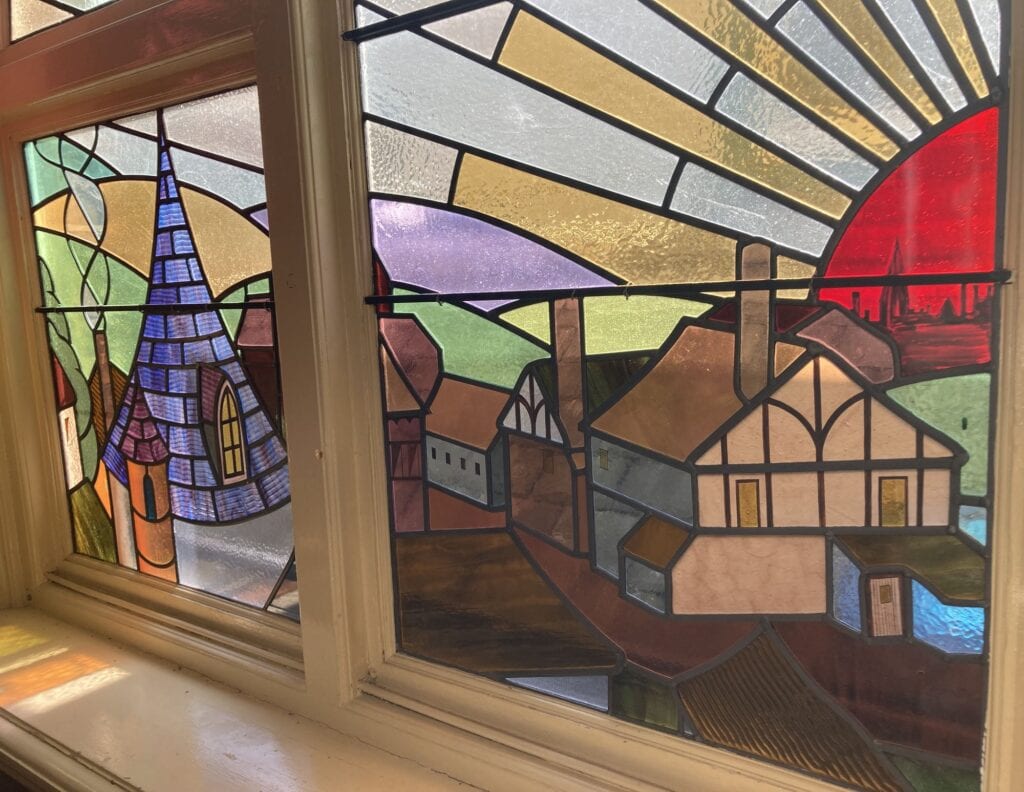
Stained glass. Coloured glass, whether coloured through, flashed or painted, assembled into windows and panels. The name is also commonly used for the finished windows. Traditional stained glass.
Stencil. A cut-out pattern that masks glass so that only the open areas are painted, acid-etched or sandblasted. See Resist.
Stipple. Dabbing paint on with a brush to give a grainy texture.
Strain point. The temperature below which stress in glass can no longer relax. Glass is cooled slowly through the range between the Annealing point and the strain point, and quickly afterwards. See Firing Temperatures and Schedules for Fused and Kiln Formed Glass.
Stress. Strain inside glass when one part cools faster than another or is made from incompatible glass. It can cause it to break.
Striking. The development of colour in some glass, notably gold ruby and some reds and oranges, on re-heating. See Gold ruby.
Stringer. A thin rod of glass, used in fusing to draw fine lines.
T
Tack fuse. The lowest fusing temperature, at which glass pieces just stick together while still keeping their shape and texture. See Full fuse. See Firing Temperatures and Schedules for Fused and Kiln Formed Glass.
Tack soldering. Joining pieces at a few points with small spots of solder to hold them in place before running full solder lines. See How to Solder.
Tempered glass. See Toughened glass.
Template. A pattern of a shape, used to mark and cut glass repeatedly.
Tesserae. The small pieces of stone or glass used in a mosaic. One piece is a tessera.
Textured glass. Glass with a surface pattern from rolling, pressing or moulding.
Thermal shock. A crack caused when part of the glass heats or cools faster than the rest.
Thin edge. The narrow vertical edge left at the rim of a bevel once the slope has been ground. It is about 3 mm for a bevel set in lead came, and about 1.5 to 1.8 mm for a bevel bonded to a sheet for overlay lead. See Bevel and How Bevelled Glass Is Made.
Tie. A length of copper wire soldered to a leaded panel and twisted round a saddle bar to hold the panel in place.
Tiffany method. Louis Comfort Tiffany’s name for wrapping each piece of glass in copper foil and soldering the joints, which allowed finer detail and three-dimensional shapes, as in his lamps. See Copper foil. See How to Grind Glass and Apply Copper Foil.
Tin side. The side of float glass that was in contact with the molten tin bath, which carries traces of tin. It can look different from the other under ultraviolet light, and it matters in fusing because the two sides can behave differently.
Tinning. Coating metal, such as a soldering iron tip or a piece of foil, with a thin layer of solder. See How to Solder.
Tinted glass. Glass with a slight colour throughout, used for windows to reduce glare.
Toughened glass. Glass that has been heated to around 620 to 650°C and then rapidly cooled, making it several times stronger than ordinary glass. When it breaks it shatters into small blunt pieces. It cannot be cut, drilled or edged afterwards, and is the base for Overlay stained glass. History: How window glass was made.
Tracery. The stone or wooden bars that divide the upper part of a Gothic window into patterns. Glass fills the spaces between.
Tracing paint. Dark brown or black glass paint used for outlines and strong lines on painted glass, and fired at about 660 to 675°C (1220 to 1250°F). See How Painted and Silver Stained Glass Is Fired.
Transept. The cross arms of a church shaped like a cross, projecting at right angles from the nave.
Transom. A horizontal bar dividing a window. A transom light is a window above a door.
Trefoil. A three-lobed shape like a clover leaf, common in Gothic tracery. See Quatrefoil.
U
U came. Came with a single channel and a U section, used to finish the outer edge of a panel.
Ultraviolet adhesive. Glue that cures when exposed to ultraviolet light, used to bond glass to glass.
V
V-groove. A V-shaped channel cut into glass or mirror, usually part of a decorative pattern, often seen on Victorian and Art Deco glass.
Venetian glass. Glass from Venice and Murano, known for its colour, lightness and techniques such as millefiori and aventurine.
Verre églomisé. Glass decorated on the back with gold leaf or paint, which is then sealed, so that the design shows through the front.
Viscosity. How easily molten glass flows. It falls as the temperature rises, and glassworkers heat or cool the glass to achieve the viscosity they want.
Vitrail. The French word for stained glass window.
Vitreous paint. Paint made from ground glass, metal oxide pigment and gum or oil, painted on glass and fired at around 600 to 650°C so that it fuses to the surface. The traditional paint for features, shading and pattern. See Glass painting.
W
Warm glass. The term for glass worked in a kiln: fusing, slumping, casting and related methods. See Kiln forming.
Waterjet cutting. Cutting glass with a high-pressure jet of water carrying an abrasive, used for complicated shapes that cannot be scored by hand.
Weathering. Gradual corrosion of the outer surface of glass by weather and pollution, seen as pitting or a dull film.
Weeding. Removing the unwanted parts of a stencil, such as the vinyl in the area to be sandblasted or etched.
Wheel engraving. Cutting designs into glass with small rotating copper wheels and an abrasive paste, giving fine pictorial detail.
Whiting. Fine powdered chalk, used in glazing to make cement and to clean and dry lead after cementing. See How to Make a Leaded Panel.
Wired glass. Glass with a wire mesh embedded in it, used where fire resistance or holding broken pieces together matters.
Y
Yellow stain. See Silver stain.
Z
Zinc came. Came made of zinc, firmer and less flexible than lead, used for larger panels, straight lines and lead-free work. See Came.
Keep reading
For how the main techniques work, see glass types. For hands-on guides, see Learn, including glass tools and equipment and a short history of stained glass.
For a quick overview of how decorative glass developed, see the timeline of decorative glass.