Painted detail is what makes a traditional window more than coloured pieces in lead. Faces, folds of cloth, lettering, shading, pattern and a whole scene are painted on to the glass and then fired in a kiln, so that the paint becomes part of the surface. This page explains how that works, gives firing temperatures and schedules, and shows how a painted scene is built up in stages.
What glass paint is
Glass paint is a mix of three things. A very finely ground glass, called the flux, melts at a lower temperature than the sheet it is painted on. A metal oxide pigment gives the colour: mixtures of iron, copper and lead oxides in different proportions give the browns and blacks used for outlines and shading. A binder, such as water with gum arabic, or sometimes oil, holds the powder in a workable paint and lets it be brushed, stippled or blended on the glass. The binder burns off in the early part of the firing and plays no part in the finished result.
How firing works
In the kiln the flux softens and flows slightly, wetting the surface of the sheet. When the kiln cools the paint has fused to the glass, in the way a glaze fuses to pottery. The top temperature is just under the point where the sheet itself would sag, so the choice of temperature controls the result:
- Underfired paint is dry and matt, and can be rubbed or scratched off. This is sometimes used for a deliberately soft finish.
- Correctly fired paint is held firmly. The surface is smooth or satin depending on the temperature chosen.
- Overfired paint runs, loses its fine detail, can burn out or leave a pitted surface, and the glass itself may warp or slump.
Hand-made glass varies in thickness and composition from sheet to sheet, and so the same paint does not behave identically on every piece. Test tiles of the glass in use are essential.
Silver stain
Silver stain is a different process. It is made from a silver compound, traditionally silver nitrate, mixed with a gum and a carrier, and it dates from the early fourteenth century. It is painted on the opposite face of the glass to the paint, and when fired the silver passes into the surface of the glass instead of sitting on top of it. There it forms tiny particles that colour the glass from pale lemon yellow through to a rich orange-amber. This is how a single piece of clear glass can carry a yellow crown or hair, or how a blue piece can be turned green.
- Stain is fired at about 550 to 560 °C (1022 to 1040 °F), lower than paint. Some stains and glasses suit up to about 600 °C (1112 °F).
- A higher top temperature, a slower firing and a thicker application all give deeper colour. Firing a second time deepens it further.
- Some glass takes stain almost not at all, and hand-made glass often needs a lower temperature, so test.
- If paint and stain are on the same piece, fire the paint first. The stain fires at a lower temperature, and putting the two through the hotter firing together would overfire the stain and leave a bloom on the surface.
- Stain is corrosive. Clean brushes and tools straight away.
Enamels
Enamels are coloured glass paints, such as reds, blues and greens, with a lower melting point than the black trace paint. They are used for colour on clear glass, and for the details that the pot metal does not provide, and they are fired at about 560 to 600 °C (1040 to 1112 °F) depending on the maker. Medieval and later painters used blue enamels coloured with cobalt and made fusible with lead and boron oxides.
Firing temperatures at a glance
| Material | Firing temperature | Notes |
|---|---|---|
| Tracing and shading paint (black or brown) | 660 to 675 °C (1220 to 1250 °F) | 660 °C gives a dry, matt finish; 675 °C gives a smooth, glossy one |
| Silver stain | 550 to 600 °C (1022 to 1112 °F) | Usually about 560 °C. Fires on the opposite face to the paint |
| Enamels | 560 to 600 °C (1040 to 1112 °F) | Depends on the maker. Follow the instructions supplied |
| Binder drying (thick or oil-based work) | 100 °C (212 °F), hold 30 minutes | Lets moisture out before the main climb |
Firing schedules
These schedules were published by a working glass painting studio for water-based tracing paint, and they are a widely used starting point. They are for a small kiln and thin sheet glass. The 5 minute holds depend on the size and thickness of the piece.
Schedule 1: tracing and shading with water-based paint
| Stage | Rate | Target | Hold |
|---|---|---|---|
| 1 | 300 °C/hour (570 °F/hour) | 660 °C (1220 °F) for a dry finish, 675 °C (1250 °F) for a smooth one | 5 minutes |
| 2 | As fast as the kiln allows | 560 °C (1040 °F) | 5 minutes |
| 3 | 10 °C/hour (50 °F/hour) | 530 °C (986 °F) | None. Switch off and let the kiln cool |
Schedule 2: flooding or oil-based paint
The same as schedule 1, with a first stage of 100 °C/hour (212 °F/hour) to 100 °C (212 °F), held for 30 minutes to drive off moisture or solvent. Oil-based paints need extra ventilation, because they give off fumes. Leave the lid or door open until the fumes have cleared.
Schedule 3: silver stain and enamels
Use the same stages as schedule 1, but with the stage 1 top temperature set at 560 to 600 °C (1040 to 1112 °F) depending on the stain or enamel. Always test first.
The cooling stages let the piece release stress, and they are a precaution more than a full anneal. Larger or thicker pieces, and pieces of hand-made glass that vary in thickness, need slower cooling.
Building a scene in stages
A painted scene or motif is not painted and fired once. It is built in stages, from the strongest and hottest lines to the lightest and coolest, because each firing fixes one layer before the next is added.
- Trace. The outlines and strong lines are painted with a fine brush and fired. This is the skeleton of the figure, face or pattern. Schedule 1.
- Matt. A thin wash of paint is laid over areas that need tone, such as drapery, shadows and backgrounds. While it is damp, highlights are lifted out with a brush, stick or quill, or the wash is stippled. Fired on schedule 1, sometimes after a second matt.
- Build up. Further matts and details, such as the modelling of a face, can be added over the fired layers. Fired glass paint tolerates many firings, so a detailed face may go through the kiln several times.
- Stain. Silver stain is painted on the back of the glass, which is the face opposite the paint, and fired at about 560 °C.
- Enamel. Enamels are fired last, at the lowest temperature, so that earlier layers are not disturbed.
Working from hot to cool means that the later layers never go through a firing hotter than their own. A scene of several figures can take three to six firings. Painters often put several coats through one firing once they have learned how their paint behaves, but this takes tests and experience.
Practical points
- Glass for firing rests on a firing surface of whiting, which is powdered chalk, because it separates the glass from the shelf. Fibre paper has been found to vary from batch to batch.
- Some painters prefer a kiln with the heating coils in the lid, because the heat comes from above and the firing is more even.
- Fire slowly. Many painters fire overnight so that several coats of paint can go through at once.
- Keep records of every firing, with the paint, glass, schedule and result. The kiln maker’s instructions have priority for the kiln.
- Make test tiles on the same glass before committing a piece of work.
- Wear a mask when mixing dry paint, enamel and stain powders, and wash after handling. Some enamels and paints contain lead. Keep tools used for glass paint separate from kitchen equipment.
Where painted glass is used
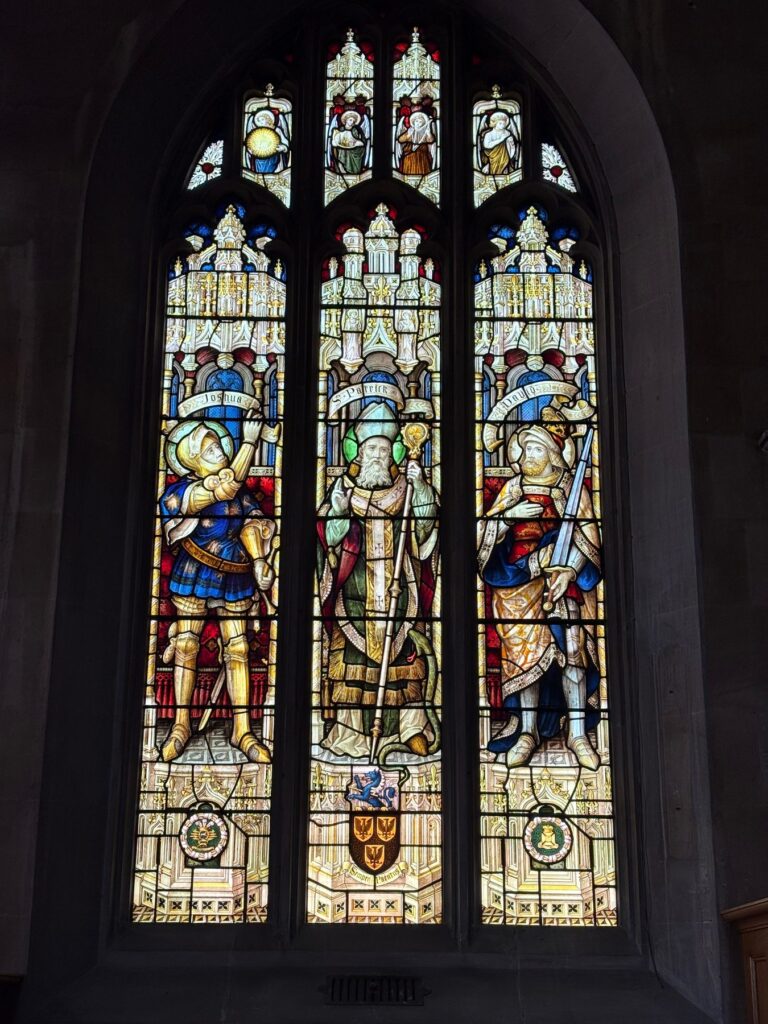
Painted and fired glass is the technique of traditional stained glass and of church windows, where each painted piece is fired before it is leaded into the panel. It was also used by Victorian glass decorators, who fired painted and stained work on domestic and public windows. In a leaded panel, only the pieces that carry paint or stain are fired. The rest are coloured glass left as it is. Overlay stained glass does not use a kiln, because the colour is a film and the lead is applied to the surface.
Related pages
- How coloured glass is made
- Firing temperatures and schedules for fused and kiln formed glass
- Medieval stained glass and the origins of leaded lights
- Does coloured stained glass fade?
- Glass Glossary