
Coloured window glass is far older than the Gothic cathedrals that made it famous. Excavations at the monastery of Wearmouth and Jarrow in north-east England, carried out between 1963 and 1978, recovered some of the earliest coloured window glass in Britain, and the largest collection of seventh and eighth century window glass in western Europe. Shards of it can be seen at St Peter’s Church in Sunderland. These were small pieces set in a frame, not the pictorial windows that followed, but they show that glass was already being coloured and glazed into church windows in the 600s.
The great age: about 1100 to 1550
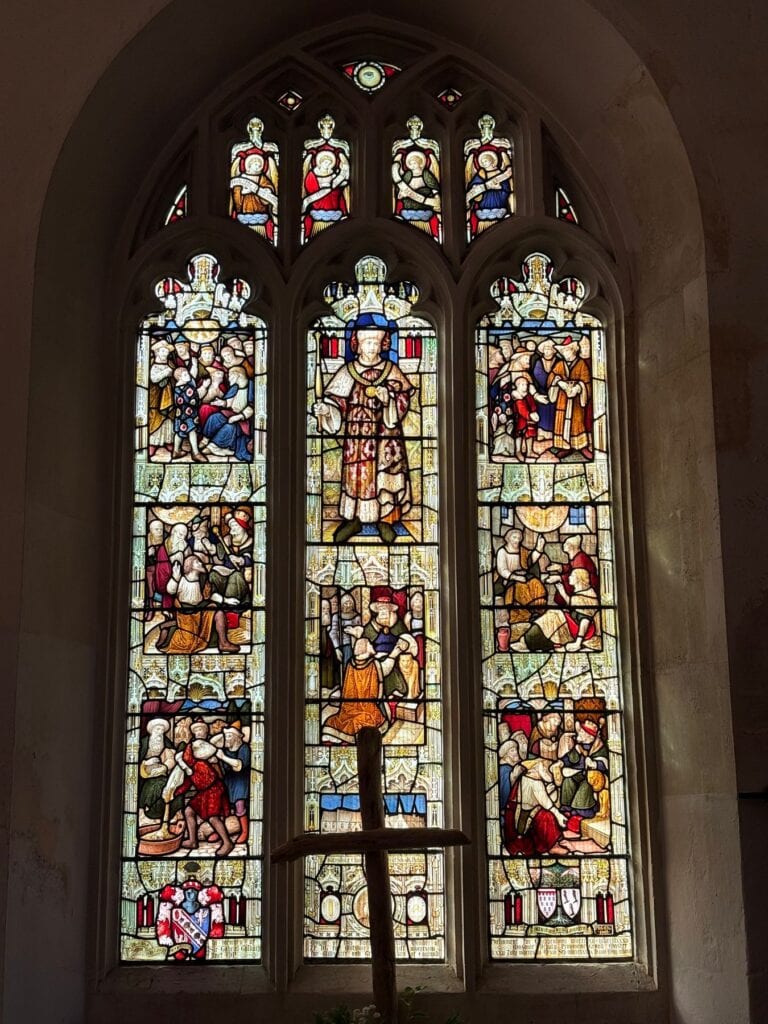
Large figured windows appear in the twelfth century. One of the earliest securely dated examples is a border panel made in the Île-de-France around 1140 to 1144. From the middle of the twelfth century to the middle of the sixteenth, stained glass was at its height in cathedrals, churches, town halls and the houses of the wealthy across Europe.
A monk writing under the name Theophilus described the craft in the early twelfth century in a treatise on the various arts. His account covers glass making, cutting, painting and leading, and the methods he describes changed little for several centuries.
Making the glass
- Around the year 1000, glassmakers in northern Europe began using the ash of woodland plants as the alkali in the mix. The glass was durable in the short term but weathered and decayed, which is why many medieval windows needed early repair.
- Colour came from adding metal oxides to the molten glass. The result is called pot metal, because the colour runs right through the sheet.
- Red was so dense that a full thickness of it was almost black. Glassmakers solved this by flashing: dipping a gather of clear glass into red so that a thin skin of red covered it. The sheet that results is mostly clear with a thin coloured face.
- Sheets were made either by the broad sheet method, where a blown cylinder was cut open and flattened, or the crown method, where a blown bubble was spun into a disc. Both are described further in how window glass was made.
Designing and cutting
The design was drawn full size on a chalk-coated table, and the lines of the leading were drawn in as part of the design. Paper became easier to obtain from about 1400, and full-size paper drawings (cartoons) became standard. Glass was cut by running a hot iron across it and chipping the edge with a grozing iron, the ancestor of the grozing pliers still used today. Diamond cutters, which gave cleaner edges, became common from the sixteenth century. The modern steel and carbide wheel cutter is a later development; see how to cut glass.
Painting the glass
Coloured glass alone produces flat shapes. The features of a face, the folds of a garment and lettering were added with vitreous paint, made from metal oxides, ground glass and a binder. It was brushed on, partly scratched away with sticks or quills to leave highlights, and fired in a kiln so that it fused permanently to the glass.
In the fourteenth century glassmakers found that a compound of silver, painted on the back of the glass and fired, stained it a colour from pale lemon to deep orange. Silver stain let a painter put yellow and white on one piece of glass without cutting and leading a separate piece, and the English name stained glass is usually traced to it. In the fifteenth and sixteenth centuries, grisaille, monochrome designs in neutral tones, combined with silver stain was popular, especially in houses. From about the middle of the sixteenth century, new enamel colours in green, blue and purple allowed more painterly pictures.
Leading
The painted pieces were assembled in grooved strips of lead called came, soldered at the joints, sealed with putty or cement and held to an iron framework of bars. This is the leaded light. The method was ideal for the glass available: sheets were small and uneven, and flexible lead could follow any shape. Windows many metres tall were built from hundreds of small pieces, and the iron bars (saddle bars) carried the weight. The method is described step by step in how to make a leaded panel.
The same construction, with clear or lightly coloured glass in diamond or square quarries, became the standard way of glazing ordinary houses before large sheets of glass were affordable. Many of the windows in the gallery belong to this long tradition.
Why it matters now
Almost every technique in this section on the history of glass either continues the medieval method or was invented in reaction to it. Copper foil replaced lead came for small pieces. Etching, bevelling and brilliant cutting decorated plate glass in the Victorian period. Overlay stained glass imitates the appearance of leaded lights on a single sheet of safety glass. Each is covered in its own article.
On this site, see the glass type page for Leaded Lights and Traditional Stained Glass.
More glass history
- A Short History of Stained Glass
- Medieval Stained Glass and the Origins of Leaded Lights
- How Window Glass Was Made: Crown, Cylinder, Plate and Float
- Stained Glass from the Gothic Revival to the Twentieth Century
- Opalescent Glass, Tiffany and the Copper Foil Method
- The History of Brilliant Cut and Bevelled Glass
- The History of Acid Etched Glass
- The History of Sandblasted and Deep Carved Glass
- The History of Fused and Kiln Formed Glass
- Where Overlay Stained Glass Came From
Terms are explained in the Glass Glossary. The tools and methods used today are covered in Glass Tools and Equipment, and the types of glass themselves under Glass Types.
Glass painting and silver stain are fired in a kiln. See How Painted and Silver Stained Glass Is Fired.
Sources and further reading
- Victoria and Albert Museum: stained glass, an introduction Dates and techniques of the medieval craft.
- St Peter’s Church, Wearmouth: archaeology The seventh century window glass from Wearmouth and Jarrow.
See also How Coloured Glass Is Made and How Lead Came and Overlay Lead Are Made.