
Conservation is the work of keeping old glass as it is. Restoration goes a step further and repairs it, sometimes replacing what has been lost. The two are closely linked, and in practice most jobs on old windows involve elements of both. Where glass needs restoring, a specialist can be commissioned to carry out the work.
Both depend on a simple rule: do as little as possible, and do it in a way that can be reversed. Original glass is irreplaceable, so a good conservator is more interested in saving what is there than in making it look new.
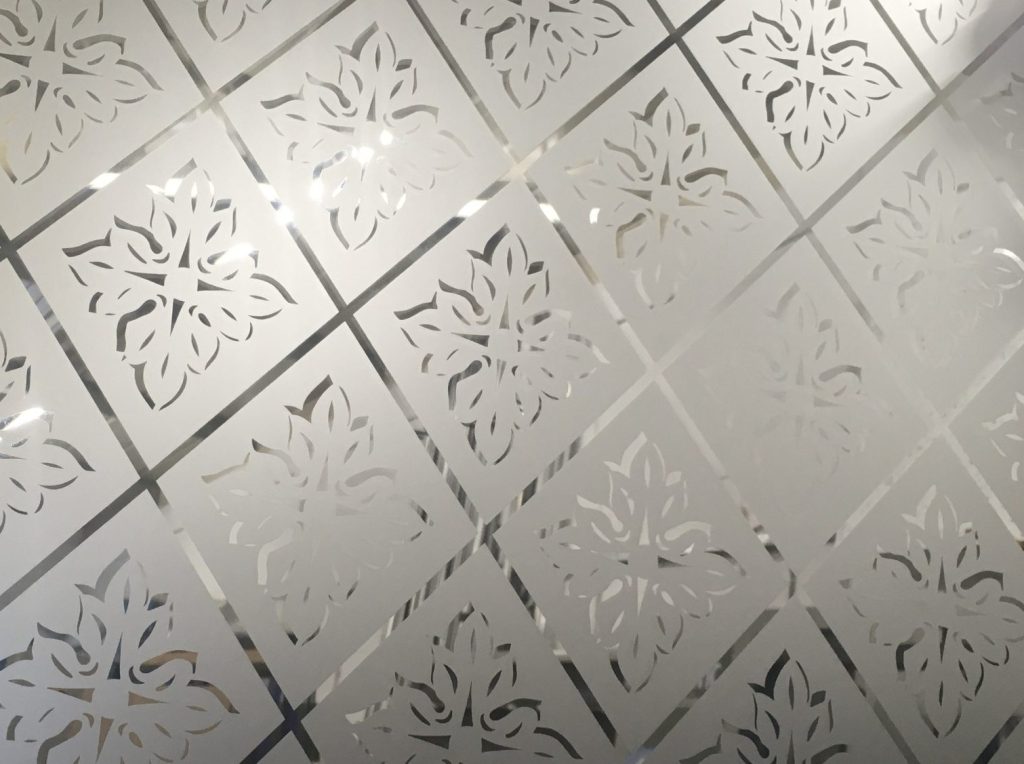
How old glass deteriorates
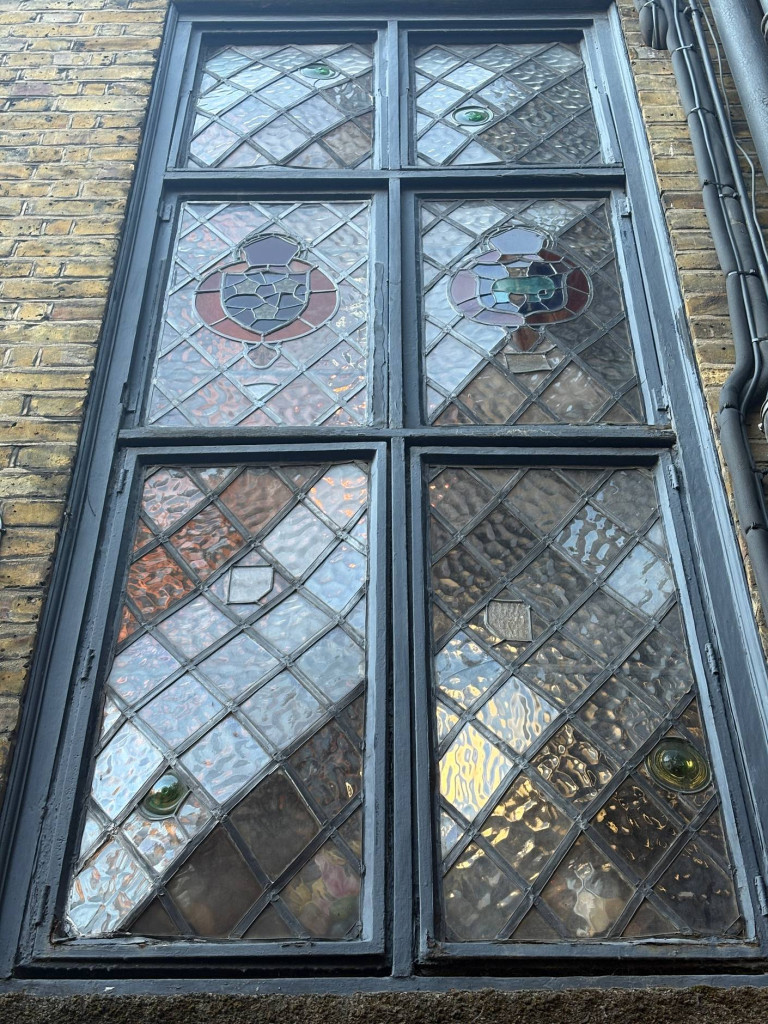
Lead fatigue. Lead is soft. A large panel in a leaded light slowly sags under its own weight, and the cames weaken and split at the joints. The panel bulges, the glass is stressed, and water begins to enter.
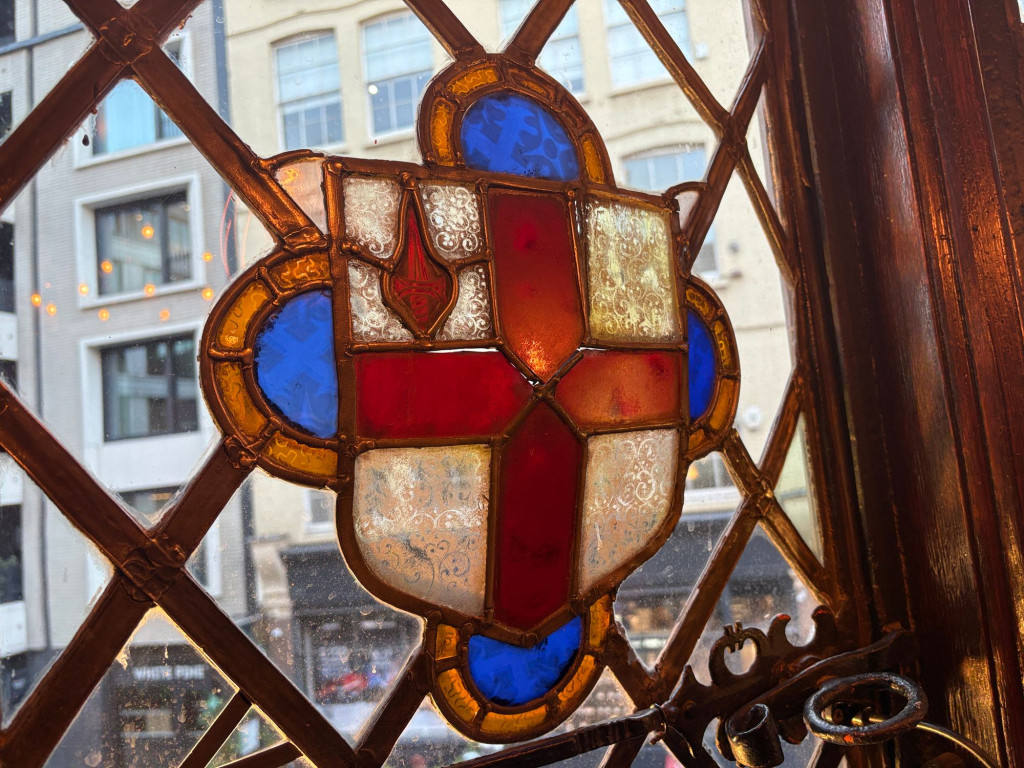
The shield above shows what happens next. As the lead around the red cross stretches and twists, the red piece slides down inside its came, and a thin gap opens through the panel above it, letting in light, draughts and water. Once one piece has moved, the pieces beside it lose their support, and the colours begin to slip out of their intended positions. Left alone, loose pieces can eventually fall out of the panel. Resecuring and recementing the loose glass, or releading the panel, stops the movement before more of the design is lost.
Cement failure. The putty that seals the glass into the lead dries out and falls away, leaving the pieces loose.
Cracks and breaks. Glass cracks from impact, from the movement of the frame, and from thermal stress when part of a window is in the sun and part in the shade.
Paint loss. On painted traditional stained glass, the fired paint that forms faces, folds of cloth and lettering can flake or fade, particularly in medieval glass. Once it has gone, it is gone.
Corrosion. Some older glass, especially medieval glass, is chemically unstable. Moisture attacks the surface and produces pitting and a crust. This is worst on the outside of a window.
Frame problems. Rusted iron bars, rotten timber and failed stonework can all damage a window, and they often have to be fixed first.
What conservators do
The work usually begins with a survey and photographs. Before a window is touched, it is recorded in detail so that every intervention can be traced, and so that nothing is lost in the process of removing it.
If a window has to come out, it is taken to a workshop, laid flat and cleaned with gentle methods. Loose pieces are secured, cracks are bonded with a clear adhesive, and new lead is used only where the old is too far gone to keep. Missing pieces are filled with new glass chosen to match, with the replacements often marked so that they can be distinguished from the original later.
Another approach is plating, where a second piece of glass is placed behind a cracked piece to support it, so the original does not have to be taken apart. For windows that are weathering, an outer protective layer of glass is often fitted, with a ventilated gap, so the original is shielded from the weather but still seen from inside.
Churches and historic buildings
Work on old windows in churches and listed buildings is usually controlled. In the Church of England, for example, changes to a church normally need permission through the faculty system, and listed buildings in the UK may need consent from the local authority. Permission should be sought before work begins. A qualified stained glass conservator will know the process and can often help with the applications. The ecclesiastical stained glass page covers church windows specifically.
Restoring other kinds of decorative glass
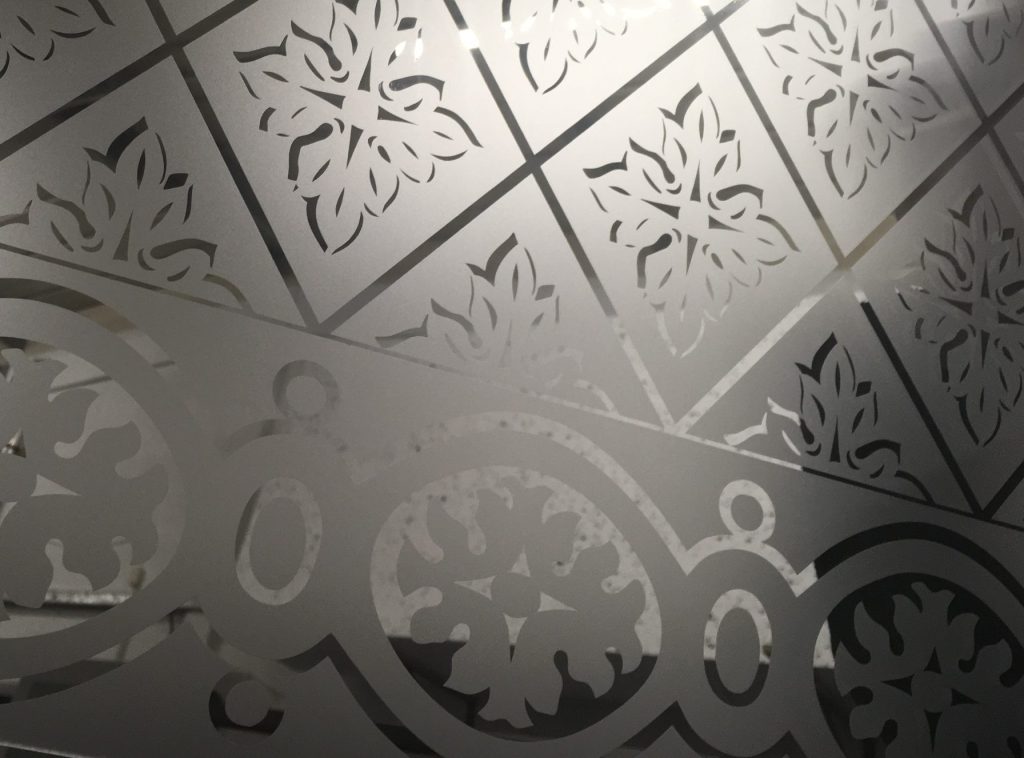
Etched and cut glass cannot be repaired when it breaks. The glass has to be replaced with a new pane, with the pattern copied from what remains. This is skilled work, and it is why the original pattern should be recorded before anything is lost. See acid etched glass, sandblasted glass and brilliant cut glass.
Modern overlay stained glass, bevelled and fused panels are in a different position. They cannot be mended either, but they can usually be replicated closely if broken.
Looking after old glass
Clean only with water and a soft brush or cloth. Avoid household cleaners and abrasives. Do not paint or seal over the lead. Do not repair cracks with silicone sealant, which cannot be removed without damage. If a panel has started to bow, support it and seek advice before the lead fails completely.
Questions people ask
How much does stained glass restoration cost?
It depends on size, condition and access, so the only reliable answer is a written quotation after an inspection. Releading a small panel is a modest task, whereas restoring a large painted window is a major undertaking.
Is it better to repair or replace?
Repair, wherever the original can be saved. Replacement loses the original, and with it the history.
How is a conservator found?
Look for someone with experience of historic glass and a record of conservation work, not just of producing new windows. Ask to see examples and to speak to previous clients.
History and related reading
Stained Glass from the Gothic Revival to the Twentieth Century. See also A Short History of Stained Glass.
See also How to Clean Decorative Glass Safely and Does Coloured Stained Glass Fade?.
Related glossary terms: Releading, Glass disease, Saddle bar, Lead came.
Frequently asked questions
Why do old windows need conservation?
Lead came fatigues, cement fails and glass can crack or lose paint, so a window can sag or leak after a century or more.
What does restoration involve?
The panel is usually recorded and removed, cleaned, repaired and releaded if needed, then refitted, often with a protective outer layer of glass.
Can valuable glass be repaired at home?
Historic or valuable windows are best left to specialist conservators. Heritage bodies publish guidance, and a mistake can be hard to undo.
What is protective glazing?
A clear outer sheet fitted outside the window to shield the old glass from weather and damage, while leaving it visible from inside. See ecclesiastical stained glass.
Help improve this page
Have you worked with this type of glass, or have specialist knowledge or experience you would like to share? Corrections, additional information and practical observations that could help make this guide more useful are welcome. Photographs of this kind of work or how it is produced are welcome too.
Suggest an improvement
Photographs of conservation and restoration
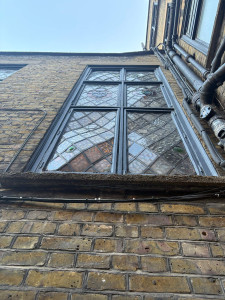 Bowed Diamond Leaded Windows from the Street, The Wheatsheaf, London
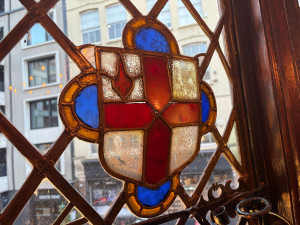 Red Cross Shield with Dropped Red Piece and Distorted Lead Came, The Wheatsheaf, London
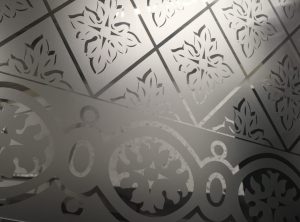 Sandblasted Replacement Glass for a Sash Window, Leaf Border and Diamond Pattern
See every photograph of conservation and restoration in the gallery →
Published 8 July 2026 · Last updated