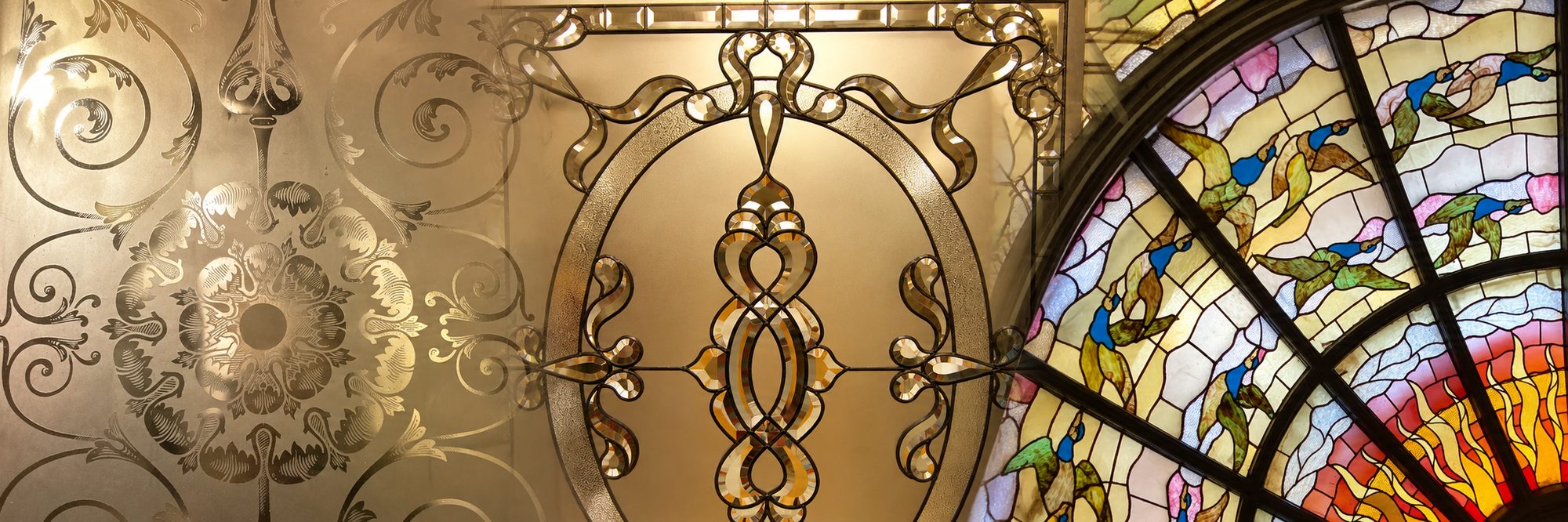

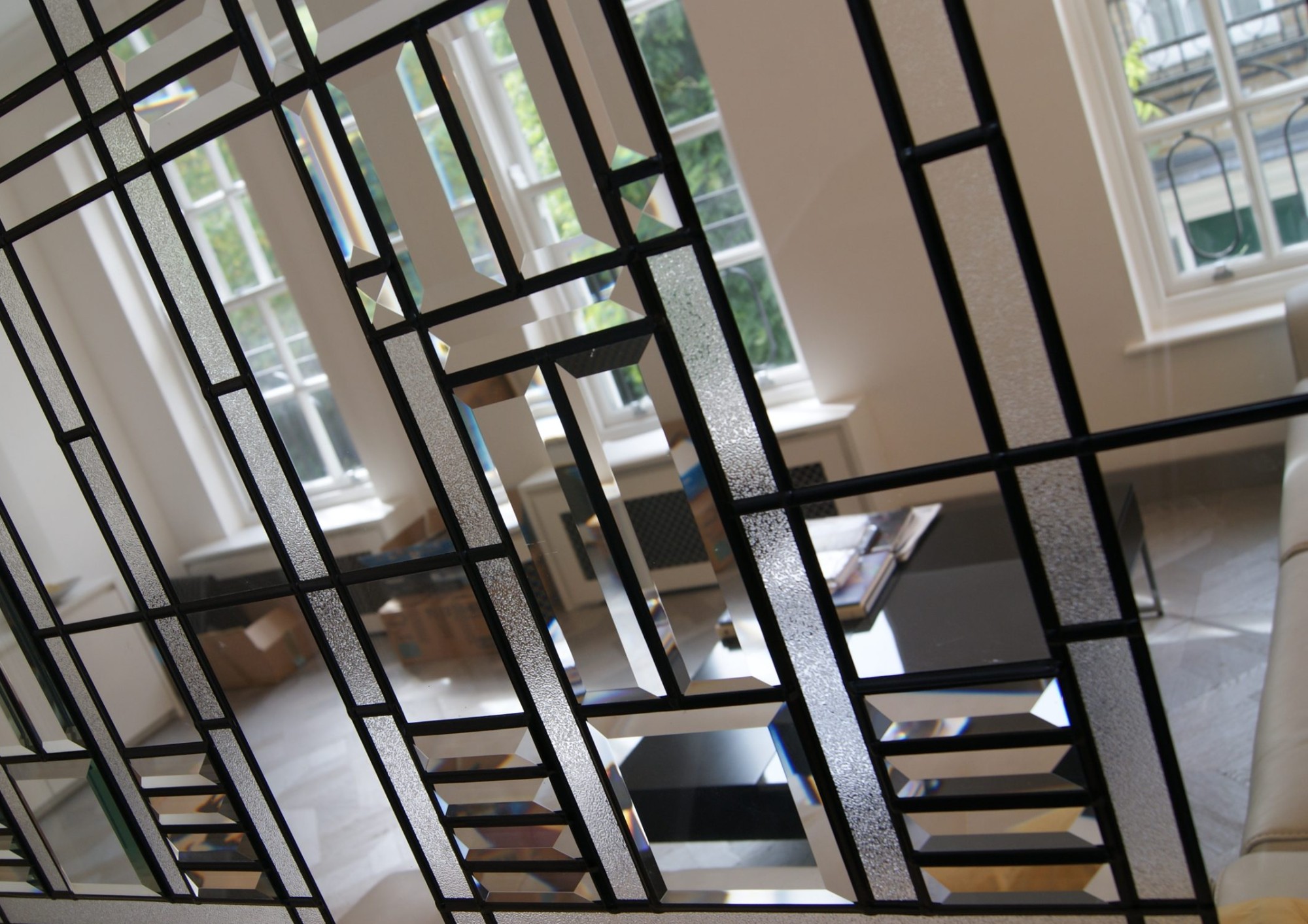
A bevel is a piece of thick glass whose edges have been ground and polished at an angle. When light passes through the sloped edge, it is bent and split into the colours of the spectrum, so a bevelled window throws small rainbows across a hall floor on a sunny day. That sparkle is the purpose of the technique.
Bevelling is not the same as brilliant cutting. A bevel is a sloped edge around the border of a piece, while a brilliant cut is a groove in the face of a sheet. The two were often used together in the same window.
How bevels are made
The edge of a piece of glass is ground against a rotating wheel, starting with a coarse abrasive that removes material and moving to finer ones, until the angled surface is smooth. It is then polished until it is clear. The angle and the width of the slope decide how much light is split, and the shape of the glass decides what the finished bevel looks like. Common shapes include squares, rectangles, diamonds and teardrops. Narrow rectangular bevels, sometimes called pencil bevels, are used to draw lines and borders.
Most bevels are clear. Some shapes are also made in tinted glass, such as bronze, blue or green, and a few have a textured face.
Bevelled glass is a form of leaded light
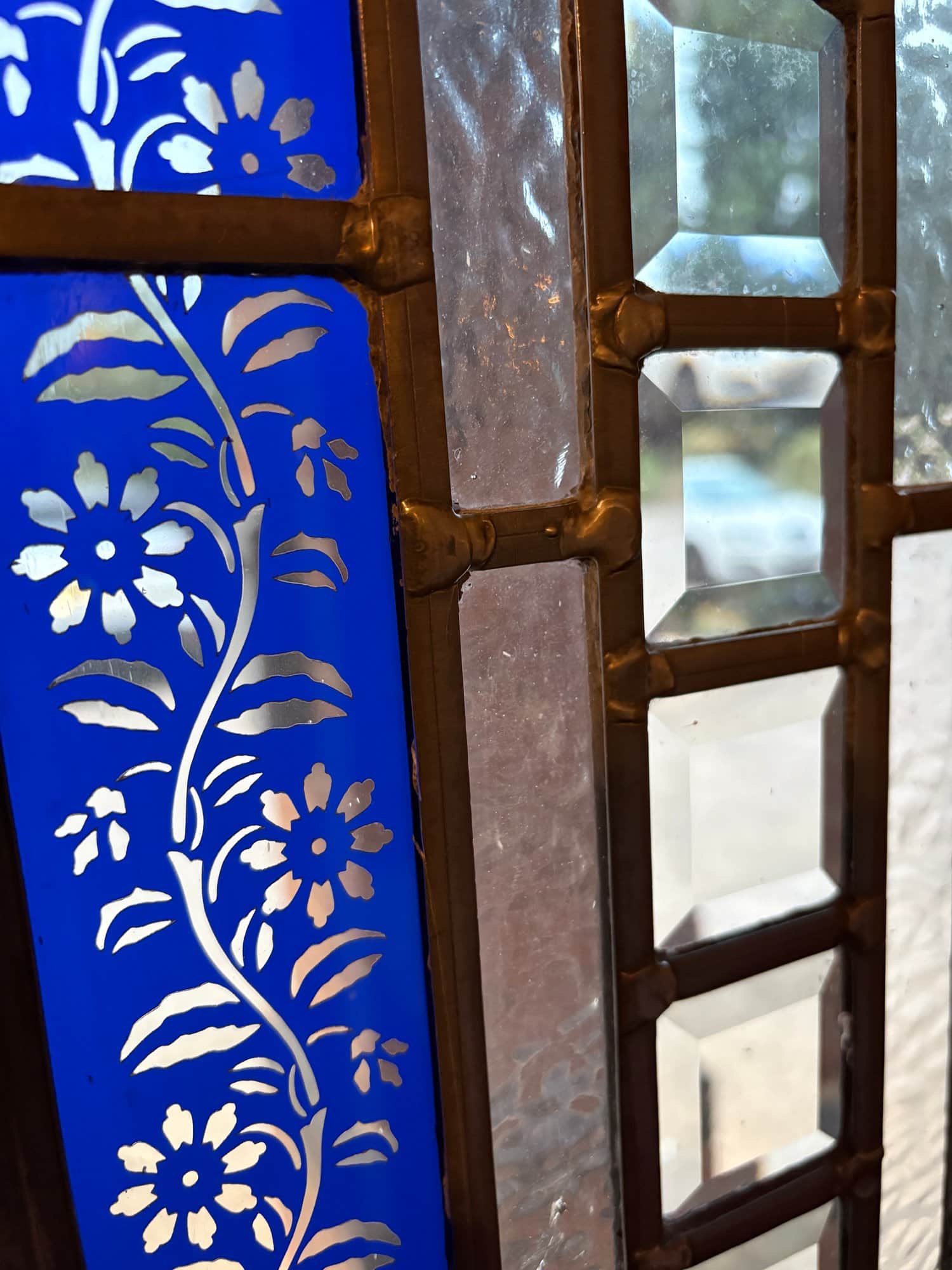
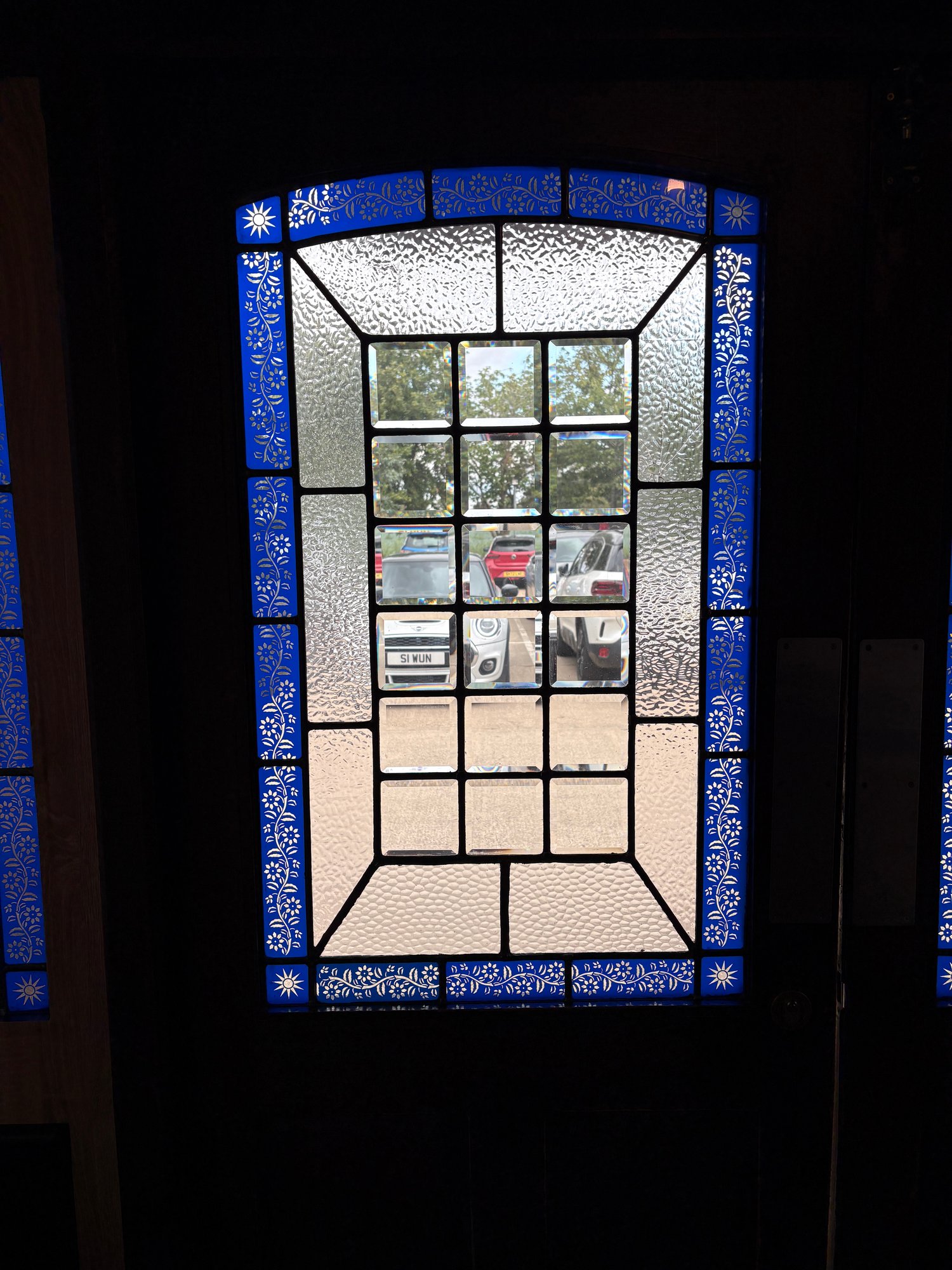
Bevelled glass is a form of leaded light. The bevels are cut, ground and polished as separate pieces, and the way they are joined into a window is the leaded light technique: each piece is held in a framework of lead came. That is how many Victorian and Edwardian doors were glazed, often with a central cluster of bevels and a border of coloured or textured glass.
A traditional leaded bevelled panel is only as rigid as its lead, and over many years a large panel can sag. Where double glazing is needed, the leaded panel has to be encapsulated: it is sealed inside the cavity of the double glazed unit, between two sheets of glass, where it cannot be touched.
Bevelled glass as an overlay panel
Bevelled glass can also be ordered as an overlay panel. The bevels are bonded with UV-cured adhesive to a single sheet of glass, which can be ordinary or toughened, and lead is then applied around each bevel, together with any overlay colour or texture. The finished panel keeps the look of a leaded light and gains the strength of modern glazing.
Because the single sheet carries the design, the panel is rigid and, where toughened glass is used, suitable for doors and low-level glazing. It can be supplied as a single, double or triple glazed unit, with the bevels on the outside of the unit where they can be touched. That suits modern front doors and replacement windows where insulation matters.
Leaded and overlay bevelled glass compared
Both forms are leaded light work, and from across a hall they look alike. The differences are in how the panel is built and how it behaves in use.
| Leaded bevelled glass | Overlay bevelled glass | |
|---|---|---|
| How it is built | Each bevel is set in lead came, with the lead holding the glass on every side. | The bevels are bonded with UV-cured adhesive to a single sheet of glass, which can be ordinary or toughened, and lead is applied around each bevel. |
| Rigidity | As rigid as its lead and any reinforcing bars. A large panel can sag over time. | Rigid, because the whole design is carried by the glass sheet. |
| Safety glass | The panel is made of annealed glass and lead, so it is not toughened. | Where the base sheet is toughened safety glass, it suits doors and low-level glazing. |
| Double glazing | Must be encapsulated: sealed inside the cavity of the unit, between two sheets of glass. | The bevels and lead sit on the outside of the unit, so they can be touched. Can be single, double or triple glazed. |
| Colour and texture | Coloured and textured glass is cut and leaded into the design. | Overlay colour and texture can be applied around the bevels, with the lead. |
| Look | The classic leaded light, as in Victorian and Edwardian doors. | Looks like a leaded light from across the room, with the bevels standing slightly proud of the glass. |
| Typical use | Period homes, restoration, and work to match existing leaded windows. | Modern front doors and replacement windows where insulation and strength matter. |
Styles you will see
Traditional. Rectangular or diamond bevels arranged in repeating patterns, usually inside a lead border, are the classic Victorian and Edwardian look.
American bevelled. Entrance doors in the United States are often glazed with many small rectangular and square bevels, in intricate symmetrical designs. The style became familiar in Britain through films and television, and it is now widely copied.
Mackintosh. Designs in the manner of the Glasgow designer Charles Rennie Mackintosh combine plain geometric lines with stylised roses. The look is airy and linear, and it remains popular in modern bevelled and leaded glass.
Contemporary and abstract. Clusters of bevels in free patterns, sometimes with a frosted background, suit modern doors and internal partitions.
Where bevelled glass is used
Front doors, door side panels and fanlights are the main uses. It is also used in internal doors, landing windows, room partitions, cabinets and mirrors.
Discover more bevelled glass
The decorative bevelled glass gallery collects photographs, with notes on each one.
Questions people ask
Is bevelled glass the same as stained glass?
No. A bevel is clear, polished glass, and the effect comes from the shape of its edge. Stained glass gets its effect from colour. The two are often combined in one window.
Does bevelled glass need special cleaning?
No. A soft cloth and a normal glass cleaner are fine. The bevelled edges are worth a wipe with a dry, clean cloth now and then.
Can a broken bevel be replaced?
In a leaded panel, yes. The panel can be opened and a matching bevel fitted, though finding the exact size and shape can take time. In a bonded panel on a single sheet of glass, the whole panel is normally replaced.
History and related reading
The History of Brilliant Cut and Bevelled Glass. See also A Short History of Stained Glass.
Care: see How to Clean Decorative Glass Safely.
How bevels and clusters are ground and polished, and why the thin edge differs for lead came and overlay lead, is explained in How Bevelled Glass Is Made.
At home: bevelled glass for homes and glass for a front door.
Related glossary terms: Bevel, Brilliant cutting, Double glazing, Lead came.
Frequently asked questions
What is bevelled glass?
Bevelled glass has its edges ground and polished at an angle, so that each piece catches the light like a prism. It is usually clear, and is often combined with leaded glass in doors and windows.
How are bevels fitted into a door or window?
There are two ways to produce a bevelled leaded light. The traditional way sets the bevels in lead came. The other, called overlay, bonds the bevels with UV adhesive to a single sheet of glass, which can be ordinary or toughened, then applies lead and any colour or texture. Overlay units can be supplied as single, double or triple glazed.
Does bevelled glass need to be double glazed?
For an external door or window it usually does. A traditional leaded bevelled panel needing double glazing is encapsulated inside the sealed unit, whereas overlay bevels sit on the outside of the unit where they can be touched. See leaded lights and overlay stained glass.
What is the difference between bevelled and brilliant cut glass?
Bevelling shapes the edge of a piece of glass, while brilliant cut glass decorates the surface with cut and polished grooves and facets. The two are often used side by side.
Help improve this page
Have you worked with this type of glass, or have specialist knowledge or experience you would like to share? Corrections, additional information and practical observations that could help make this guide more useful are welcome. Photographs of this kind of work or how it is produced are welcome too.
Suggest an improvement
Photographs of decorative bevelled glass
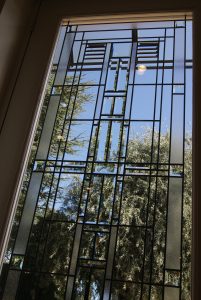 Large Bevelled Glass Door Panel with Geometric Lead Lattice, Milton Keynes
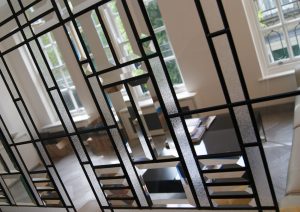 Bevelled Glass Feature Window with Textured Panels, Chelsea
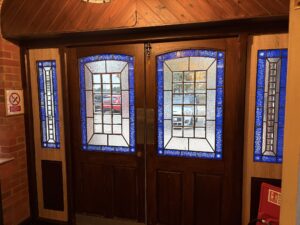 Entrance Doors with Blue Bordered and Bevelled Panels, Leaded Lights
See every photograph of decorative bevelled glass in the gallery →
Published 8 July 2026 · Last updated