
Most church windows were designed to be read. For centuries many worshippers could not read text, and glass, wall paintings and carvings carried the stories of the Bible and the lives of the saints. A few habits of looking make a window much easier to understand: who is shown, what they hold, what they wear, what colours are used and what is written or painted beneath them.
Start with the attributes
Saints are rarely labelled. They are recognised by an attribute, an object linked to their life or death, which artists used as a kind of visual name tag. The attribute is often the thing the saint was martyred with, or the thing they are best known for.
| Saint | Usual attribute | Notes |
|---|---|---|
| Peter | Keys; sometimes a fish, a boat or a cockerel | The keys of heaven. Often shown with short curly grey hair and beard. |
| Paul | Sword and a book | The sword is the instrument of his martyrdom, the book his letters. |
| Andrew | Saltire (X-shaped) cross; fish or net | The cross is the form of his martyrdom and appears on the Scottish flag. |
| John the Evangelist | Eagle; chalice with a serpent; book | Often young and beardless. The chalice refers to the legend of poisoned wine. |
| James the Great | Pilgrim staff, scallop shell, wide hat | The pilgrim saint of Santiago de Compostela. |
| Catherine of Alexandria | Wheel | The spiked wheel on which she was bound. Often with a sword and crown. |
| Mary Magdalene | Jar of ointment | Refers to her anointing of Christ. Often long loose hair. |
| Stephen | Stones | The first martyr, stoned to death. Wears a deacon’s dalmatic. |
| Lawrence | Gridiron | Shown as a deacon holding the grid on which he was said to have been roasted. |
| George | Dragon, white shield with a red cross | The patron saint of England. Usually in armour. |
| Michael | Scales, sword or spear; defeated dragon | The archangel of the Last Judgement. Winged and often armoured. |
| Nicholas | Three gold balls or three children in a tub | A bishop, with mitre and crozier. |
| Barbara | Tower | Imprisoned in a tower by her father. |
| Agnes | Lamb | A young martyr; the lamb is a pun on her name, which echoes agnus (lamb). |
| Cecilia | Organ or other musical instrument | Patron saint of music. |
| Christopher | Carrying the Christ child across a river | Often huge, leaning on a staff. |
| Martyrs in general | Palm branch | The palm marks victory over death. |
Two cautions apply. First, the same figure can appear with different attributes in different regions and centuries. Second, Victorian and later windows sometimes combine saints with their emblems in a more decorative way, so identification is easier when an inscription is also present.
The four Evangelists
The authors of the four Gospels are often shown as winged creatures or as men accompanied by them. The creatures come from the four living beings in the visions of Ezekiel and of Revelation, and the early Church fathers, including Jerome, assigned one to each Gospel.
| Evangelist | Creature | Common reading |
|---|---|---|
| Matthew | Winged man or angel | Christ’s humanity and the incarnation. |
| Mark | Winged lion | Courage, kingship and resurrection. |
| Luke | Winged ox or bull | Sacrifice, service and priesthood. |
| John | Eagle | The divine nature of Christ and the Ascension. |
Windows with all four are common in towers, chancels and the corners of larger designs, where they fit neatly into small tracery lights.
Symbols of Christ and the Church
- Chi-Rho. The Greek letters X (chi) and P (rho), the first two letters of the Greek word for Christ, laid over one another.
- Alpha and Omega. The first and last letters of the Greek alphabet, from the Book of Revelation, meaning that Christ is the beginning and the end.
- IHS (also written IHC or JHS). A contraction of the name Jesus in Greek letters, often seen on altar frontals and in roundels.
- Fish. The Greek word for fish, ichthys, was used as a secret sign by early Christians.
- Lamb. The Lamb of God, usually carrying a banner with a cross.
- Dove. The Holy Spirit, as at the baptism of Christ.
- Pelican. Medieval stories said the pelican fed its young with its own blood, so it became a symbol of sacrifice.
- Lily. Purity, particularly of the Virgin Mary, and often in scenes of the Annunciation.
- Triangle and three interlocking circles. The Trinity.
Some of these, especially the pelican and the Lamb of God, are explained differently by different writers. Treat them as common readings rather than rules.
Colour
Colour in church glass was partly a matter of what could be made. Early medieval glass, coloured with metal oxides in the melt, was dominated by deep blue and ruby. Colours also carried meaning, though not rigidly:
- Blue. Heaven and the Virgin Mary.
- Red. Martyrdom, love and the blood of Christ; also royalty.
- Green. Growth, hope and new life.
- Gold or yellow. Divine light, holiness and glory. From the fourteenth century silver stain gave a controlled golden yellow on white glass; see how painted and silver stained glass is fired.
- White. Purity and innocence.
- Purple. Penitence, royalty and Lent.
- Black. Mourning or death, though in glass most black is the paint used for outlines and shading.
Heraldry
Coats of arms are among the commonest things in older glass. In the later Middle Ages donor portraits were increasingly replaced by the arms of those who paid for a window. Shields can identify the family, the guild, the college or the see, and they help date a window. A shield is read from the point of view of the person who carried it, so the left side as you look at it is the right side (dexter) of the shield. A shield with two coats side by side often records a marriage. Victorian and Edwardian windows frequently carry the arms of a donor family in a small panel at the base, alongside a memorial inscription.
Scenes you will meet again and again
- The Annunciation. The angel Gabriel greeting Mary, often with a lily and a dove.
- The Nativity and the Adoration. The stable, shepherds and kings.
- The Baptism of Christ. With the dove above.
- The Crucifixion. Usually with Mary and John on either side.
- The Resurrection. Christ stepping from the tomb with a banner.
- The Good Shepherd. Carrying a lamb on his shoulders.
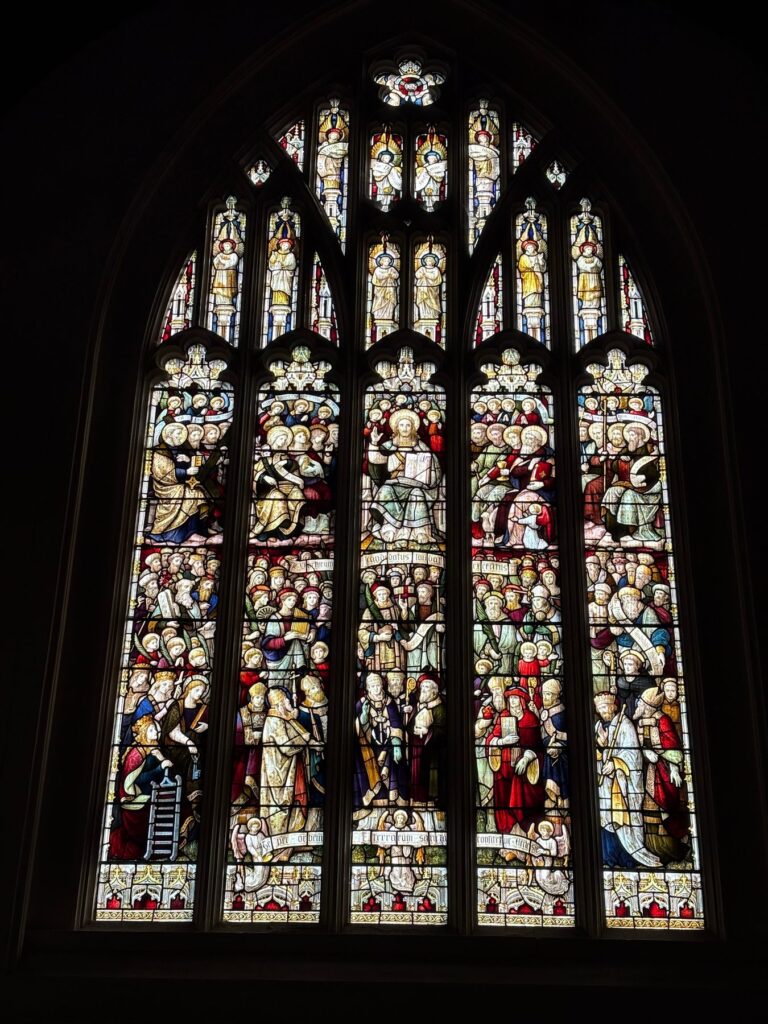
- The Last Judgement. Christ enthroned, with the saved and the damned, usually in a west window.
- The Tree of Jesse. A tree rising from the sleeping figure of Jesse, father of King David, with kings in its branches leading up to the Virgin and Child. It was a favourite subject in medieval glass and again in the nineteenth century.
- The Works of Mercy and the Seven Sacraments. Found in fifteenth century glass in some East Anglian churches.
- War memorial subjects. St George, St Michael, the Sacrifice of Isaac and the Good Samaritan, often with regimental badges.
Reading a whole window
- Look at the bottom first. Inscriptions and donors’ shields are usually in the lowest panels.
- Read up or left to right. Narrative windows in the Middle Ages read in rows from the bottom, either in a series of panels or in medallions.
- Identify the main figures by attributes.
- Check the tracery at the top. Angels, the Holy Spirit and symbols of the heavens are often placed there.
- Look for repairs and re-leading. Fragments from other windows are often gathered into a single patchwork, particularly in medieval buildings.
Related pages
- Ecclesiastical stained glass
- Traditional stained glass
- A short history of stained glass
- Window styles by period
- Famous workshops and makers
- Glass Glossary