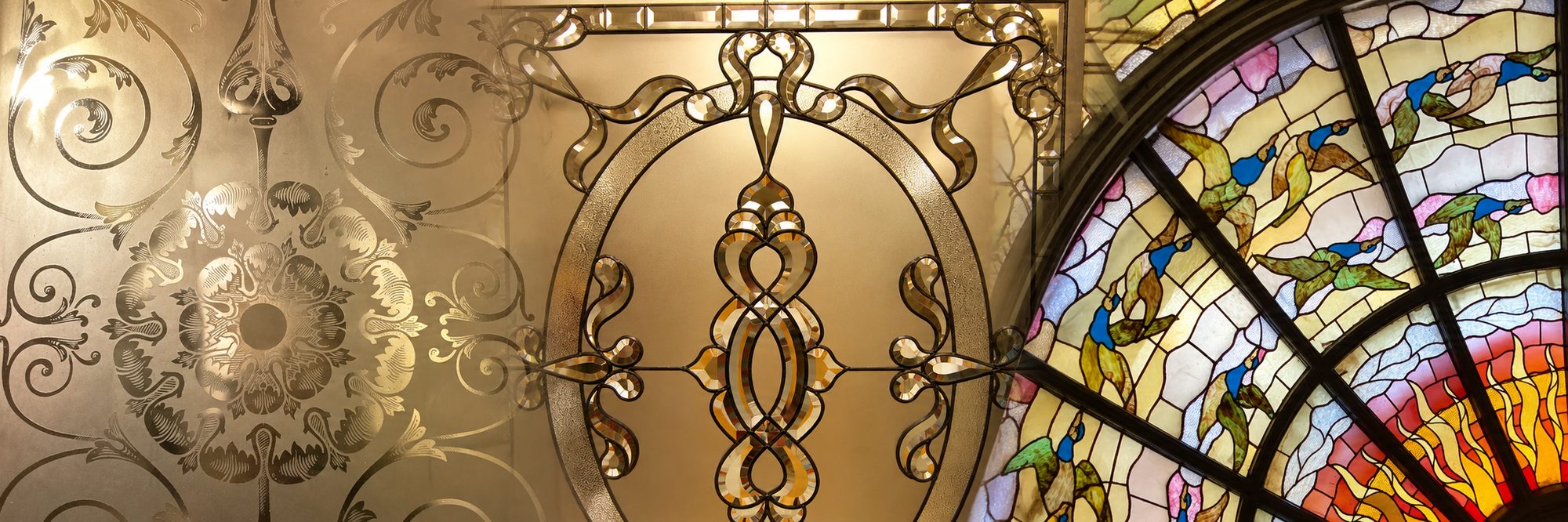

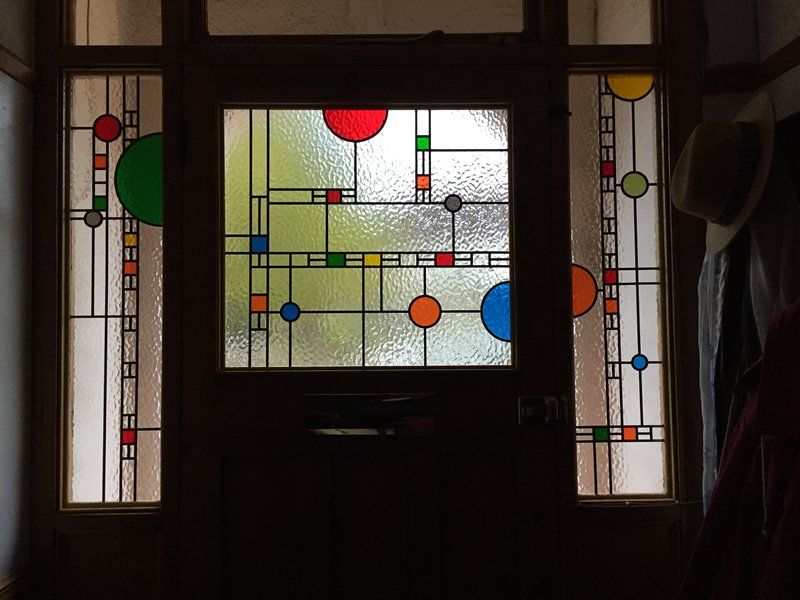
Overlay stained glass gets its colour from a film, not from coloured glass. That makes the film the part of an overlay panel that deserves the most scrutiny. This page explains what colour films are made of, what the UV filters in them do, how long they may last, and why overlay suits double glazing, toughened, laminated and fire-resistant glass in ways that traditional leaded lights cannot.
What a colour film is
Most films of this kind are made on a base of polyester (PET). Polyester is chosen because it is clear, strong, stays flat and does not shrink. The layers are:
- The colour. The film is dyed or pigmented, either in the polyester itself or in a coating on it, to give a transparent colour. Some films also have a clear scratch-resistant surface layer.
- The adhesive. A clear pressure-sensitive adhesive on one face bonds the film to the glass when it is pressed on. Adhesives made for long outdoor life are acrylic.
- The release liner. A protective sheet covers the adhesive until the film is applied.
Colour films are typically thin, in the region of 50 microns. In overlay work the film is cut to the shapes of the design and fixed to the back of the glass, worked in mirror image, so that it is seen through the glass. Lead lines are applied to the front. Overlapping films mix to make new colours, and sheen, frost and texture films add variety. See how overlay lead is made for the lead side of the construction.
Dyed and pigmented films
The colour is carried either by a dye, which dissolves in the film, or by a pigment, which is made of tiny solid particles. Both can fade in sunlight. Ultraviolet light breaks down the dye molecules, so the colour weakens or shifts, and the glass looks paler. Dyes put on by dipping a finished film in a dye bath are the most prone to it. More durable films use large, stable dye molecules mixed into the polyester itself while it is molten, and sandwich that coloured core between clear outer layers. This reduces the loss of dye, and the outer layers can carry a UV absorber as well.
UV filters
Ultraviolet light is the main cause of fading, though heat, visible light, damp and chemical vapours contribute. Films protect themselves and the glass behind them in three ways:
- UV absorbers. Chemicals added to the polyester or the adhesive absorb UV and turn it into a small amount of heat. A clear polyester film absorbs UV up to around 380 nanometres, and films with added inhibitors can reach about 400 nanometres. A good UV film is described as blocking over 99 per cent of UV at 380 nanometres.
- Light stabilisers. Compounds known as hindered amine light stabilisers do not absorb UV. They stop the chain reactions that damage the plastic, and they work together with absorbers.
- Colour itself. Tinted films absorb more of the visible and near-UV spectrum, up to about 500 nanometres, which is why deeper colours often last better than very pale ones.
A useful side effect is that a colour film with a UV filter also reduces the UV passing through the window, which helps protect carpets, furniture and artwork. The size of this effect depends on the film, so it should not be quoted without data from the film maker.
How durable are they?
Modern films are made for long service. Good ones use stable dyes, UV absorbers and stabilisers, and a film inside a sealed double glazed unit is also protected from weather, cleaning and handling. Some points are reasonably well established:
- Testing. Makers expose films to measured doses of UV in a weathering chamber and then measure the colour change. Better films show only a small change after doses that stand for many years of exposure.
- Service life. Window films in general are described as lasting ten years or more in service, with manufacturers’ warranties of around five years. The figures vary with the product and the installation.
- Position. A film in a sealed unit is shielded from rain, dirt and handling. Windows facing south and west receive the most UV and heat.
- Colour. Some colours are more stable than others. Ask the supplier for test data for the colours used.
- Heat. Very dark or reflective films absorb more solar energy, which matters in double glazing (see below).
Film colours are not the same as glass coloured in a furnace, which does not change, but a quality film in a good unit gives many years of stable colour. The best guide to a particular film is its weathering results, its warranty terms and windows made with it that have been in place for years.
Double glazed units: feel and see the lead
Overlay can be made into a double glazed unit in a way that traditional leaded glass cannot. In the usual arrangement the sheet carrying the design is one pane of the unit. The lead lines are stuck to its outer face, and the colour film is on the other face, which looks into the sealed cavity. The film is therefore inside the sealed unit, away from weather, cleaning and handling, and the lead is on the outside, where it can be seen and felt.
That contrasts with a flat encapsulated unit, in which the decoration is sealed inside the cavity or laminated between sheets, so that both faces of the unit are smooth. Encapsulating protects the decoration, and some products are made that way for this reason, but it gives up the raised line. The advantages of keeping the lead on the outside are:
- Real relief. The lead stands proud of the glass, so it catches the light and casts a fine shadow, and the window reads as leaded at close range and from an angle. A flat unit shows its lines as printed or flat lines.
- Touch. A raised lead can be felt with a finger, as with a traditional window.
- Colour depth. Seen through the glass, the film is a little behind the lead, which gives a sense of depth between the lead and the colour.
- Thermal performance. A sealed double glazed or low-emissivity unit insulates far better than the single glazing of a traditional leaded window, and the cavity can hold gas. A leaded light must otherwise be fitted as a panel on its own or sandwiched in a unit with its own limitations.
- Cleaning. The outer face is smooth glass with narrow lead lines, and they can be wiped. Coated lead resists fingerprints and cleaning products.
The trade-off is that the lead on the outside faces the weather and handling, so it needs a durable fixing and a good lead, which is the reason for coated overlay lead. A tinted film also absorbs solar energy, and in a sealed unit this heats the glass, so the film should be one that is suitable for sealed units and for the glass in use. Not every film suits every glass, and a wrongly chosen film can lead to thermal cracking.
Why a good sealed unit matters
The best protection for a film in a double glazed unit is a good unit that stays sealed. A unit is two sheets of glass separated by a spacer bar that contains a drying agent, called a desiccant, with sealant round the edge. The desiccant keeps the air in the cavity extremely dry, with a dew point of around minus 40 degrees Celsius or lower in a new unit. In that dry, sealed space the film is not exposed to damp, and a well-made unit can keep its colours stable for a very long time.
Moisture is the one thing to guard against. Over the years water vapour can slowly pass through the edge seal. A unit that has lost its seal mists inside, and damp air does the film no good, because damp, heat and ultraviolet light together are harder on polyester films and dyes than any one alone. Published test data on decorative films in this situation is scarce, so no figures can be given.
Getting the most from the unit
- Have the units made by a skilled, careful maker. A unit is only as good as the person sealing it, so the quality of the workmanship, the edge seal and the spacer matter more than any paperwork.
- Ask what the guarantee covers and for how long.
- Glaze them in a frame with a drained and ventilated rebate, so that water does not sit against the edge seal.
- Check that the film and lead are suitable for sealed units and for the glass used.
- If a unit ever mists, replace it promptly. Because overlay is made from a pattern, the panel can be reproduced to match.
Toughened, laminated and fire-resistant glass
Traditional leaded lights are built of many small pieces held in soft lead, and the construction cannot be toughened, laminated or made fire-resistant, because all of those processes have to be applied to a single sheet of glass of a fixed size and shape. Overlay stained glass starts with a single sheet, so it can be used on:
- Toughened glass. Toughened glass cannot be cut, drilled or edge-worked after treatment, so the shape, holes and edges are completed first and the glass is then toughened. The film and lead are applied afterwards. When it breaks it crumbles into small blunt pieces, which suits doors, side panels and low-level windows where safety glass is needed.
- Laminated glass. Two or more sheets are bonded with a tough interlayer that holds the glass together when it cracks, and that is the usual choice where security, acoustic performance or protection against falling glass matters. The decoration is applied to a surface of the laminate.
- Fire-resistant glass. Special fire-resistant glass is used in fire doors and screens. It is made by a modified toughening process or with layers of intumescent material between sheets, and it is installed as a tested system with its framing. Lead came melts at around 327 degrees Celsius, so a leaded panel cannot provide fire resistance. With overlay, the decoration is applied to the surface of the fire-resistant glass.
For fire-resistant glass in particular, the fire rating belongs to the whole tested glazing system, not to the glass alone. Some glass makers publish assessments that allow certain decorative films on one or both faces without lowering the rating, but those assessments name the glass types, the films and the maximum rating, and they have time limits. Do not assume that any film or lead is acceptable: get written confirmation from the glass manufacturer or the certifying body for the product to be used, before anything is applied.
For doors and low windows in the UK, safety glazing requirements are set by the Building Regulations (Approved Document K) and the relevant standards, and for fire doors by the fire test standards. Check the current rules for the particular building.
Related pages
- Overlay stained glass
- Where overlay stained glass came from
- How lead came and overlay lead are made
- How window glass was made, including toughened glass
- How coloured glass is made
Terms are explained in the Glass Glossary.
Sources and further reading
- Wikipedia: window film
- US patent 9,630,384: durable extruded dyed polyester films
- US patent 5,494,715: decorative multiple-glazed sealed units
- British Glass: toughening, old techniques and new technologies
- NREL: moisture effects on polymers and adhesives
Traditional coloured glass does not fade in the same way, as explained in Does Coloured Stained Glass Fade?. For cleaning overlay, see How to Clean Decorative Glass Safely.