
Roundels and bullseyes are the thick, round, glittering discs seen in old pub windows, front doors and cottage windows. They look alike, and they come from the same process, but they are not the same thing. This page explains where each comes from, how they are made, and how they are set in leaded lights.
Bullseyes: the centre of a crown glass disc
The common belief that bullseyes are leftovers from making glass is partly right. Before the nineteenth century, most window glass was crown glass. A glassblower blew a bubble, attached a rod called a punty to the opposite side, opened the bubble and spun it quickly until it flattened into a disc up to about 1.5 metres across. The disc was cut into small panes. The centre of the disc, where the punty had been fixed, stayed thick, uneven and rippled, with a mark at the middle. That centre is the bullseye, also called a bullion.
Bullseyes were not wanted for good windows, because they bend light and cannot be seen through clearly. They were first treated as waste, then they were sold on, and they were fitted in cheaper windows, in doors and in places where privacy or light was wanted more than a view. They became popular for their appearance, and they are still used for it. Crown glass is no longer made in the old way for general use, so today’s bullseyes are made specially for the trade and not as leftovers. They are not an offcut of modern sheet glass, because rolled and float glass have no thick centre.
Roundels: small blown discs
A roundel, also called a rondel, is a small disc of mouth-blown glass made by the same spinning method as crown glass, on a smaller scale. The maker blows a small bubble, fixes it to a punty, opens it and turns the rod until the glass spreads into a flat disc with a turned-back rim. The disc is knocked off the rod and cooled slowly. In a hand-made roundel:
- The diameter is typically about 6 to 13 cm, and it varies a little from one to the next.
- The centre, where the punty was attached, is a raised knob called the navel. It and the area around it are about 5 mm thick.
- The rest of the disc is thinner, about 2 to 3 mm, so the thickness changes across each disc.
- The rim is folded over to give it strength.
- Colours range from clear to deeply coloured, and the glass often has ripples and small bubbles.
The thick central knob with a ring of ripples is why a roundel resembles the base of a bottle. They are not cut from bottles, though. The look comes from the way they are spun.
Roundels were used in town houses in medieval and later times, and many survive in old windows. A seventeenth century window in a museum collection is built from 64 plain roundels with folded rims and small marks at the centre, set in lead. Imitation roundels are made by pressing or spinning glass instead of blowing it, and these cost less but lack the character of the hand-made ones.
A second meaning
In the history of stained glass, “roundel” also means a small round or square panel of clear glass painted in grisaille and silver stain, usually no more than 30 cm across. These were made from the fourteenth century and were most popular in the early sixteenth century, particularly in the Low Countries, for town houses and civic buildings. They are a different thing from the plain blown discs used in leaded lights.
Setting them in leaded lights
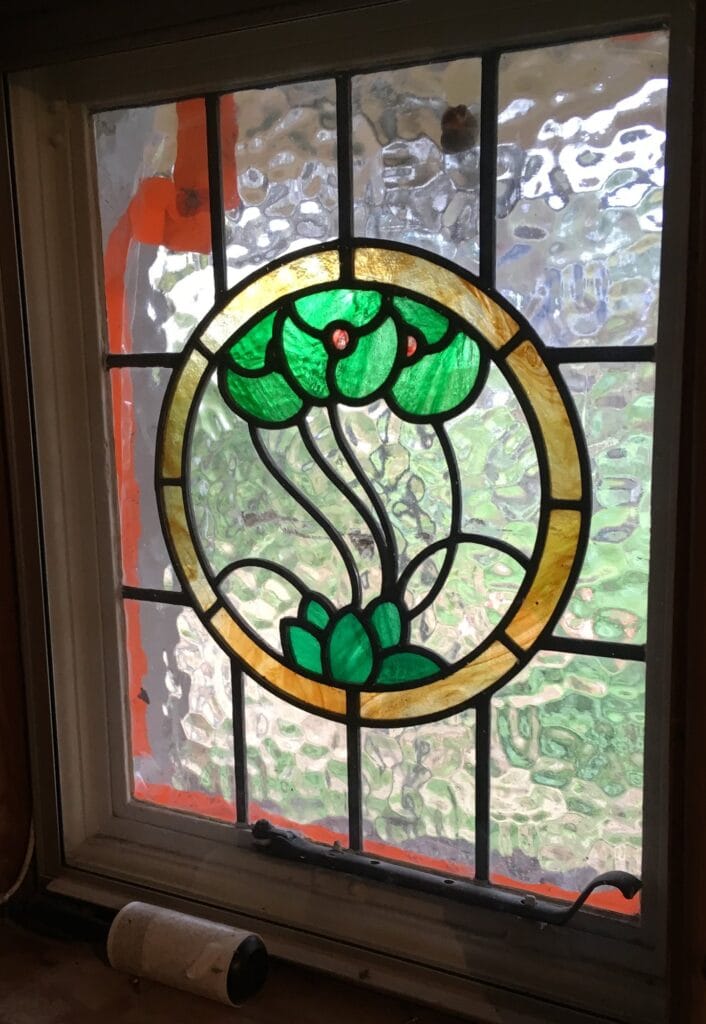
- Each disc is set in lead came like any other piece of glass, but the bulge of the centre means the lead must be shaped to suit, and a good leader improvises. Roundels are usually thicker and more domed than flat sheet, so the came is worked into position carefully.
- In a traditional layout the discs are set in a grid or a pattern, with pieces of flat glass cut to fit the gaps between them.
- Roundels and bullseyes distort and scatter the light, so they are popular in pub windows, in doors and in places where privacy is wanted.
- Because each disc is slightly different in size, the pattern is usually drawn to suit the discs actually available.
Related pages
- How window glass was made, including crown glass
- Leaded lights
- How bevelled glass is made
- How to make a leaded panel
- Glass Glossary