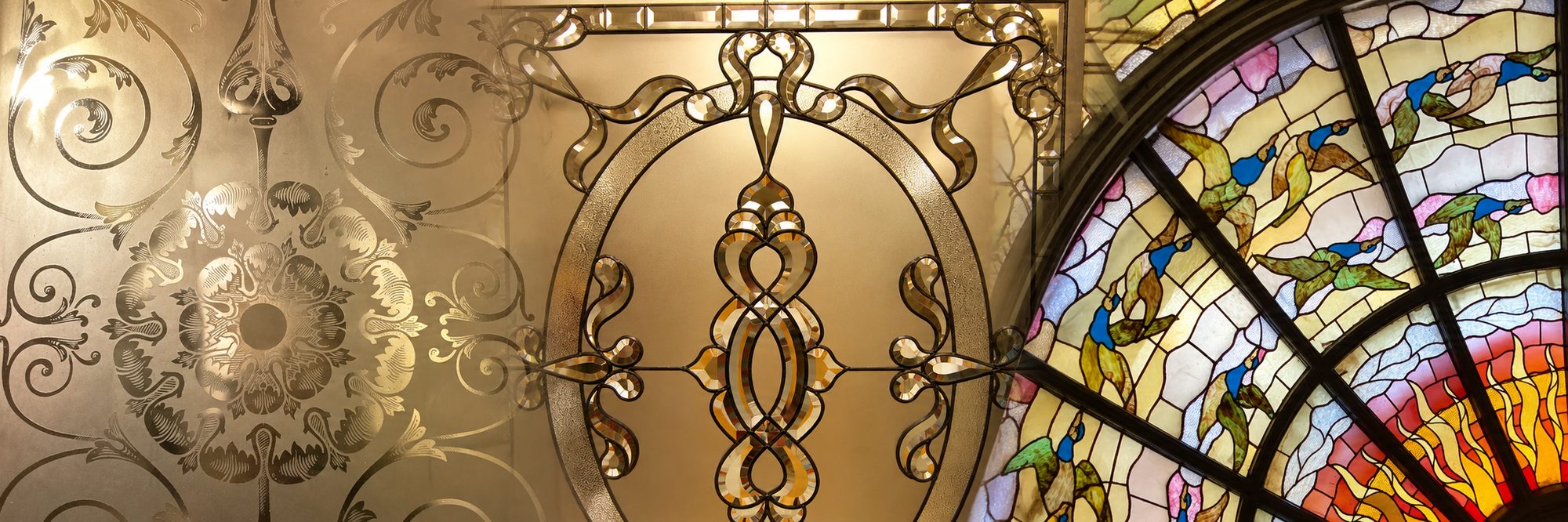

A bevel is a piece of glass with its edge ground and polished at a slant. The slope catches daylight and splits it into colours, as a prism does, and it gives doors, side screens and windows their sparkle. This page explains how bevels are made, the equipment used, what single bevels and clusters are, and why the thickness of the thin edge is different for bevels set in lead came and for bevels used with overlay lead.
The parts of a bevel
- The face. The flat, polished central area of the glass.
- The bevel. The sloping band ground round the outside. Its width and its angle decide how much light is refracted and how bold the effect looks.
- The thin edge. The narrow vertical edge left at the outer rim, once the slope has been ground. This is the part that is held in the lead.
- The back. Flat and unground.
The sloping band is a polished surface, so it needs to be crisp, evenly wide and free of scratches. Poor bevelling shows as dull patches, chips along the edge and a bevel that varies in width.
The glass
Bevels are usually made from clear float glass. Most are cut from 5 mm or 6 mm sheet (3/16 or 1/4 inch), and bevel makers work to a tolerance of about 10 per cent on the thickness. Thicker glass, up to about 10 mm (3/8 or 1/2 inch), has been used for larger windows, and older door glass was often cut from thick plate with wide bevels. Bevels can also be made from mirror, from tinted and coloured glass, and from glass with a coating such as a dichroic finish.
How a bevel is ground
Bevelling removes glass in stages. Each stage uses a finer abrasive to remove the scratches left by the one before, and everything is done wet, with water to cool the glass and wash the debris away.
- Cutting. The shape is cut from a sheet, by hand with a glass cutter or on a computer-controlled cutting table. Every piece of a cluster must be cut to the exact size, so that the pieces fit together.
- Roughing. The slope is cut with a coarse wheel or a flat rotating plate, fed with an abrasive such as sand or silicon carbide and water. This sets the width and angle, and leaves the thin edge at the right thickness.
- Smoothing. Finer abrasive wheels, which were traditionally large natural stone wheels, take out the coarse scratches. Modern machines use diamond or metal-bonded wheels in graduated grits.
- Fine grinding. Still finer wheels make the surface smooth enough to be polished.
- Polishing. A wheel loaded with pumice, or a cork wheel, takes out the finest scratches.
- Buffing. A felt wheel with a very fine polishing powder, such as rouge or cerium oxide, gives the final clear shine.
Equipment
- Cutting table or hand cutter for the shapes, with templates or computer-controlled cutting for repeat work.
- Flat grinding laps and rotating plates for straight edges and outside curves. The glass is held on the plate and moved across it by hand or in a jig.
- Profile wheels and cones for inside curves and small radii. These are shaped so that they follow the curve.
- Multi-head bevelling machines that take a piece through a series of wheels, from coarse to polishing, in one pass. Industrial machines work in lines, with the glass moving from head to head.
- Jigs and templates that hold the glass at the correct angle, and guides that keep the bevel width constant.
- Water supply, tanks and slurry handling, because the process is wet and produces a fine glass slurry.
- Felt and cork polishing wheels with polishing powder for the final finish.
- Safety equipment: eye protection, gloves for handling edges, and extraction or wet working to keep dust down.
Single bevels and straight lengths
A single bevel is one piece with a bevel on all of its sides, such as a square, rectangle, diamond, circle or oval. Straight pieces are often ground in long lengths and cut to size afterwards. The cut ends are then bevelled by hand. Curved pieces are ground on a wheel by hand to the required shape and edge thickness, and regular straight-sided pieces can be ground in a jig that moves the glass against the grinder.
Bevel clusters
A cluster is a group of small bevels arranged to make a design. The pieces are shaped and ground to fit each other, so that the finished cluster is a diamond or star, a flower, or a symmetrical pattern of squares, triangles and diamonds. Simple clusters of three or four pieces are common in transoms and conservatory windows. More complex clusters, of ten or more pieces, are used for door panels and side screens. Clusters are normally sold in standard sizes, so that a design can be repeated. Once the pieces are cut and ground, they are fitted together on a pattern.
Thickness and the thin edge
The thickness of the bevel at its thin edge matters more than the thickness of the sheet it was cut from, because it decides how the bevel can be fixed.
| Use | Glass thickness | Thin edge | How it is fixed |
|---|---|---|---|
| Set in lead came | 5 to 6.35 mm (3/16 to 1/4 in), up to about 10 mm for large windows | About 3 mm (1/8 in) | The thin edge sits in the channel of the came, and the lead grips it |
| Bonded bevels with overlay lead | 5 mm float glass is usual | About 1.5 to 1.8 mm | Bonded to a sheet of toughened glass with a UV-curing adhesive, then finished with self-adhesive lead |
| Early simulated bevels | Machined or moulded in plastic | About 1.6 mm (1/16 in) | Patent described flat-bottomed grooves with strips of lead |
Bevels used with came
A bevel set in lead has to have a thin edge that fits the channel of the came, which is why the edge is traditionally about 3 mm. The came grips the edge, and the thicker part of the bevel stands up above the lead, which gives the bevel its depth. A thicker edge would not sit in standard came.
Bevels used with overlay lead
For overlay, the bevels are bonded on to the surface of a single sheet. The lead is not a channel but a thin self-adhesive strip that is pressed across the joins between the bevels. A thick edge leaves a step between the bevel and the glass, so the strip tilts, lies badly or fails to stick. This is why bevels made for this technique are ground to a finer edge, about 1.5 to 1.8 mm, so that the strip lies flat and the lines look right. An American patent for a bevel panel with a 1.6 mm edge notes that conventional 3 mm edges needed build-up pieces or specially shaped came.
Bonding bevels to glass
- Each bevel is set on the glass with a clear adhesive beneath it, and pressed down so that air and surplus adhesive are pushed out.
- The adhesive is cured with ultraviolet light, which hardens it in a few seconds. A template with an opening the shape of the cluster can be used to catch surplus adhesive, which is peeled off once it has cured.
- Once cured, the joins are covered with self-adhesive lead, and the panel is built up piece by piece.
- The result can be made into a single, double or triple glazed unit, with the bevels and lead on the outer face of the unit.
Bonded bevels appeared on the UK market in 1992. See The History of Brilliant Cut and Bevelled Glass and Where Overlay Stained Glass Came From.
Bevels in lead and bevels in double glazing
The two ways of building a bevelled panel behave differently in double glazing. If a customer needs double glazing, a traditional leaded bevelled panel has to be encapsulated: it is sealed inside the cavity of the double glazed unit, between two sheets of glass, where it cannot be touched. An overlay bevelled panel is different. The bevels and lead sit on the outside of the unit, so the bevels can be touched and felt. The unit can be made single, double or triple glazed.
What to look for
- An even bevel width all round, with no wavy lines.
- A clear polish without dull patches or fine scratches.
- Square corners on cluster pieces, and pieces that fit tightly.
- A thin edge that is the same thickness all the way round, and the right one for the method of fixing.
- No chips on the edge or the face.
Related pages
- Decorative bevelled glass
- Brilliant cut glass
- Overlay stained glass
- How lead came and overlay lead are made
- How to make a leaded panel
- Glass Glossary