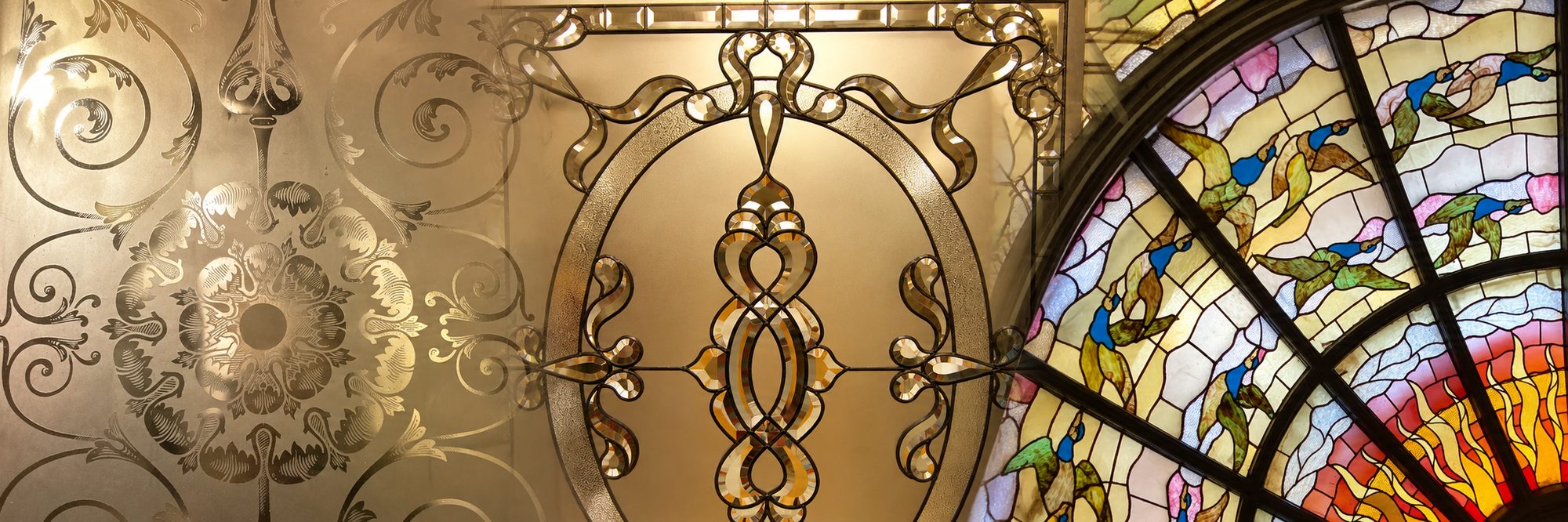

Louis Comfort Tiffany (1848 to 1933) was the son of the founder of the New York jewellers Tiffany & Co, and he began as a painter. By the 1880s he had turned to interiors and, above all, to glass. His name is now attached to lamps, but the windows came first, and the reason his work looks the way it does is a technical one: he and his rival John La Farge worked out how to build pictures from layers of coloured glass instead of from paint.
Opalescent glass
Medieval windows were made of pot-metal glass, with faces and folds of drapery painted on. Tiffany and La Farge both preferred a different material, opalescent glass, which is milky and scatters light so that colours seem to glow rather than shine. It was made in American pressed-glass factories and was not available in ordinary flat sheets, so both men had to persuade small flintware makers in Brooklyn to produce it for them.
Their patents tell the story of the rivalry. La Farge filed his application in November 1879 and was granted United States patent 224,831 in February 1880, for the material itself. Tiffany applied in October 1880 and received patent 237,417 in February 1881, for an arrangement of opalescent and coloured glass separated by an air space, which he said made the colours brighter and more changeable. In practice each man needed the other’s idea. The Metropolitan Museum of Art simply records that both patented an opalescent glass in 1881.
Favrile glass
Late in 1892 or early in 1893 Tiffany built a glasshouse at Corona in Queens, New York. There, with Arthur Nash, a glassworker from Stourbridge in England, he developed a way of blending colours in the molten glass. He called the blown glass that resulted Favrile, from an old English word meaning hand-wrought. Vases made in this way were collected early, and in 1896 the collector H. O. Havemeyer gave fifty-six of them to the Metropolitan Museum.
The lamps
Tiffany Studios began making lamps in 1898. Each shade is built from many small pieces of glass chosen for their colour and pattern, so no two are quite alike. They are assembled by wrapping each piece in copper foil and soldering the joints, a method now widely called the Tiffany method. It makes much finer lines than lead came and allows curved, three-dimensional shapes. Recent research has shown that many of the lamp designs came from the women in his studio, notably Clara Driscoll, who is now credited alongside him.
Tiffany-style lamps today
The lamp was copied almost as soon as it appeared, and it still is. Modern lamps in the Tiffany style are built in the same way, from many small pieces of coloured glass and fine lines of solder, and they turn up in houses, restaurants and shops everywhere. These ones were photographed in a house in Buckinghamshire that was being renovated. They are modern lamps in the style, not examples from Tiffany’s own studios.
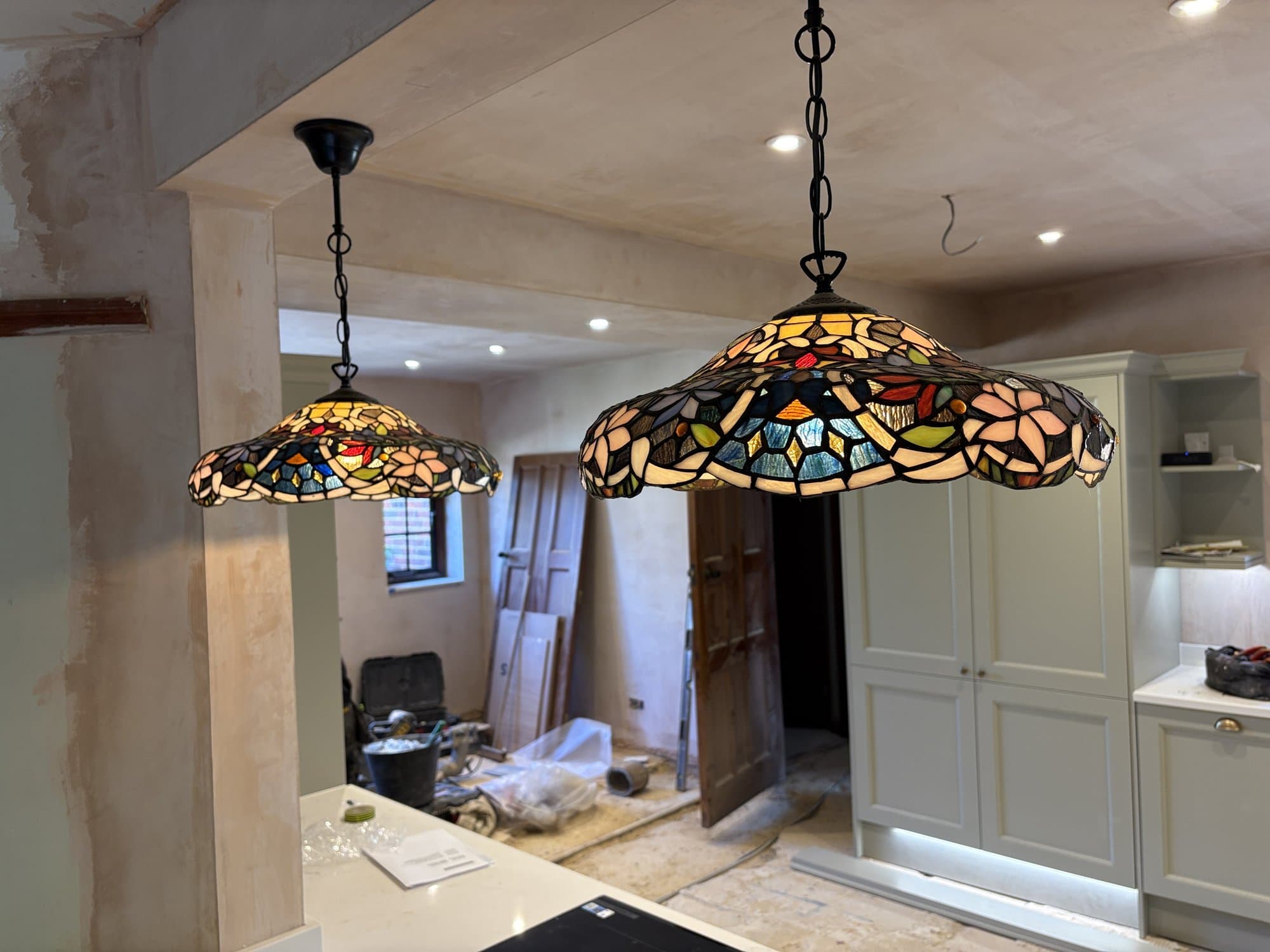
The shade is a bowl of small pieces rather than large panels. Pale pink flowers with yellow centres sit against blues and greys, with red and green leaves, and the pale pieces around the edge and the amber at the top are the ones that light up when the lamp is on.
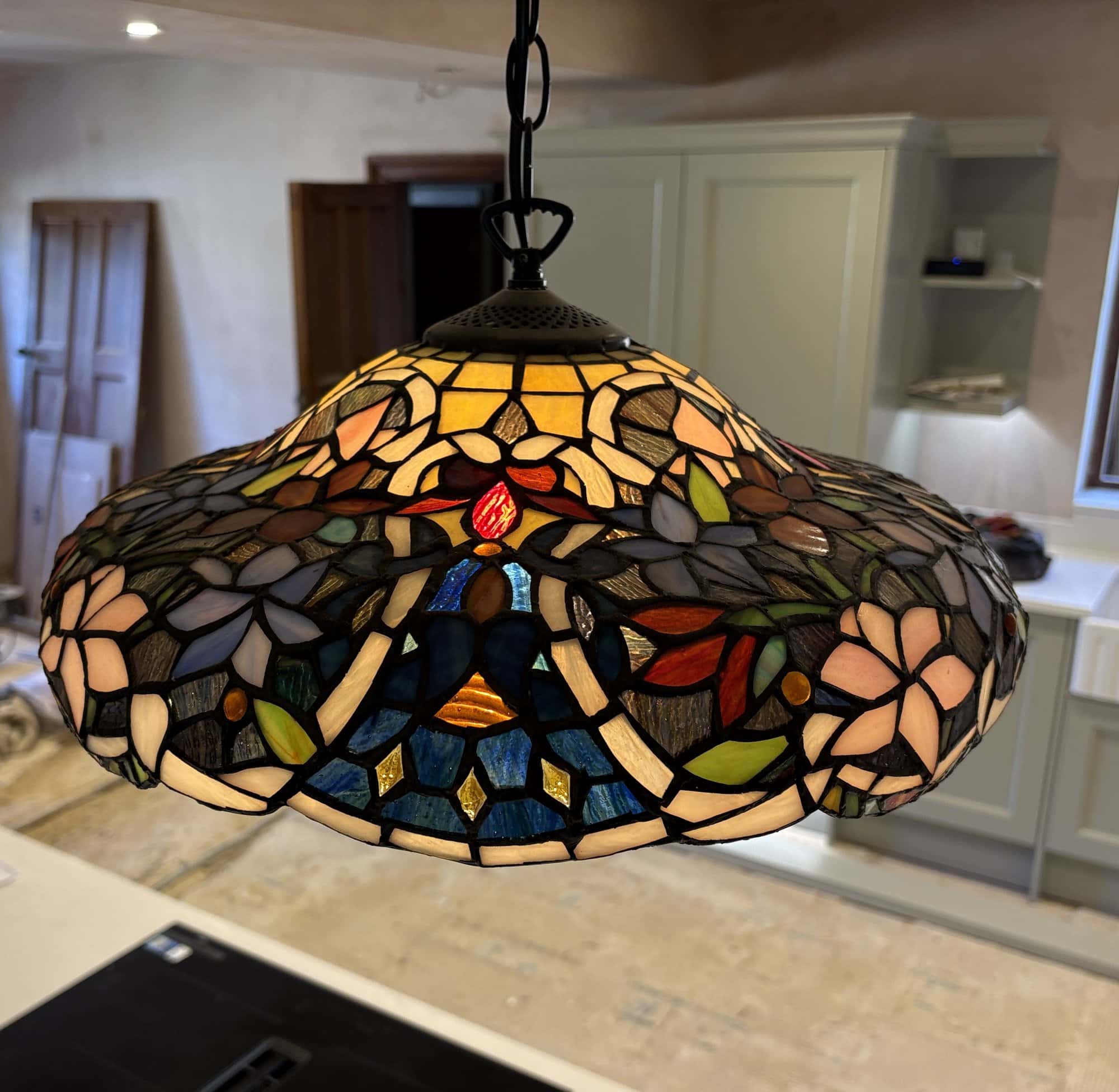
Look closely at the lines. They are slightly raised and rounded, which is the mark of soldered copper foil. Lead came gives a flatter, wider line. That difference is why foil work can follow the curves of a flower so closely, and why it suits a shade that curves in three directions.
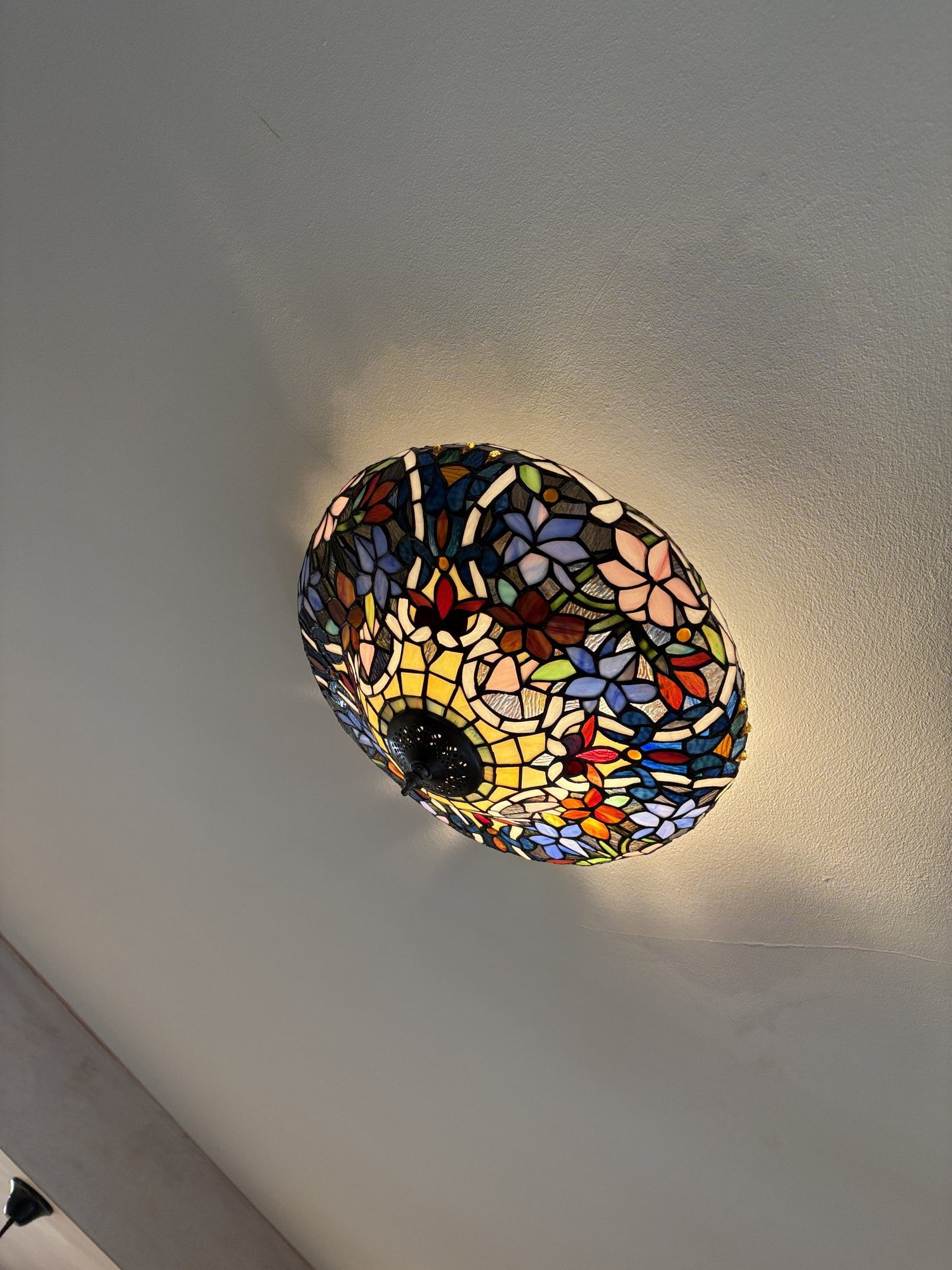
See the gallery for the pendant lamps and the ceiling light, and the carnivorous plant lamp shade in Orlando.
Laurelton Hall and the windows
Between 1902 and 1905 Tiffany built himself Laurelton Hall, an 84-room house on nearly 600 acres at Oyster Bay, New York. The house has since been destroyed, but parts of it survive in museums, including a loggia in the Metropolitan Museum. His studios also produced hundreds of church and memorial windows, among them Magnolias and Irises, a memorial window of about 1908 based on the River of Life motif.
Why it matters for stained glass
Tiffany’s work changed what people expected a window to look like. Instead of drawn outlines and painted features, the picture is made of the glass itself, in layers of colour and texture, with the metal lines kept thin. It also made the lamp and the coloured domestic panel fashionable at the same moment that Frank Lloyd Wright and Mackintosh were working with simpler geometric glass. See leaded lights for the lead-based method, and the glossary for terms such as plating and opalescent glass.
See also The History of Stained Glass in the USA.
Sources and further reading
See also Stained Glass in the USA: Places to See.
More artists
Also on this site: Charles Rennie Mackintosh, Frank Lloyd Wright, John La Farge, Edward Burne-Jones and William Morris, Harry Clarke, Marc Chagall, John Piper and Patrick Reyntiens. See all artists.
For the wider story, see Opalescent Glass, Tiffany and the Copper Foil Method and A Short History of Stained Glass.
Tiffany’s studio made the copper foil method famous. See Copper Foil Stained Glass.