Christopher Whall: Arts and Crafts Stained Glass
Masters of Glass · No. 001
Painter turned glass artist who led the Arts and Crafts reform of English stained glass and taught a generation of artists.
Lived: 1849 to 1924Place: Thurning, NorthamptonshireCountry: EnglandDiscipline: Stained and painted glassPeriod: Art Nouveau and Arts and Crafts, 1880 to 1920
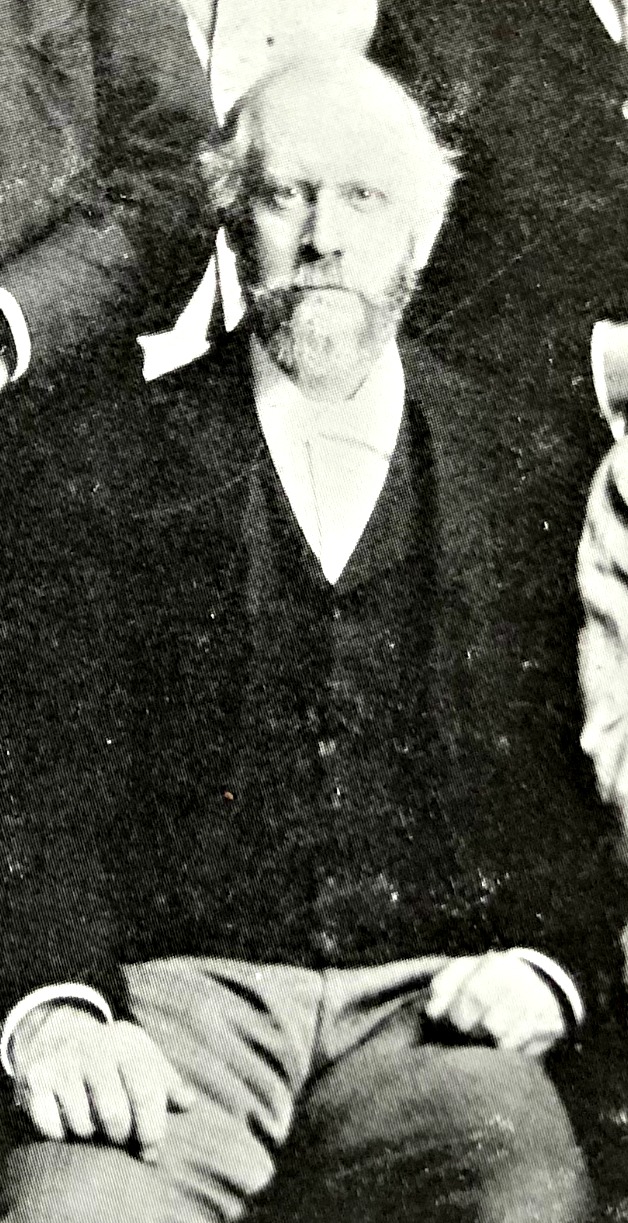
Christopher Whall (1849 to 1924) was one of the most influential figures in English stained glass of the Arts and Crafts period. He was a painter by training and came to glass late, but he then spent thirty years arguing that a window should be designed by someone who understood glass itself, with the colour coming from the glass rather than from paint laid over it.
At a glance
- Dates: born 1849 at Thurning, a village on the old border between Northamptonshire and Huntingdonshire (the county line ran through the village, with the parish church on the Huntingdonshire side); died 23 December 1924. Thurning lies today in North Northamptonshire. Its postal town is Peterborough, but the village is not part of the city of Peterborough.
- Country: England.
- Discipline: traditional stained glass and church glass, designer, teacher and writer.
- Movement: Arts and Crafts.
- Known for: windows that use thick, uneven slab glass; the textbook Stained Glass Work (1905); teaching a generation of English glass artists.
From painting to glass
Whall was educated at home and then at Rossall School in Lancashire, and entered the Royal Academy Schools in 1868 against his parents’ wishes. He worked for some years as an illustrator and as assistant to other artists, and spent almost three years in Italy after 1875. His first stained glass designs date from the 1880s, and by the end of that decade he had set up a small workshop at Dorking, where he intended to control every stage of production himself. That was an unusual aim at a time when most windows were designed by one person, painted by another and assembled by a commercial firm.
Slab glass and the Stamford window
His first major independent commission, given to him by the architect John Dando Sedding, was the east window of the north chapel, known as the Corpus Christi chapel, at St Mary’s Church, Stamford, completed in 1890 to 1891. The stained glass historian Peter Cormack identifies it as the first large window to use slab glass, the thick, bubbled and irregular glass that the architect Edward Schroeder Prior had devised in 1889 and which was sold as Early English glass. Slab glass varies in thickness across each piece, so it transmits light unevenly and gives a window a jewelled, shimmering surface. Whall learned to exploit that unevenness, placing the thicker and thinner areas deliberately and keeping painted detail to a minimum.
Teaching and the workshop
Whall taught stained glass at the Central School of Arts and Crafts from 1896 and at the Royal College of Art from the end of the 1890s, and he was elected Master of the Art Workers’ Guild in 1912. Among those who learned from him were Karl Parsons, Louis Davis and Edward Woore, his influence reached younger artists such as Wilhelmina Geddes, and the Arts and Crafts approach to church glass in England owes much to that circle. His textbook, Stained Glass Work, published in 1905 in a series of craft manuals, set out his belief that design and making should not be separated.
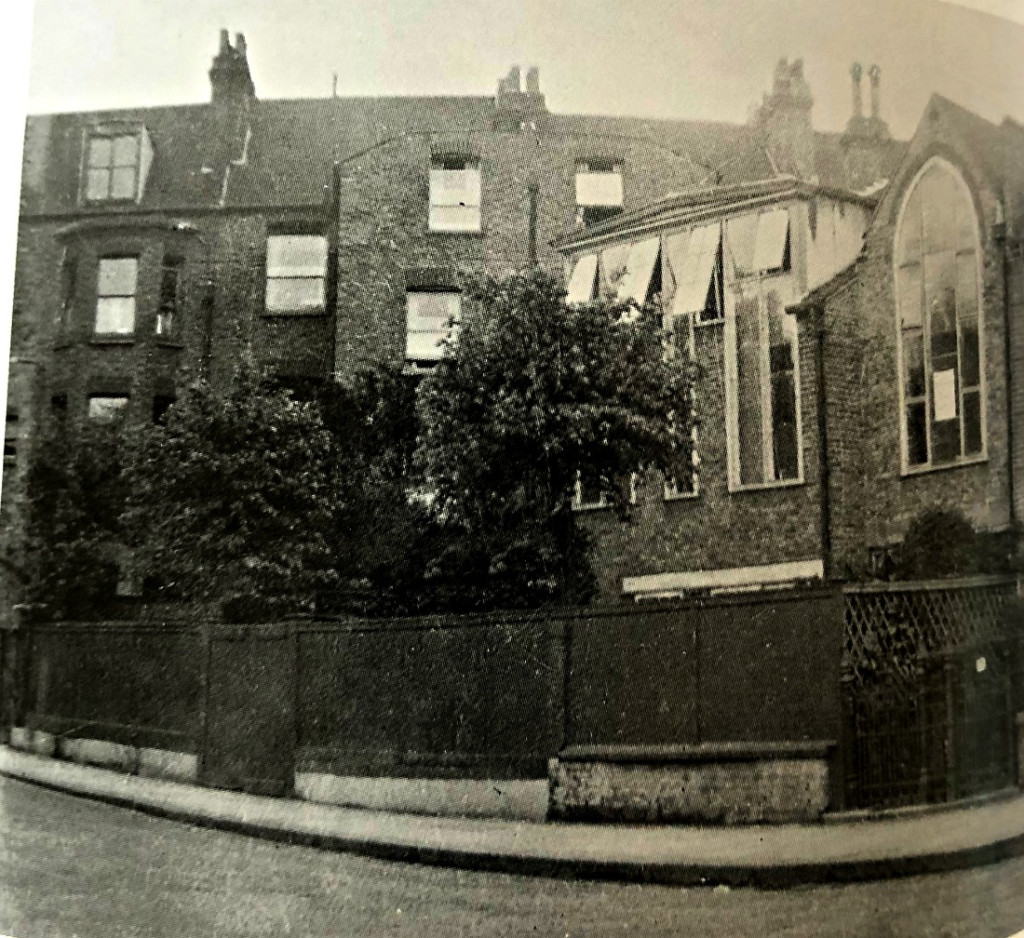
From 1897 to 1906 his windows were fabricated at the Chelsea workshop of the stained glass firm Lowndes and Drury. In 1907 he moved into a studio and workshop at Ravenscourt Park in Hammersmith. His home nearby, at 19 Ravenscourt Road, now carries an English Heritage blue plaque. His daughter Veronica worked alongside him and in 1922 became co-director of Whall and Whall Ltd. She ran the studio after his death, which followed an illness in the early 1920s.
Where to see his work
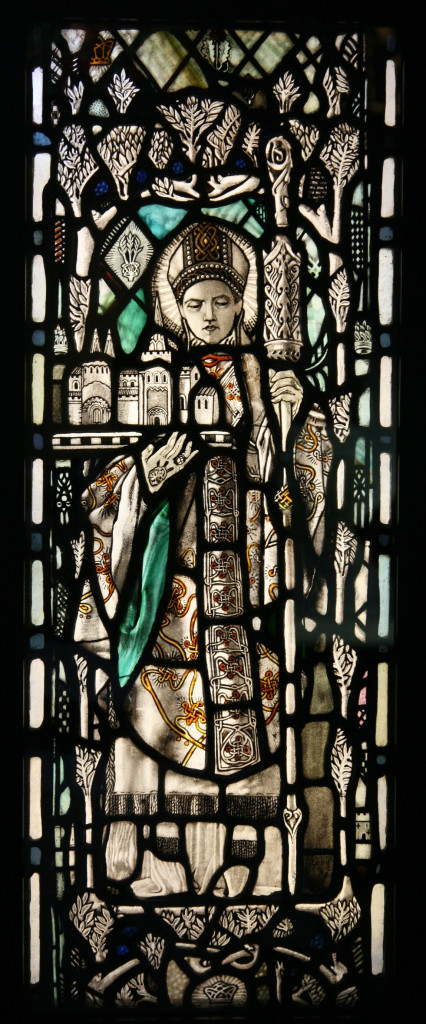
- Gloucester Cathedral, Lady Chapel. Windows for the chapel are among his best-known commissions, and the Victoria and Albert Museum holds a smaller panel of St Chad that relates to one of them.
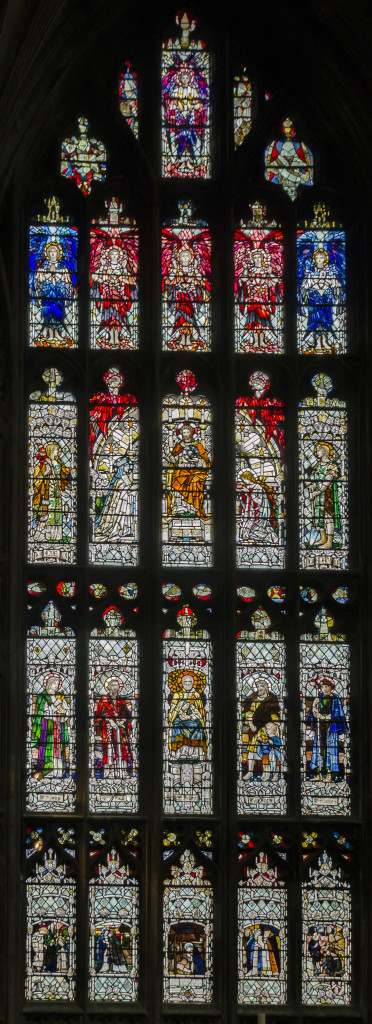
- Canterbury Cathedral. A window of 1902.
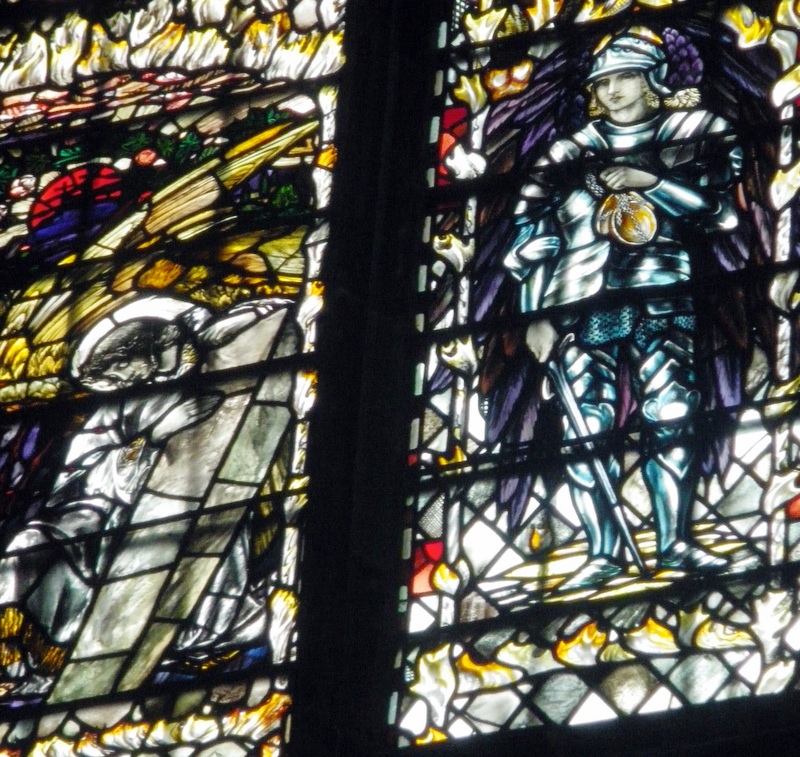
- Chapel of Gray’s Inn, London. The Archangel Michael, 1920.
- St Mary’s Church, Stamford. The east window of the Corpus Christi chapel, 1890 to 1891.
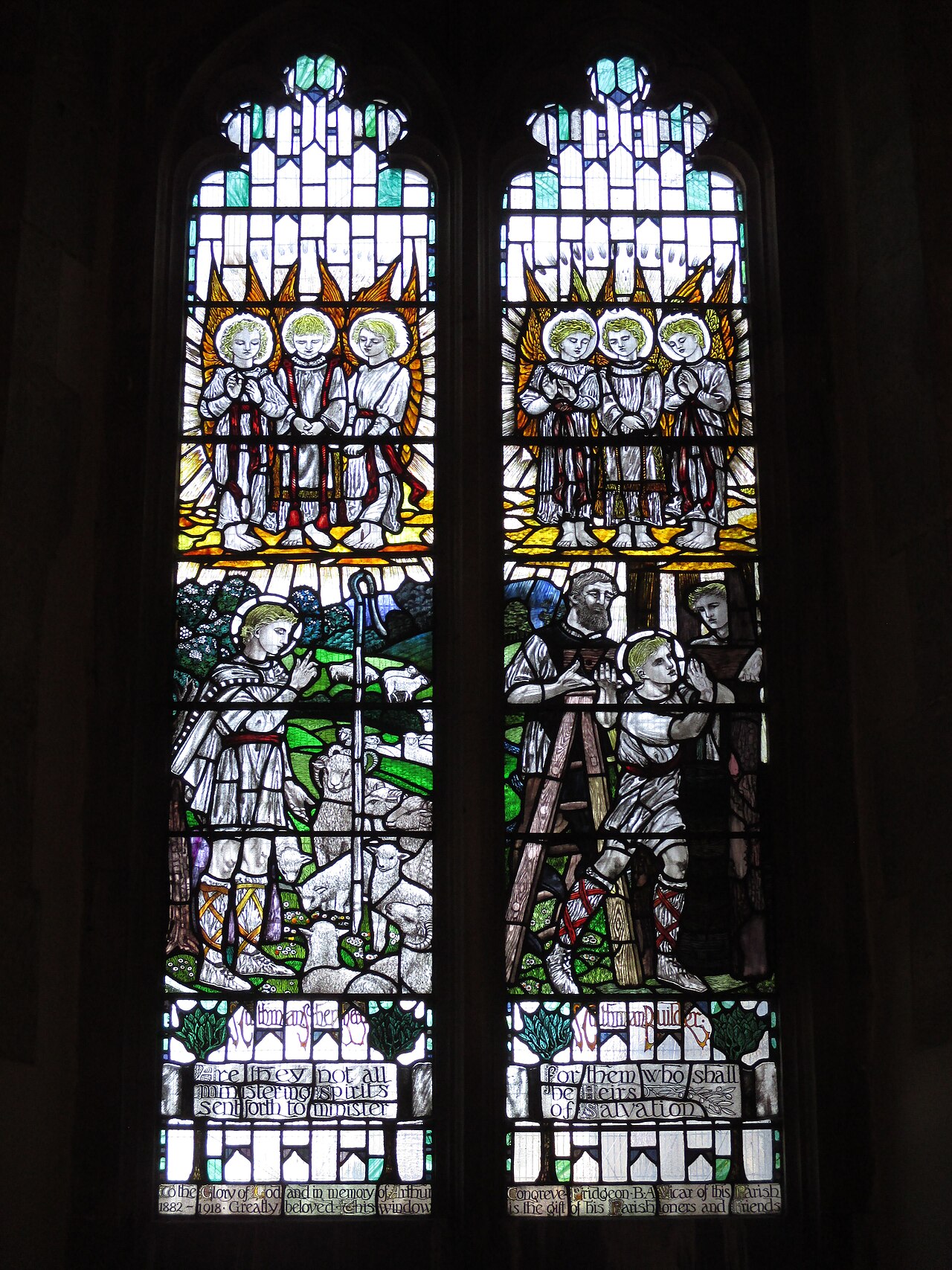
- St Andrew and St Cuthman, Steyning, West Sussex. A south aisle window of about 1918, illustrated below.
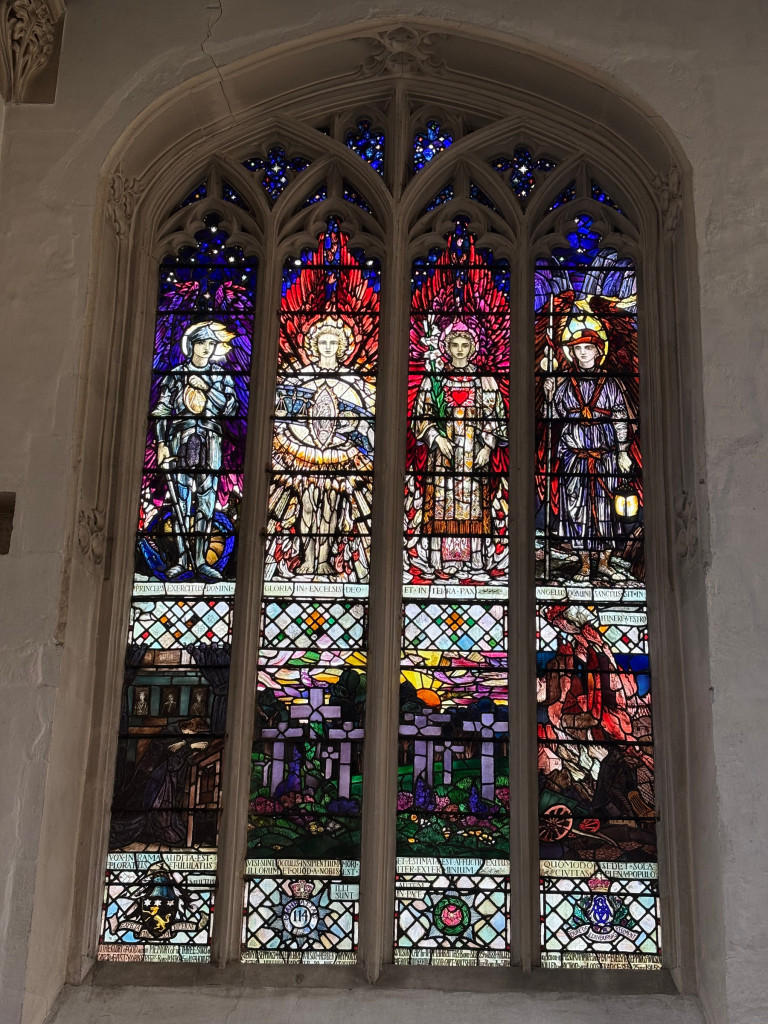
- St Andrew’s Church, Chippenham. The baptistry window remembering three brothers of one family killed in the First World War, illustrated below.
What to look for
Whall’s windows tend to be lighter and more open than most Victorian church glass. Figures are drawn simply and monumentally, with a good deal of clear or pale glass around them, and the leadwork is allowed to be part of the drawing. The colour is carried by the glass itself, so that a window changes with the light through the day. Painting is used for faces, hands and drapery detail but rarely for large areas of colour. A visitor who has learned to recognise the thick, irregular texture of slab glass will find it in many windows by his pupils and followers. The guide to reading a church window explains how to identify figures, symbols and dates, and the pages on ecclesiastical stained glass and window styles by period place his work in context.
Why he matters
Whall is one of the figures who moved English stained glass away from the large commercial studios of the later Victorian period and towards the idea of the glass artist as a designer and maker. The same principle underlies the studio craft that followed, and it is still the working assumption of artists who design, cut and assemble their own glass. For the wider background, see stained glass from the Gothic Revival to the twentieth century and the profile of famous British workshops and makers.
What the windows cost
Few prices for Whall’s windows have been published. One early figure survives in the archives of James Powell and Sons, which produced some of his first designs: in 1893 the firm charged Whall £46 for creating the Barnes memorial window at St James, Somerton, in Oxfordshire. That sum is about £3,800 at 2017 values (The National Archives currency converter, using its nearest year, 1890), or roughly 139 days’ wages for a skilled tradesman of the time. It covered only the cutting, painting, firing and glazing; Whall’s own fee for the design and cartoons was separate and is not recorded.
Sources and further reading
- Peter Cormack, Arts and Crafts Stained Glass (Paul Mellon Centre for Studies in British Art, 2015).
- Christopher Whall, Stained Glass Work: A Text-book for Students and Workers in Glass (John Hogg, 1905).
- Victoria and Albert Museum, collection record for the panel of St Chad by Christopher Whall (museum number C.87-1978), collections.vam.ac.uk.
- English Heritage, blue plaque record for Christopher Whall, 19 Ravenscourt Road, Hammersmith.
Image credits
Lead image: Christopher Whall, 1902. Photographer unknown; public domain.
Four-light window by Christopher Whall, St Andrew's Church, Chippenham: photograph by stainedglass.co.uk.
Published 31 October 2026 · Last updated