
John Hutton: engraver of the Coventry glass screen
Masters of Decorative Glass · No. 004
Engraved the 66 saints and angels of Coventry Cathedral's Great West Screen using a hand-held flexible-drive wheel.
Lived: 1906 to 1978Place: Clyde, New ZealandCountry: New ZealandDiscipline: Cut and engraved glassPeriod: Twentieth century
From Clyde to the London art world
John Hutton was born on 8 August 1906 at Clyde, a small town in the South Island of New Zealand. He was educated at Wanganui Collegiate School between 1920 and 1922 and was then intended for the law, which he studied for several years before abandoning it for painting. He had no formal art training. In the mid-1930s he left for England with his first wife, the painter Helen (Nell) Blair; sources differ on whether the move took place in 1935 or 1936. The couple spent a period at an artists’ community at Assington Hall in Suffolk and exhibited together in London.
Hutton’s first reputation was as a mural painter. During the late 1930s he took on several decorative commissions, including murals for the Paris Exhibition of 1937 and for the liner SS Orcades. When war came in 1939 he joined the army and served in the camouflage pool of the 21st Army Group. There he met the architect Basil Spence, and the friendship formed in that unit shaped the rest of his career. In 1951 Spence brought him in to paint murals for the Sea and Ships pavilion at the Festival of Britain.
A painter turns to glass
Hutton’s move into glass came soon after the war. In 1947 he engraved four panels representing the seasons for a restaurant on the Cunard liner Caronia, his first large-scale work in the medium. In the years that followed, and especially from the early 1950s, glass engraving became his principal occupation, although he continued to draw and paint. In 1949 the family moved to Landermere Creek near Thorpe-le-Soken in Essex, where he worked from a garden studio. Later, while the Coventry figures were in progress, he lived and worked at Greville Place in St John’s Wood, London.
His first marriage ended while he was living in St John’s Wood, although he and Helen continued to collaborate on some projects. In 1963 he married Marigold Dodson, who had already served as the model for many of his figures. Three sons were born of the first marriage, among them the artist Warwick Hutton, and a daughter, Katie, of the second.
Technique: grinding wheels on a flexible drive
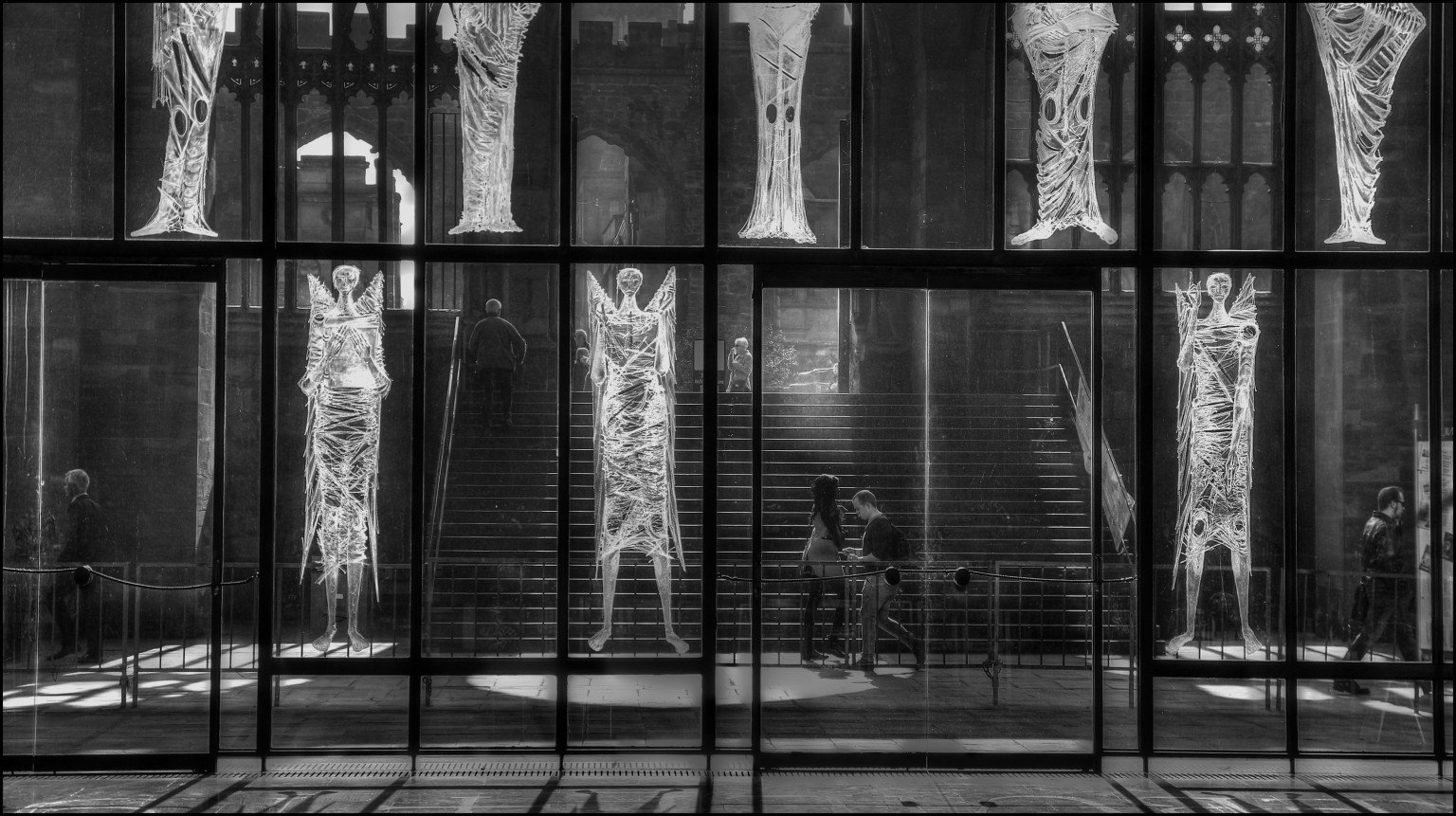
Hutton’s significance rests as much on method as on design. His commissions called for figures several feet high on sheets of architectural plate glass, and by about 1953 he had devised his own solution: small grinding wheels driven through a flexible shaft and held in the hand. Accounts of the tool describe it as powered by a motor salvaged from an old washing machine; the Victoria and Albert Museum compares the mechanism to a dentist’s drill. Water applied with a sponge kept the wheel and glass cool.
The working sequence began with a pencil design, which was then redrawn at full size in white chalk on black paper, serving the same purpose as the full-size cartoon for a stained glass window. The sheet of glass was laid flat over this drawing so that the chalk lines showed through, and Hutton worked directly on the surface above them. Some outlines were masked and roughed out with the abrasive blast now associated with sandblasted glass, after which the wheel work modelled the forms. The result has a dry, chalk-like grain, and the varying depth of the abrasion gives the figures a sense of volume when light falls across them.
The Great West Screen at Coventry
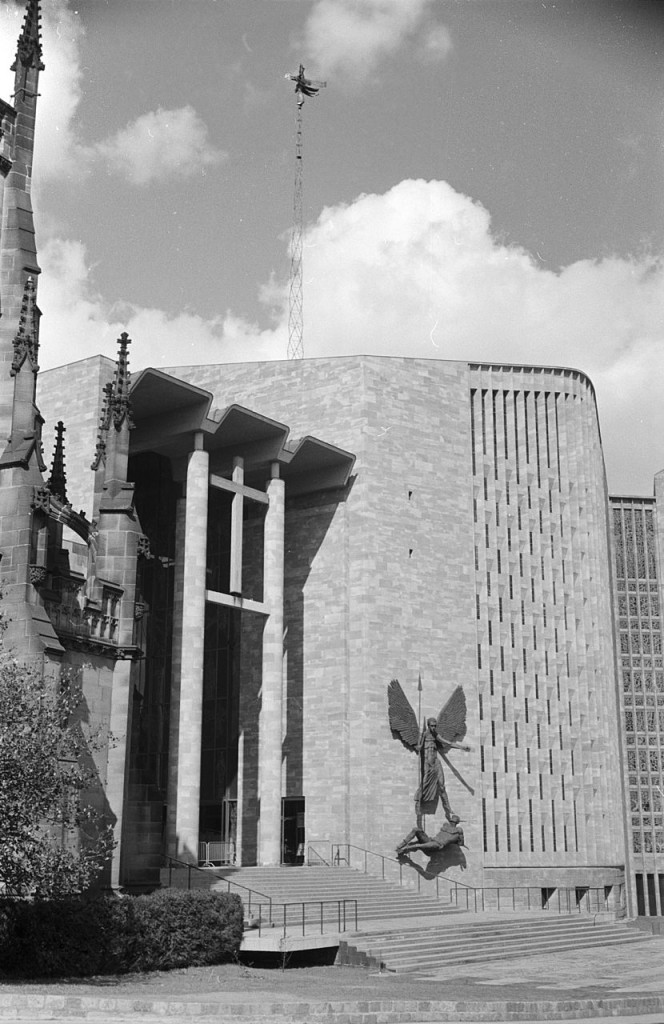
The old Cathedral of St Michael in Coventry was destroyed by bombing on 14 November 1940. Spence, the architect of the new building, asked Hutton to design the glass wall that would close its ceremonial west end and face the ruins across a covered porch. Because the new cathedral is aligned north to south, the so-called west screen in fact faces south. The commission dates from the early 1950s: preparatory studies for the screen held in New Zealand collections are dated about 1952 and 1954. Work continued until shortly before the consecration on 25 May 1962, and most accounts, including the cathedral’s own, put Hutton’s labour on it at about ten years.
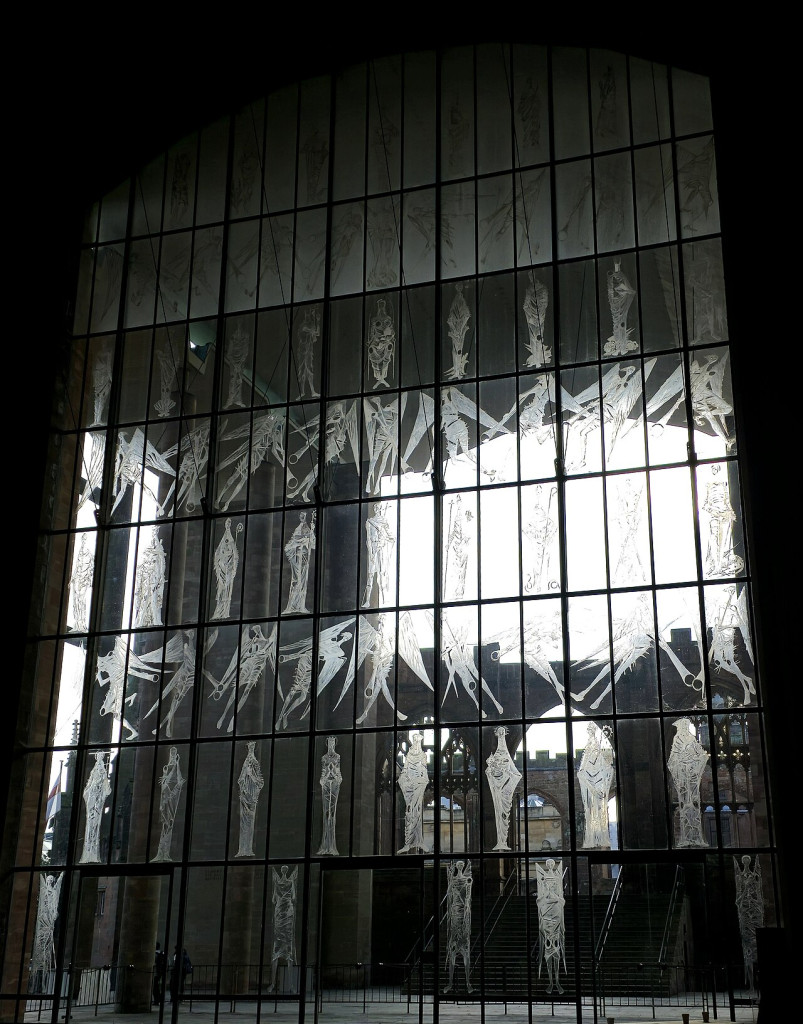
The Grade I list entry for the cathedral describes the wall as fully glazed from floor to ceiling and side to side, made up of nineteen lights in eight horizontal bands, with plate glass held in bronze bars. Published dimensions give a height of 21.5 metres (about 70 feet) and a width of 18.85 metres. The engraving shows 66 larger-than-life figures. Standing saints are interspersed with angels whose wings and trumpets sweep across the mullions. Hutton considered an earlier scheme, with saints and angels in alternate panes, too rigid, and introduced the flying angels to give the screen movement. A local study notes that the angels never cross the central vertical of the screen, which keeps the composition stable. Marigold posed for the female figures; for the male heads Hutton used his own face, studied in a mirror.
The final stages were not straightforward. By August 1961 all the glass apart from the bottom row was finished, and the panels went to Coventry for glazing in September, with the last standing angels deliberately installed late to limit the risk of damage. One of them broke and had to be replaced at short notice. Once the screen was in place, Spence judged it too dense when viewed from outside, and Hutton, working with two of his sons, removed the heaviest areas of engraving to produce the lighter screen seen today. Inside, the clear glass allows a view of the ruins from the nave; from the steps outside, visitors see their own reflections in the glass, with the tapestry of Christ behind the altar visible beyond.
The screen is one element of a building that brought together leading artists of the period, among them John Piper and Patrick Reyntiens, whose ecclesiastical stained glass fills the baptistery window, together with Lawrence Lee, Geoffrey Clarke and Keith New in the nave. The Coventry Cathedral tour covers the building’s glass as a whole. Hutton’s ashes were buried at the foot of the screen, and an inscribed paving slab marks the place.
The commission also generated smaller pieces. Around 1958–59 a limited edition of large engraved vases was produced at the Whitefriars glassworks of James Powell and Sons, each with its own arrangement of angels drawn from the screen; they were sold at the cathedral to help meet its debts after completion. The Victoria and Albert Museum holds an example (C.28-1975), and the Corning Museum of Glass holds an engraved vase of about 1958 blown by Webb’s Crystal Glass Company.
Screens, doors and windows in public buildings
Alongside Coventry, Hutton received a steady series of commissions for memorials, cathedrals, offices and civic buildings, in Britain and overseas.
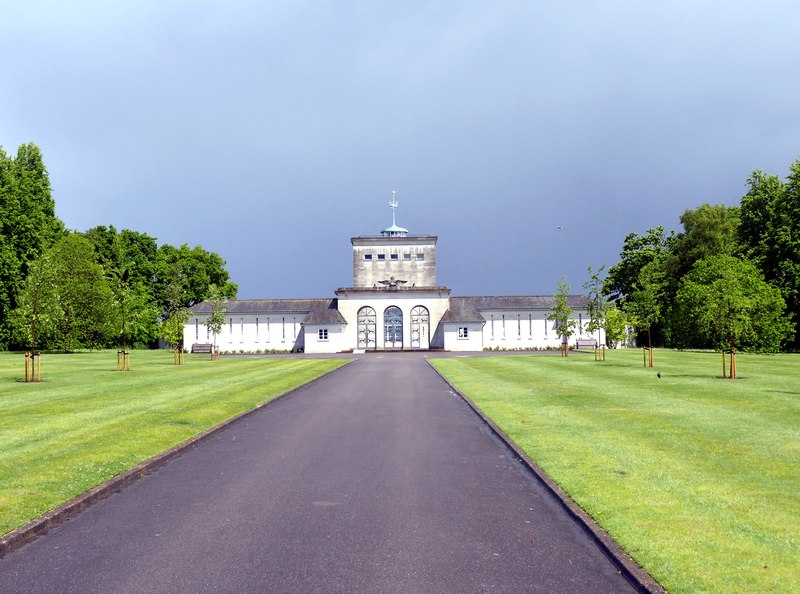
- Air Forces Memorial, Runnymede, Surrey (1953). Sir Edward Maufe’s memorial to Commonwealth airmen with no known grave includes an engraved north window and painted ceilings by Hutton.
- Dunkirk Memorial, France (1957). The memorial, designed by Philip Hepworth, includes an engraved glass panel by Hutton depicting the evacuation of 1940.
- Bucklersbury House, City of London (late 1950s). Engraved glass above the entrances of this office block drew on the Roman Temple of Mithras uncovered on the site in 1954, with Roman soldiers and deities.
- Guildford Cathedral, Surrey (1961). Engraved angels, known as the sentinel angels, stand guard on the glass of the west entrance doors of Maufe’s cathedral. In January 2024 a panel was smashed by vandals, and the cathedral described it as irreplaceable.
- Shakespeare Centre, Stratford-upon-Avon (1964). For the building opened next to Shakespeare’s Birthplace on the 400th anniversary of the playwright’s birth, Hutton engraved 19 characters from the plays, including Macbeth, Lady Macbeth and Desdemona. The brief originally proposed portraits of actors, but Hutton argued that his medium did not suit portraiture.
- Civic centres at Plymouth and Newcastle upon Tyne. Hutton contributed artwork to Plymouth Civic Centre, opened in 1962. At Newcastle Civic Centre his engraved glass screen in the entrance area, photographed for the architectural press in 1970, is recorded in the building’s Grade II* list entry.
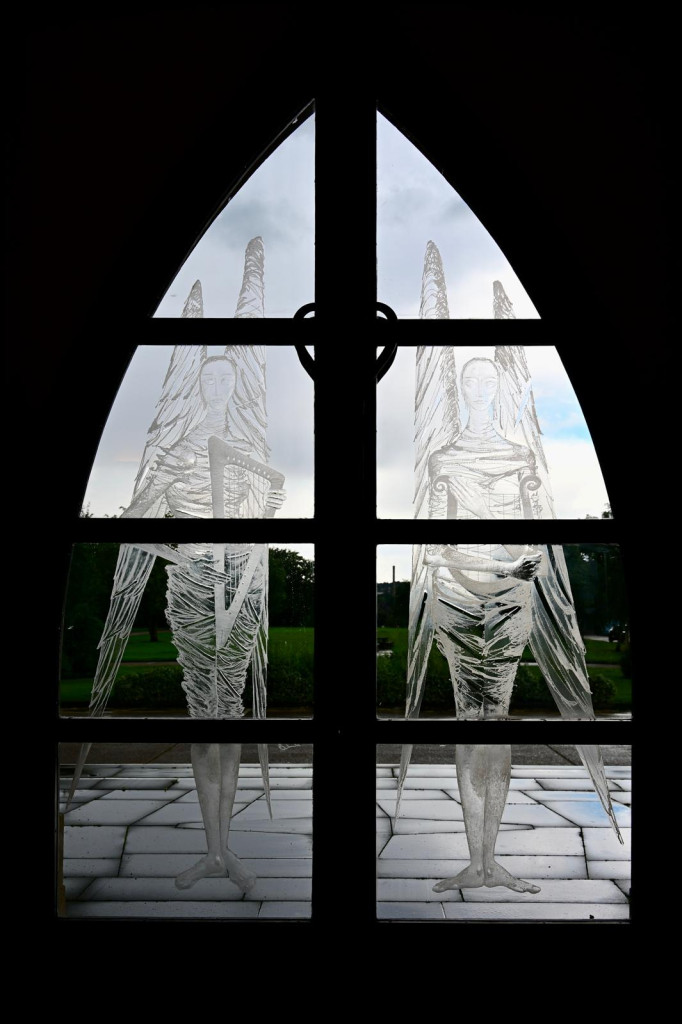
- Wellington Cathedral of St Paul, New Zealand (1973). Engraved windows at the entrance show pairs of elongated angels close in style to Coventry, again modelled on Marigold Hutton. One of the windows was presented by Hutton himself.
Hutton also produced engraved glass for the National Library and Archives building in Ottawa, Canada, and the National Library of Canada later published a record of his engravings.
Where to discover the work today
The Coventry screen remains in its original position and can be seen from both the porch and the nave. Hutton glass also remains in its original settings at Guildford (where one door panel was destroyed in 2024), Runnymede, Dunkirk, Stratford-upon-Avon and Wellington (where four of the five windows survive). Designs and studies are held in public collections in New Zealand, including Auckland Art Gallery, which has studies for Coventry figures of about 1952, and the Sarjeant Gallery in Whanganui, which holds a flying angel design of 1954 and an engraved vase. The University of Warwick Art Collection also owns a Hutton vase.
Influence and significance
Hutton’s hand-held method allowed him to engrave figures at the scale of architecture, and the Coventry screen showed that clear engraved glass could act as both wall and window, revealing a building’s surroundings rather than shutting them out. In this respect his work belongs to the wider post-war renewal of church art described in Gothic Revival to modern stained glass. His standing within the craft was reflected in 1975, when he became the first Vice President of the newly founded Guild of Glass Engravers. He died of cancer in 1978 at Clifton Hampden, near Abingdon in Oxfordshire. For other figures in this series, see Masters of Decorative Glass, and for the wider chronology, the timeline of decorative glass.
Sources and further reading
- Coventry Cathedral: The West Screen
- Historic England: Cathedral of St Michael, Coventry (list entry 1342941)
- University of Warwick Art Collection: John Hutton
- Victoria and Albert Museum: vase engraved by John Hutton, C.28-1975
- Margaret Brentnall, John Hutton: Artist and Glass Engraver (1986)
- Charles R. Hajdamach, 20th Century British Glass (2009), pages 245–248
Published 2 November 2026