
Stephen Adam: Glasgow’s painter of working lives in glass
Masters of Glass · No. 004
His 1878 panels for Maryhill Burgh Halls show Glasgow workers in modern working clothes rather than biblical or medieval dress.
Lived: 1848 to 1910Place: Bonnington, EdinburghCountry: ScotlandDiscipline: Architectural and ecclesiastical glass, Stained and painted glassPeriod: Victorian and Gothic Revival, 1800 to 1880
Edinburgh beginnings and the Cottier years
Stephen Adam was born in 1848 at Bonnington, then on the northern edge of Edinburgh and since absorbed by the city. He attended Canonmills School, where Robert Louis Stevenson was among his contemporaries, and an early aptitude for drawing secured him an apprenticeship around 1861 with the Edinburgh decorating and glass-staining firm led by James Ballantine. He also attended classes at the Trustees’ Academy in Edinburgh and at the Haldane Academy in Glasgow.
After the family moved west in the mid-1860s, Adam joined the young Glasgow workshop of Daniel Cottier as an assistant. Cottier’s use of strong, harmonised colour left a lasting mark, and Adam later described him as his master in that respect. He also named Rossetti, Burne-Jones and William Morris and the French muralist Puvis de Chavannes among the artists who shaped his figure work.
The Glasgow studio
When Cottier left for London in 1869, Adam set up on his own. In 1870 he opened premises at 121 Bath Street with David Small, a fellow former Ballantine apprentice, and the partnership traded as Adam & Small until it was dissolved in 1885. Small’s precise identity is still debated: some writers equate him with the painter David Small (1846–1927), while others point to a glass-stainer of the same name with his own Edinburgh business.
The firm moved several times, and by 1891 it occupied a six-storey building in St Vincent Street. A publicity description from that year sets out a production line arranged floor by floor: lead working, cartoon drawing and pattern painting, glass painting and staining, kilns, stock rooms and packing. The same notice claimed some 220 memorial windows completed within a decade, with clients across Britain and the colonies. Church memorials provided the core income.
Adam did not draw every design himself. Robert Burns, David Gauld and Alex Walker supplied designs on a freelance basis, and the stained glass historian Martin Harrison has attributed the figure scenes of the Helensburgh windows of about 1881 to the English draughtsman Harry John Burrow (1846–1882), which suggests that the firm also relied on English figure draughtsmen. Execution was also shared: the glass painter Joseph Miller, whose signature is scratched on the Railway Porter panel, is thought to have painted at least part of the Maryhill series described below. For the wider context of firms organised in this way, see famous stained glass workshops and makers.
Ideas about the medium: colour, lead and light
Adam set out his principles in print. Stained Glass: Its History and Modern Development appeared in 1877, and a lecture delivered in Glasgow in 1895 was published the following year as Truth in Decorative Art. Following the classification of the writer Charles Winston, he separated the mosaic method, in which coloured glass is cut and set in lead came with only modest painted detail, from enamel work painted on to white glass. He regarded the second as a slide towards easel painting and argued that light should pass through the glass rather than bounce off a painted surface.
In practice this meant antique glass of good quality, leadlines treated as part of the drawing, and restraint with paint. He disliked stippled shading and the hard blue of flashed glass, and he rejected both slavish copying of thirteenth-century work and the mass-produced saints of commercial Gothic Revival studios. For domestic windows he recommended symmetrical lead patterns with plant ornament kept subordinate to the geometry. In his final decade the palette darkened towards blacks, greys, deep blues and browns, ornament became sparer, Japanese influence appeared, and small painted cameo portraits were set into larger designs. The broader shift away from Gothic convention is traced in Gothic Revival to modern stained glass.
The Maryhill Burgh Halls panels
Maryhill, a canal-side industrial community north-west of the city centre, became a burgh in 1856 and was absorbed into Glasgow in 1891. Its Burgh Halls, designed by Duncan McNaughtan and now listed at Category B, were opened by the provost on 26 April 1878. For the hall Adam & Small produced twenty stained glass panels, generally dated to 1878, though some writers extend the work to about 1881; the partners were still pressing the council for the balance of their fee in that year, and the name of the firm appears on the Boat Builder panel.
The subjects are the working people of the burgh in their own clothes and at their own tasks. The series includes boatbuilders, iron moulders, blacksmiths, joiners, sawyers, engineers, railwaymen, gas workers, zinc spelters, chemical workers, a glassblower, a papermaker and a dye-press worker, together with a teacher and soldiers. Machinery and tools are drawn with evident first-hand knowledge, and several figures are seen from behind, absorbed in their work. Compositions are calm and uncluttered, with clear colour and none of the foliage or diapered backgrounds usual in church glass of the period. The contrast with his trades windows for Trinity Hall in Aberdeen, where craftsmen wear quasi-medieval and biblical dress, is marked.
Two panels featuring women have been reinterpreted. Long known as the Linen Bleachers and the Calico Printers, they are now read as women working cloth in water at a bleachworks or laundry, and as an earlier stage of calico production, possibly linked to the Kelvindale Mills beside the River Kelvin. Historians including Michael Donnelly, Iain Galbraith and Ian R. Mitchell have studied the series, and it has been described as the finest group of secular stained glass in Scotland.
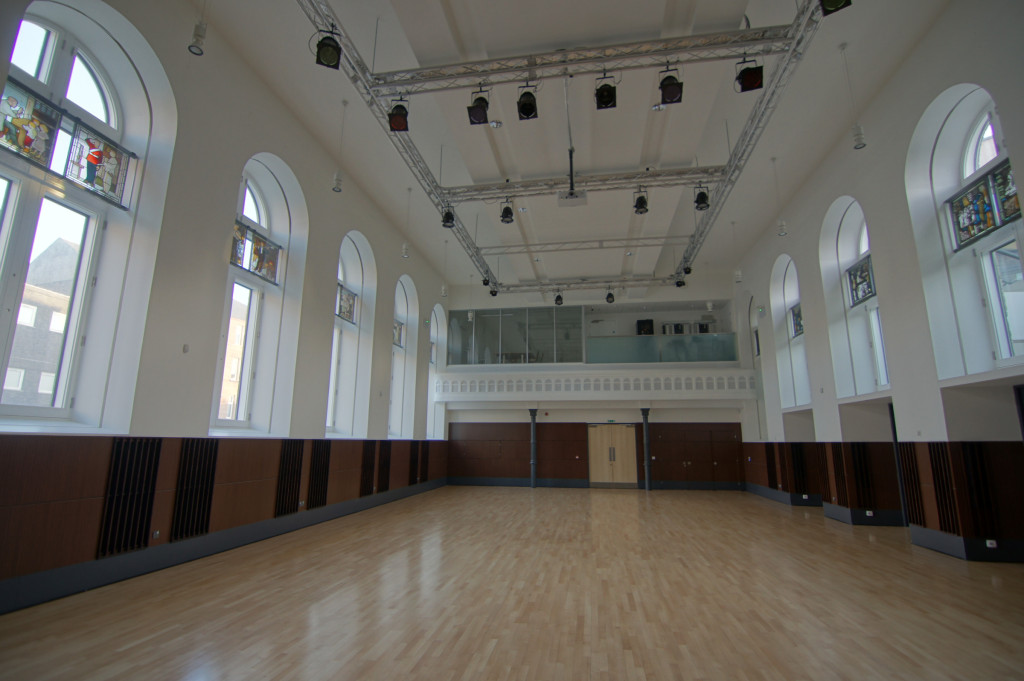
As the halls declined, the panels were removed in 1963 and passed into the care of Glasgow Museums, with most kept at the Burrell Collection, and were conserved before their return as part of the restoration of the building (see conservation and restoration). A restoration of the building supported by a Heritage Lottery Fund award of £990,000 allowed it to reopen in 2012, and original panels returned to the main hall alongside ten newly commissioned panels on present-day themes. Accounts differ on how many originals are displayed at any time: ten or eleven are cited, with the remainder held in storage or rotated.
Houses, civic buildings and commercial interiors
Secular work formed a substantial part of the studio’s output. Merchants’ villas and terraces in Glasgow’s West End and South Side received figurative and ornamental windows, among them an Allegory of Art of 1877 and a harpist window for houses in Devonshire Gardens, and a Cleopatra of 1890 for a Pollokshields villa known as The Knowe. For the suburban market the firm also supplied leaded lights produced in quantity, with stencilled ornament and hand-painted figures. Grander domestic clients included the Pullar family of Perth and the Coats and Clark families of Paisley; commissions are recorded for Dundas Castle, Drumalis in County Antrim, Blyth Hall in Newport-on-Tay, Fife, and Gartmore House, near Aberfoyle, where Sir Charles Cayzer commissioned Art Nouveau panels. For Broughton House in Kirkcudbright, the home of the painter E. A. Hornel, the studio produced a cameo of a Cavalier’s head.
Civic and institutional work included glass for Glasgow City Chambers (1887), the town halls of Annan and Inverness, Glasgow’s Hospital for Sick Children and the Carnegie libraries at Ayr and Dumfries. The Ayr library, opened in 1893, received a nine-panel staircase window with a figure of Knowledge in the lower central panel. Overseas, eight heraldic windows bearing the arms of hospital directors were supplied in 1907 to the Royal Prince Alfred Hospital in Sydney; one published obituary describes them as commemorating leading colonial families.
Commercial clients ranged from the Pettigrew and Stephens department store in Sauchiehall Street to the Imperial Bar in Howard Street, the Grosvenor restaurant in Glasgow and a Spiers & Pond restaurant in London. For the Clyde Navigation Trust’s boardroom on the Broomielaw it produced panels including Commerce and Shipbuilding, dated to between about 1905 and 1908, and in the same year oval panels for the foyer doors of the King’s Theatre in Edinburgh. At the Glasgow International Exhibition of 1901 the firm showed large mosaic panels with life-size craftsmen. The practical background to this kind of work is covered in decorative glass for pubs, shops and restaurants.
Church windows
The ecclesiastical output was concentrated in the west of Scotland. Early commissions include a three-light window at St Andrew’s in the Square, Glasgow (1874), windows at the former Belhaven Church in Glasgow produced with Andrew Wells, a fellow Cottier assistant, and the Baird memorial at Alloway (1877). The Smollett window at Bonhill Parish Church (1880) sets figures against grisaille quarries, and Adam & Small glazed the east window of St Michael and All Angels, Helensburgh, in about 1881.
Later work includes a group of windows of 1892 for St Columba’s and the Clark Memorial Church in Largs, Charity (1898) at Craigrownie Church, Cove, Corona Vectrix (1903) at Kilwinning Abbey Church and The Baptism of Christ (1907) at Lecropt Kirk in Stirlingshire. At Kilmore Church, Dervaig, on Mull, completed in 1905 to designs by Peter MacGregor Chalmers, seven windows by Adam were installed between 1905 and 1910. Among his last projects was a series for Trinity Congregational Church in Glasgow depicting modern thinkers, among them Carlyle, F. D. Maurice and George MacDonald; a window by his son for the same church is now at St James the Less, Bishopbriggs. Paisley Abbey, North Berwick, Pollokshields and New Kilpatrick Church in Bearsden also hold his glass; contemporaries singled out the Bearsden windows for their colour. Guidance on interpreting such windows is given in how to read a church window.
Pupils and the later studio
Obituaries noted that many craftsmen who later achieved recognition had trained under Adam. David Gauld and William Tait Meikle passed through the studio, as did his son, Stephen Adam junior, who studied design at Glasgow School of Art and became a partner in the 1890s. A quarrel ended that partnership in 1904, and the younger Adam is believed to have emigrated to America.
Alf Webster, also a Glasgow School of Art student, became the leading assistant and was running the practice by the time Adam died at his Bath Street home in late August 1910, aged 62. Webster extended the studio’s technical range with acid etching, abrading and thick slab glass, and his First Fruits window at New Kilpatrick Church honours his former master. He was fatally wounded in 1915 while serving with the Gordon Highlanders; the business continued under his widow, assisted by Douglas Hamilton, until their son Gordon Webster took control in 1929.
Where to see the work today
Part of the trades series is displayed again in the main hall of Maryhill Burgh Halls, for which it was created. Church glass survives at Bonhill, Largs, Alloway, Lecropt, Dervaig, Paisley Abbey and Bearsden, among others. Much of the domestic and commercial glass is of unconfirmed survival and is known chiefly through catalogues and photographs. Further profiles appear in the Masters of Glass series and the glass artists section.
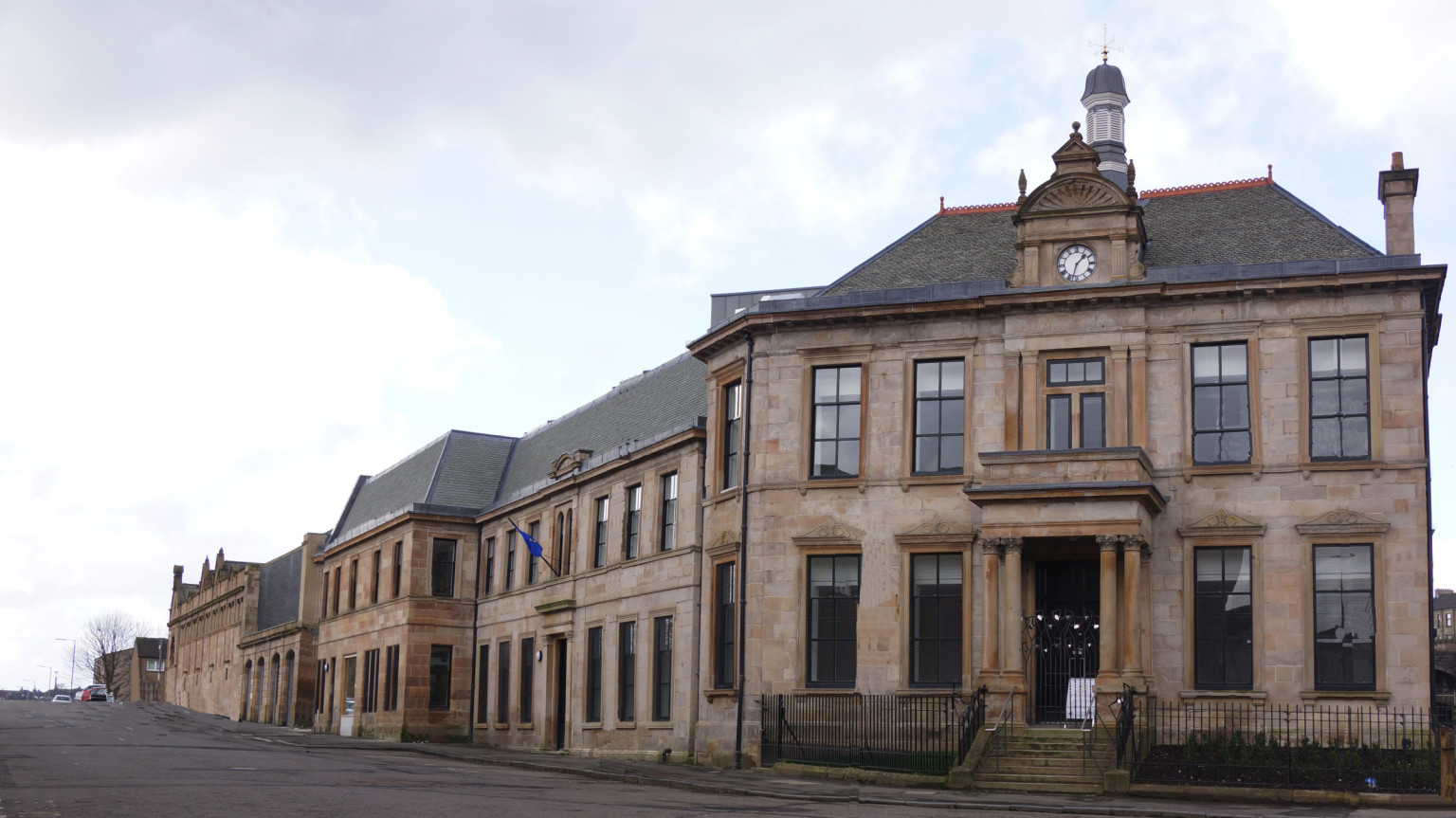
Featured image: The front entrance of Maryhill Burgh Halls, Glasgow. Photo: Maryhill Burgh Halls Trust, CC BY-SA 4.0, via Wikimedia Commons.
Sources and further reading
- Lionel Gossman, A Stained Glass Masterpiece in Victorian Glasgow (Victorian Web)
- Lionel Gossman, Stephen Adam: the early years and the Glasgow studio (Victorian Web)
- Lionel Gossman, Stephen Adam on stained glass (Victorian Web)
- A provisional chronology of stained glass windows by Stephen Adam (Victorian Web)
- Iain B. Galbraith, Always happy in his designs: the legacy of Stephen Adam (Victorian Web)
- Mackintosh Architecture, University of Glasgow: Stephen Adam biography
- Glasgow School of Art Archives: Stephen Adam junior
- Visit Stained Glass: Stephen Adam
- Visit Stained Glass: Adam (Stephen) Studio
- Glasgow Women’s Library: Maryhill Burgh Halls panel, The Calico Printers
- Glasgow Women’s Library: Maryhill Burgh Halls panel, The Linen Bleachers
- National Lottery Heritage Fund: award for Maryhill Burgh Halls
- Historic Environment Scotland: Maryhill Burgh Halls, listed building LB32349
- Scotland’s Churches Trust: Kilmore Church, Dervaig
- Gazetteer for Scotland: Stephen Adam
- Scottish Glass Society: talk on the Maryhill Burgh Halls glass
- Scottish Transport and Industry Collections Knowledge network: Maryhill panel identification
- Michael Donnelly, Scotland’s Stained Glass: Making the Colours Sing (Historic Scotland, 1997)
Published 16 November 2026 · Last updated