
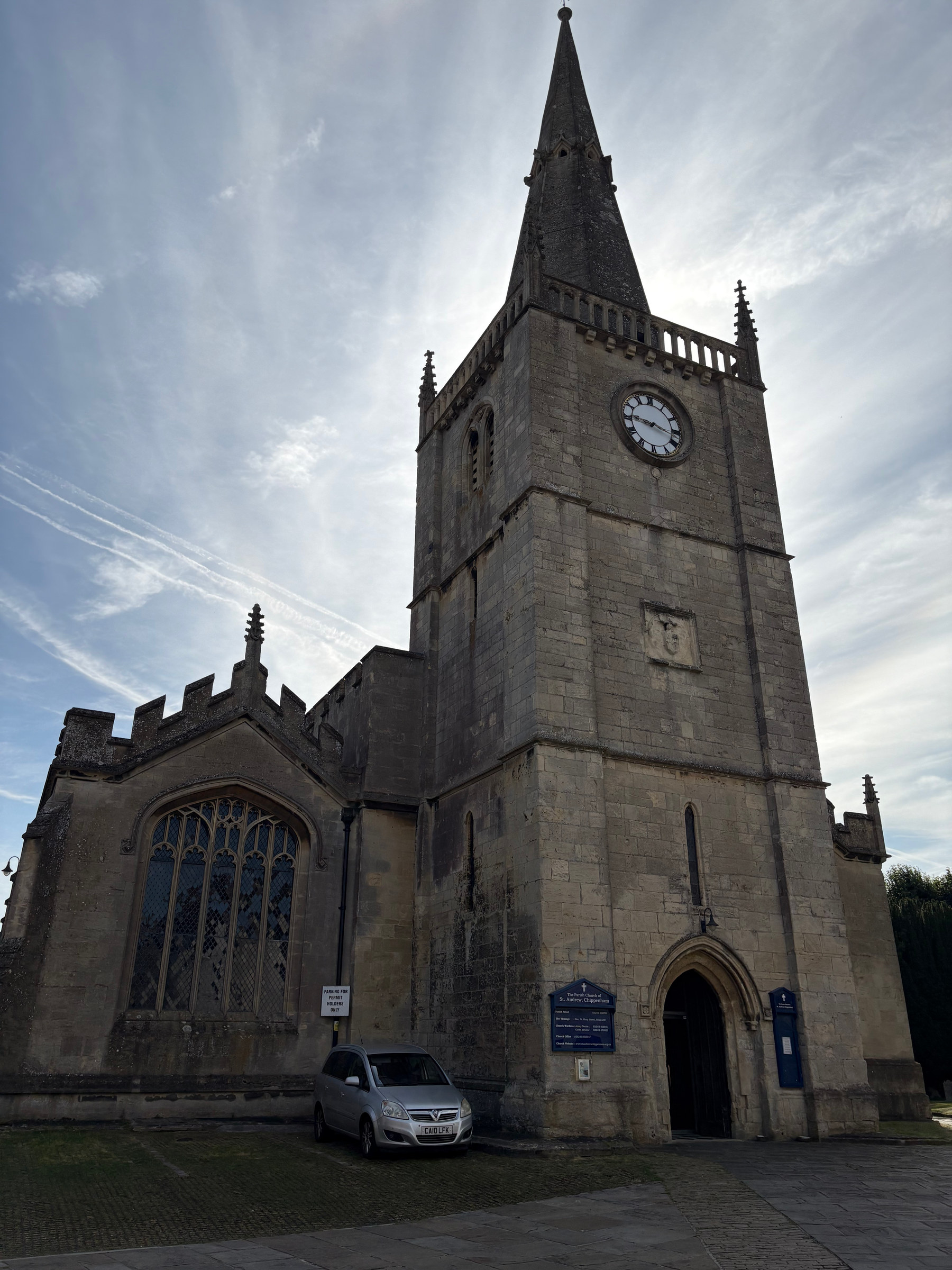
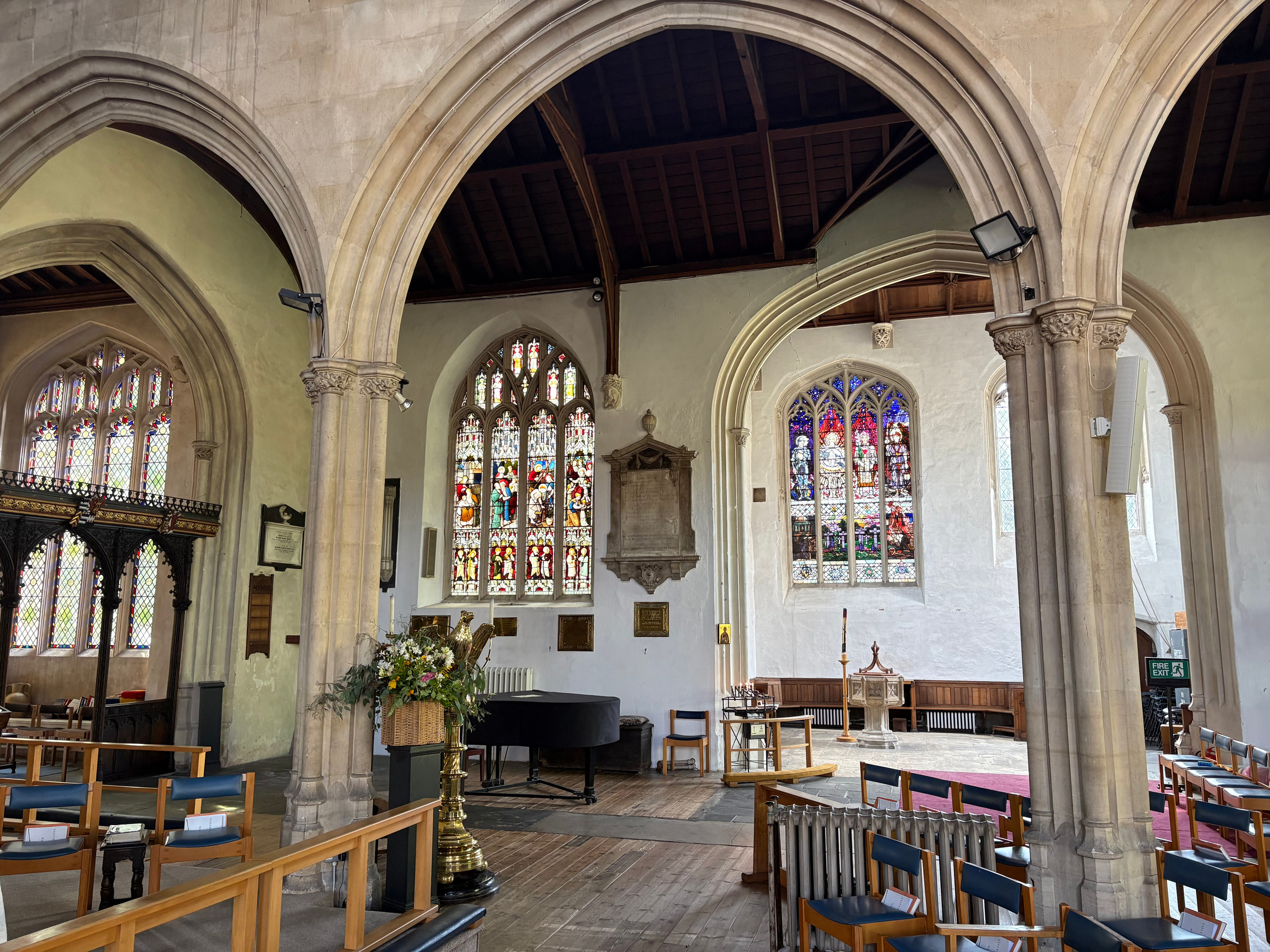
St Andrew’s stands on the Market Place at the heart of Chippenham, and its windows trace almost five centuries of change in the town. A church has occupied the site since Anglo-Saxon times, possibly as a minster, which would explain the unusually spacious churchyard. The present stone building has a Norman core: the chancel arch dates from about 1120, and the lower stages of the west tower were added around the start of the fourteenth century. The church is listed at Grade II*.
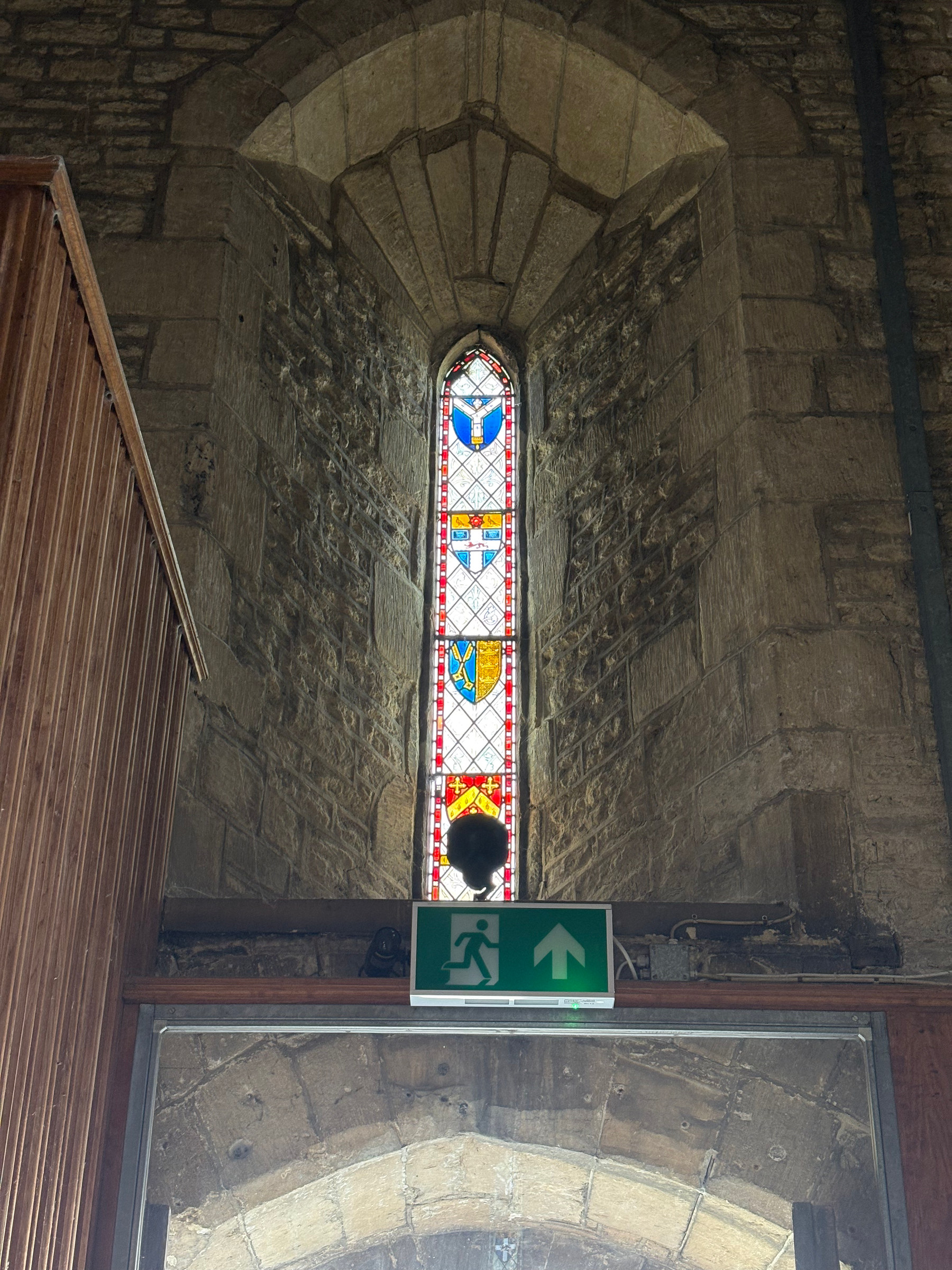
Much of what is seen today is Perpendicular. In 1442 Walter, Lord Hungerford, Lord High Treasurer to Henry VI, paid for a new south chancel chapel and for the upper tower and spire; two of the Hungerford family’s heraldic devices still survive in small painted panes in a south window of the Lady Chapel. A further chapel on the south side of the nave followed in 1485. By the early seventeenth century the tower was showing signs of collapse, and by 1633 it had been taken down and rebuilt fifteen feet lower. That work is recorded as costing £320, of which Sir Francis Popham gave £40.
The church took its present form in 1875 to 1878, when the architects John and Richard Darley carried out a thorough restoration. The chancel was rebuilt and extended twenty feet to the east behind a new chancel arch, a clerestory was added to the nave, a north aisle and organ chamber were built, and the flat plaster ceilings of the eighteenth century were taken out. The organ, which keeps pipework from its eighteenth-century predecessor, was rebuilt and moved from the west gallery into the new chamber in 1879. The enlarged building gave the parish a set of new and larger windows, and almost all of its coloured glass was installed over the following four decades, as families and townspeople commissioned memorials.
Key facts
- Town: Chippenham
- County: Wiltshire
- Listing: Grade II*, listed 1950
- Building: Norman origins, enlarged in the 14th and 15th centuries and restored 1875–78
- Glass: mainly Victorian and Edwardian stained glass, with some earlier fragments
- Photographed: July 2026
The stained glass
The windows form a compact survey of late Victorian and Edwardian ecclesiastical stained glass, produced by three London workshops and one of the leading figures of the Arts and Crafts movement. Most were given as memorials, and many of them include the heraldry, inscriptions and local scenes that tie each window to a particular family.
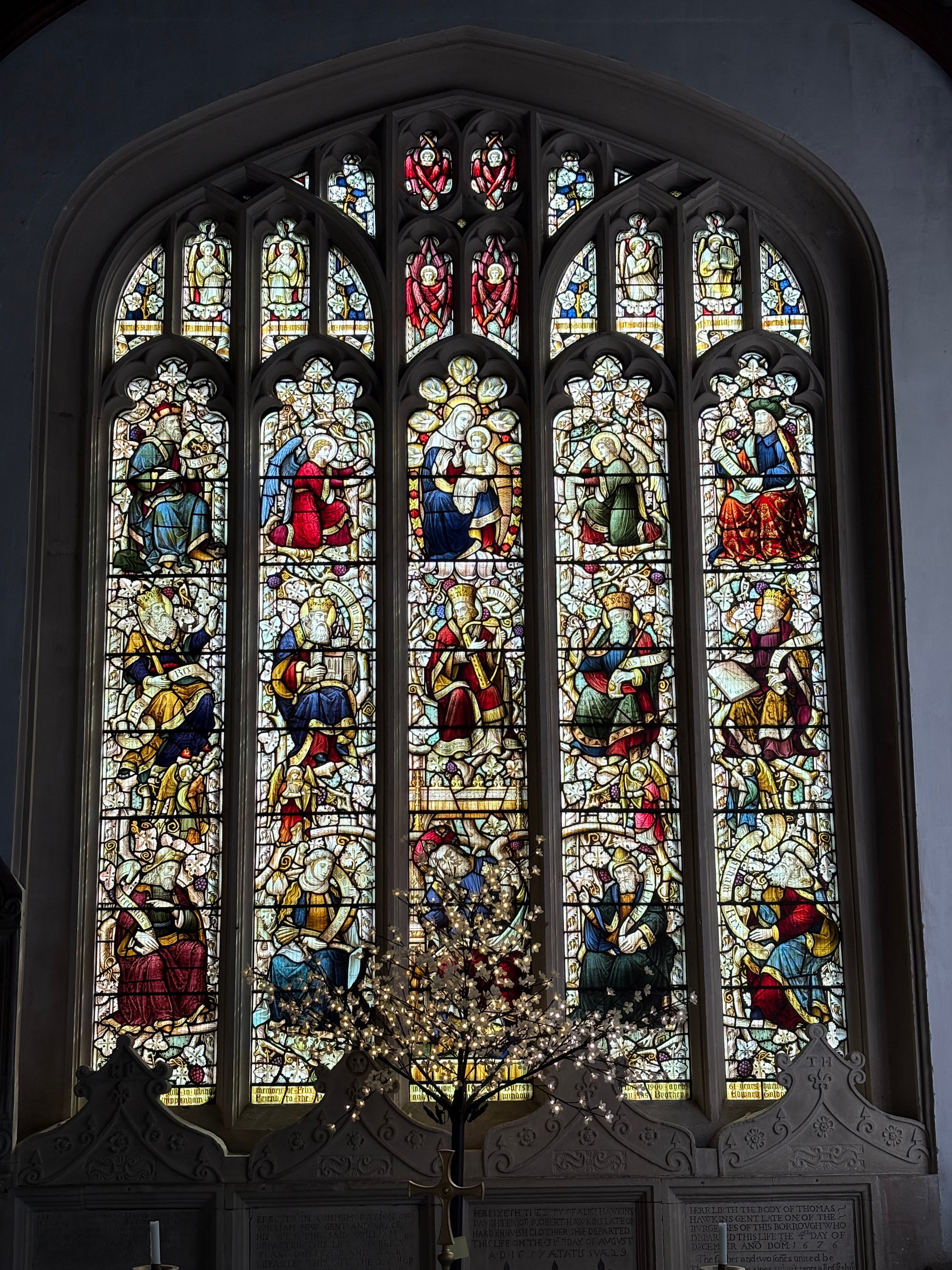
The east window, 1878
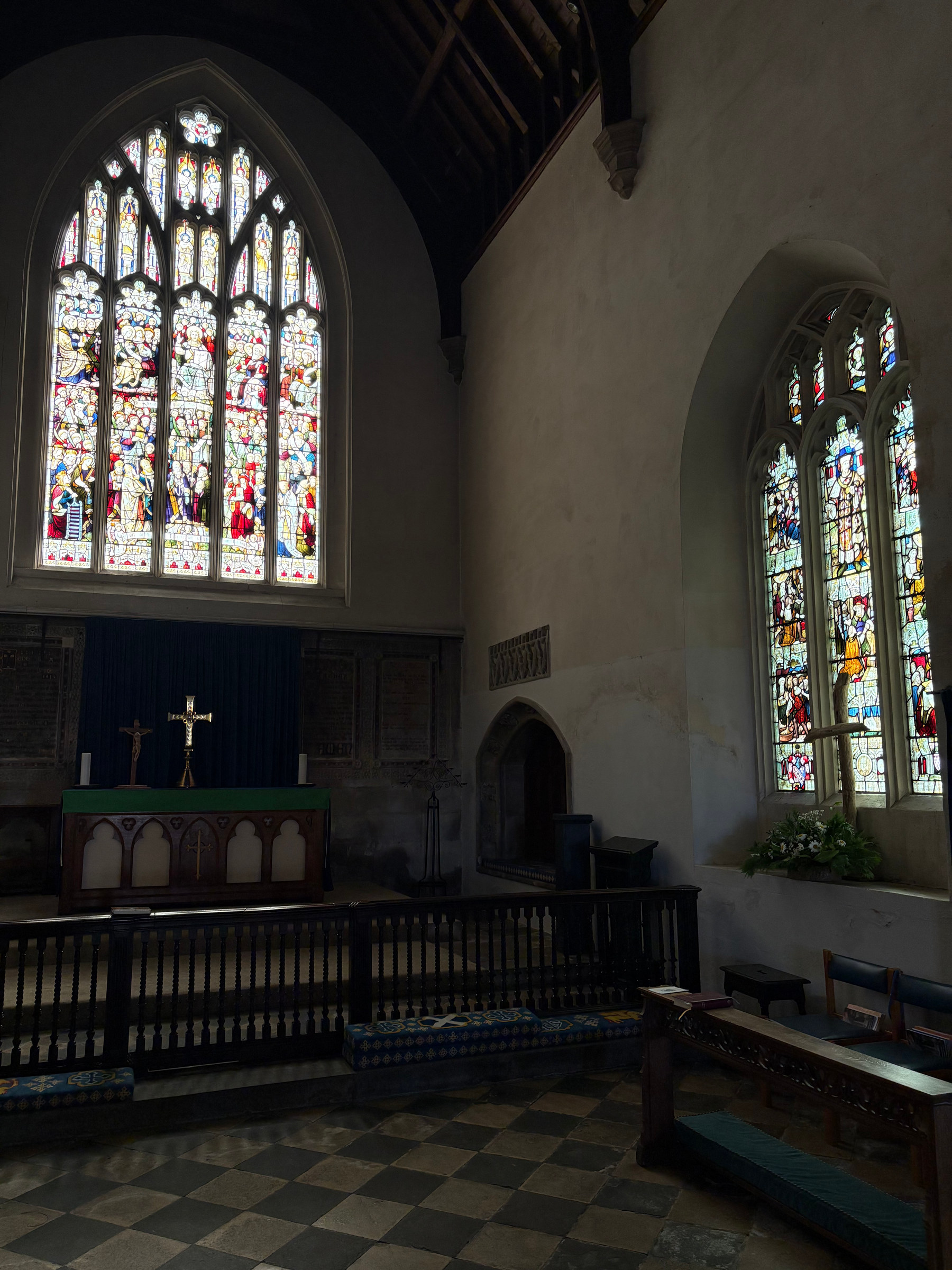
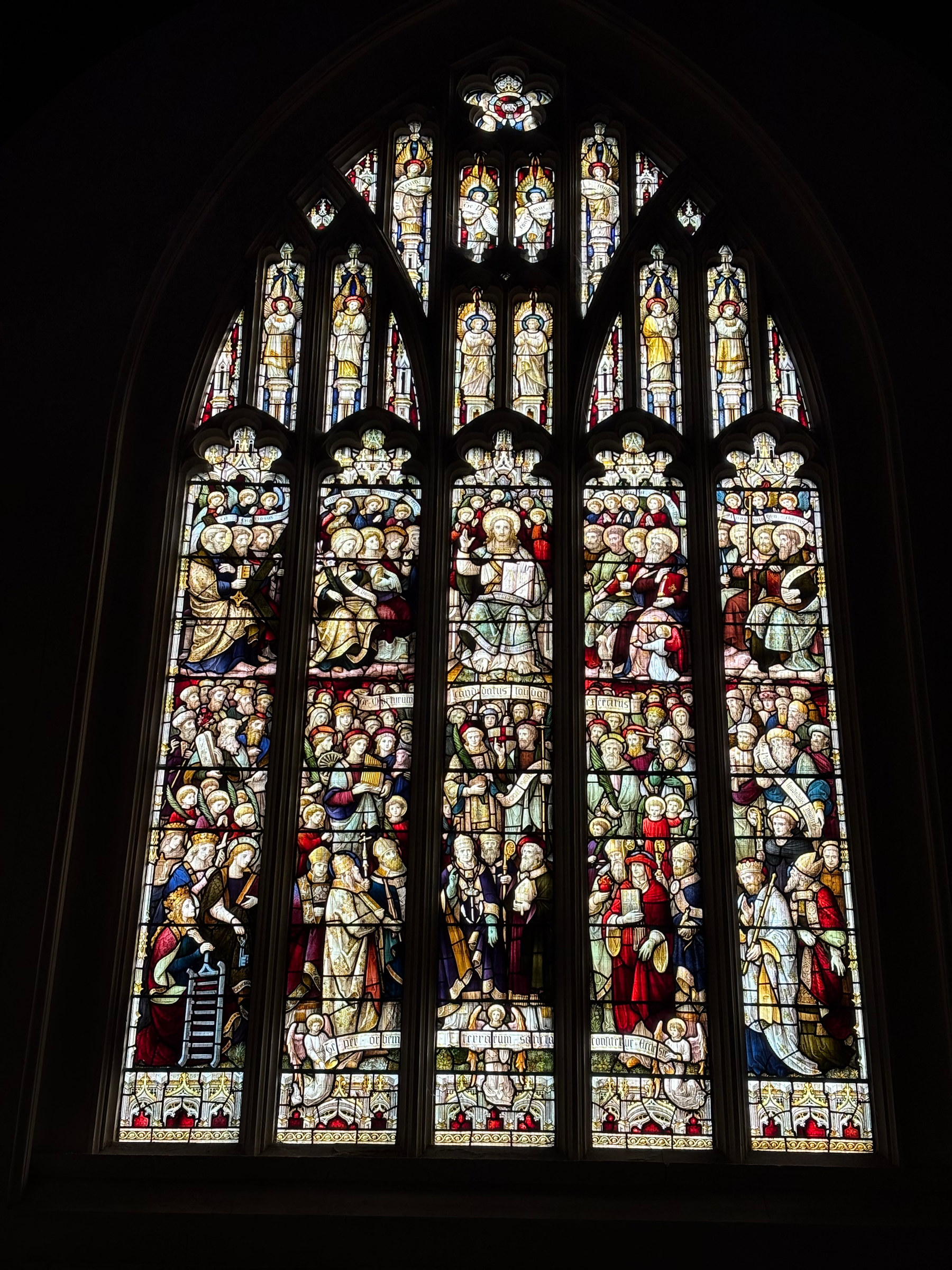
The great five-light east window was installed in 1878, as the restoration reached completion. It illustrates the Te Deum, the ancient hymn of praise, with Christ in glory at the centre and tier upon tier of angels, saints, prophets and martyrs filling the lights below and around him. The design follows the Perpendicular tracery of the new chancel, so the window reads as a single crowded vision of heaven when seen from the nave. The published sources do not name its maker.
Burlison and Grylls
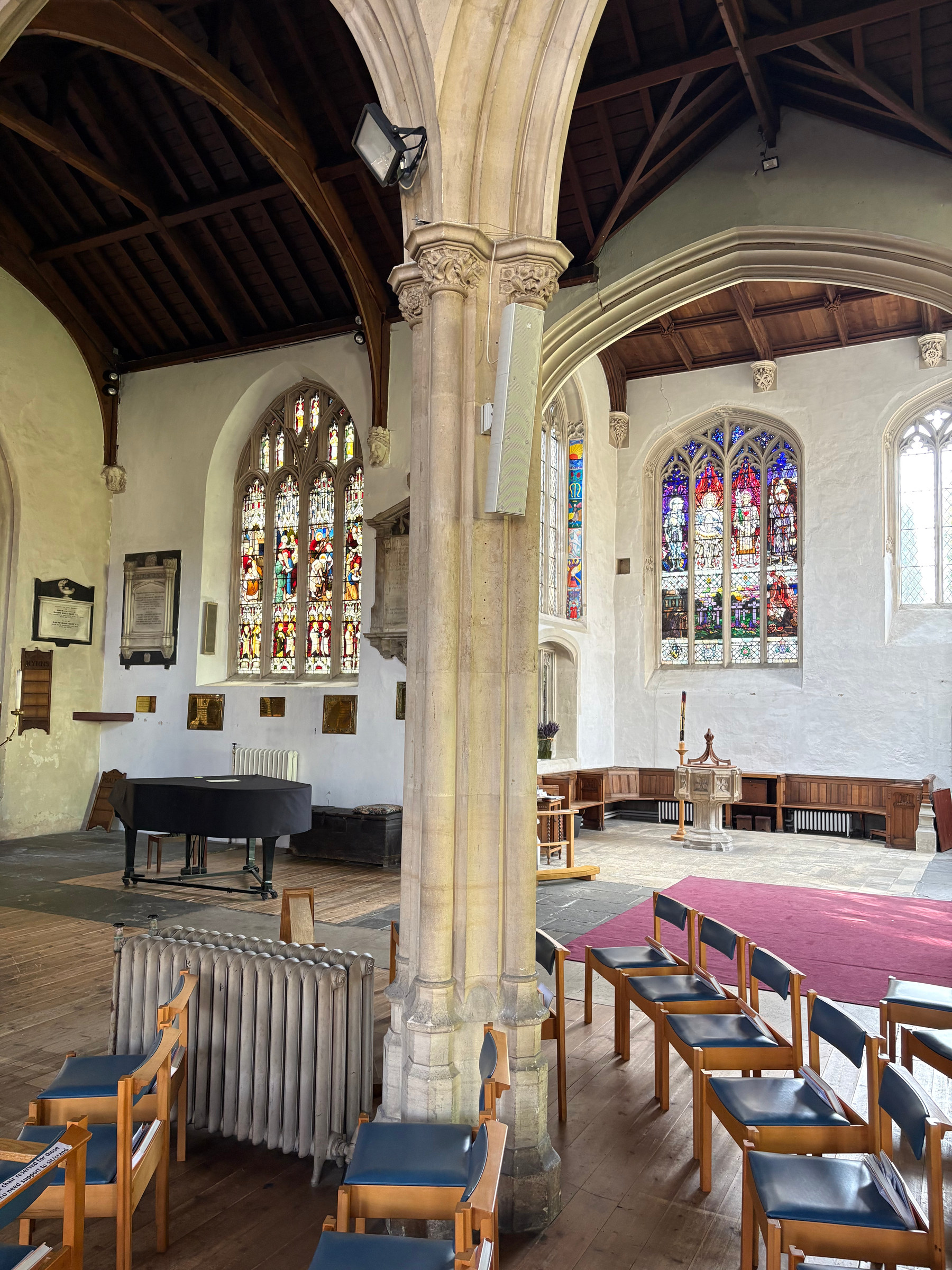
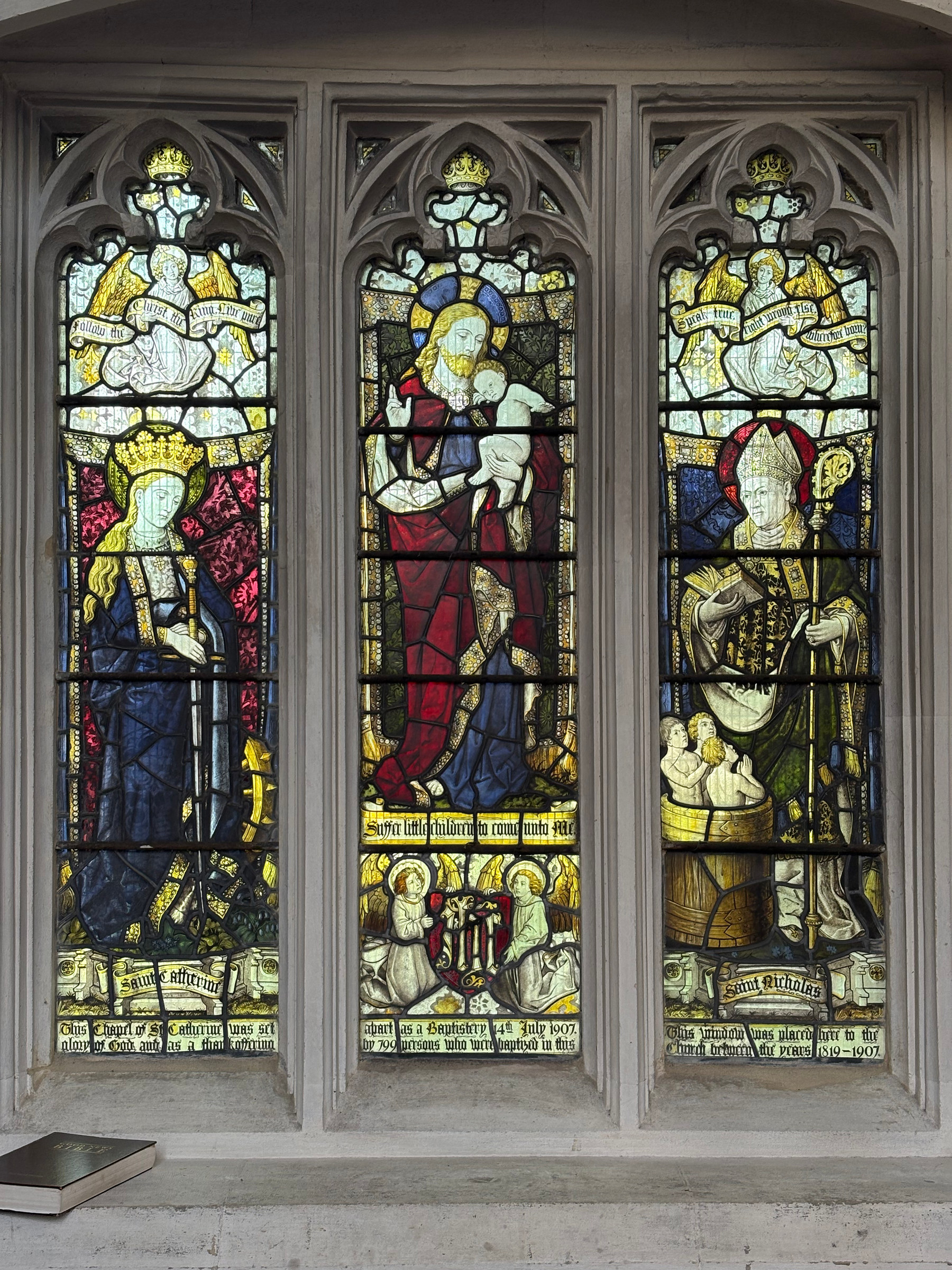
John Burlison and Thomas Grylls had trained under Clayton and Bell before setting up their own studio in 1868, and their glass is known for its restrained colour and careful late Gothic drawing. Their first window at Chippenham, of 1882, stands in the north aisle beside the organ: St Matthew stands among angels, with the four corporal works of mercy, feeding the hungry, giving drink to the thirsty, clothing the naked and visiting the sick, set out in small scenes. Twenty-five years later, when the south nave chapel was refurbished as a baptistry in 1907, the firm returned to glaze its east window. A crowned St Katherine of Alexandria and St Nicholas, patron saint of children, flank a central figure of Christ with children, a fitting subject above the font.
Lavers and Westlake
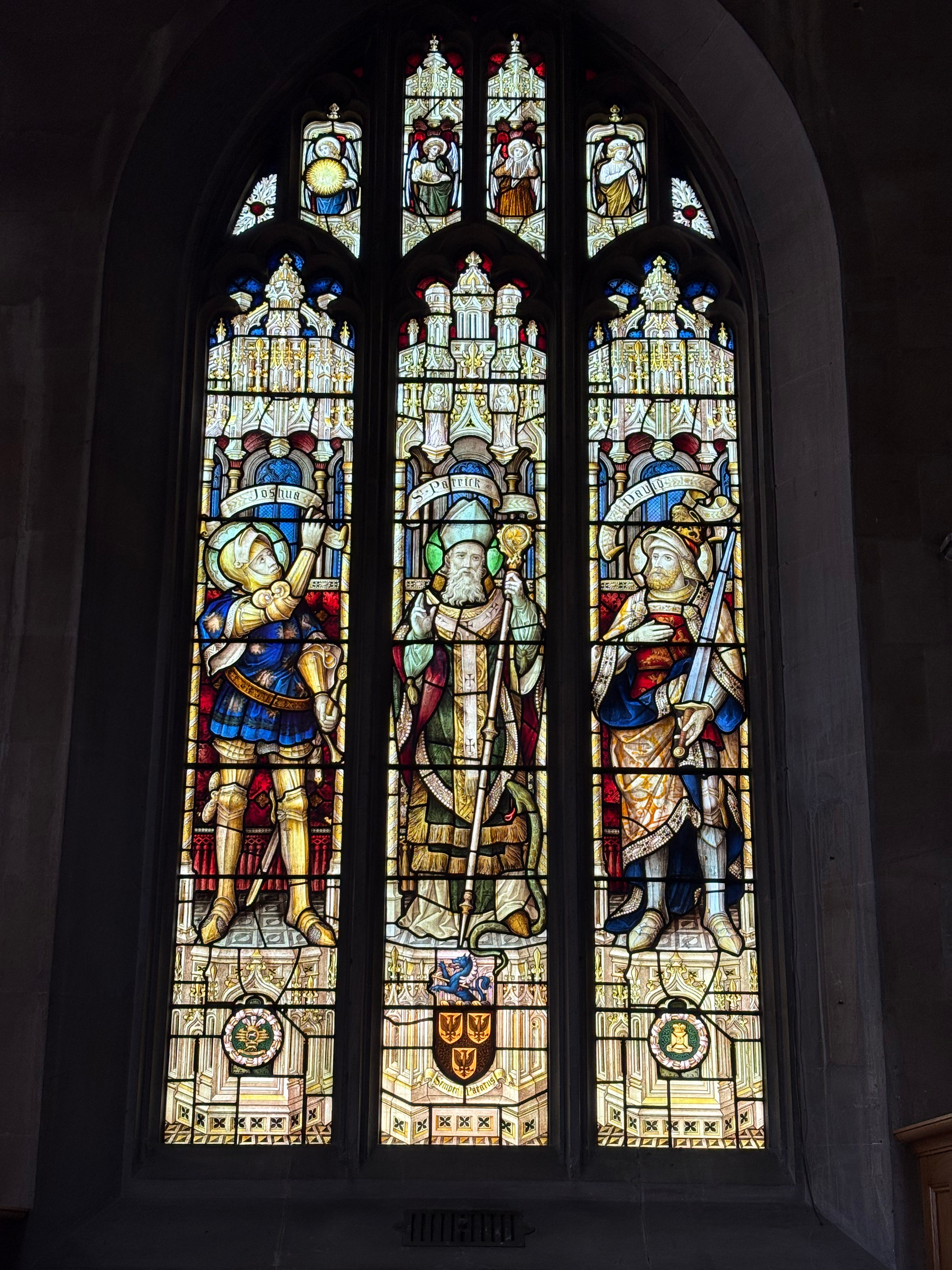
The largest group of windows is by Lavers and Westlake, the firm founded by Nathaniel Lavers and later directed by the designer and writer Nathaniel Westlake, one of the most prolific church glass studios of the period. Their Jesse window in the east of the Lady Chapel, of 1900, sets out the ancestry of Christ as a spreading vine rising from the root of Jesse, a subject explained in how to read a church window. In the same year the firm supplied a north aisle window of Joshua, St Patrick and King David.
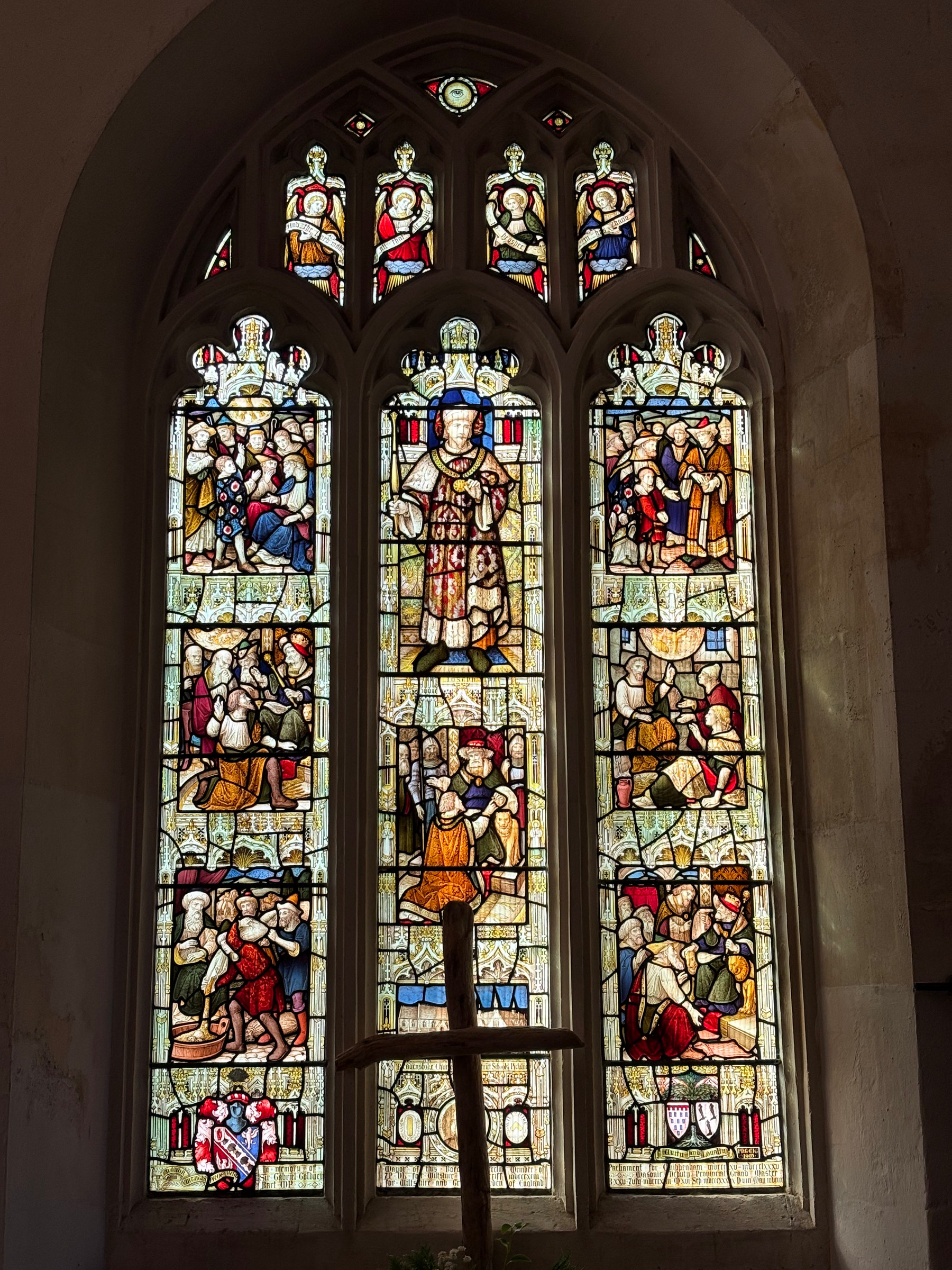
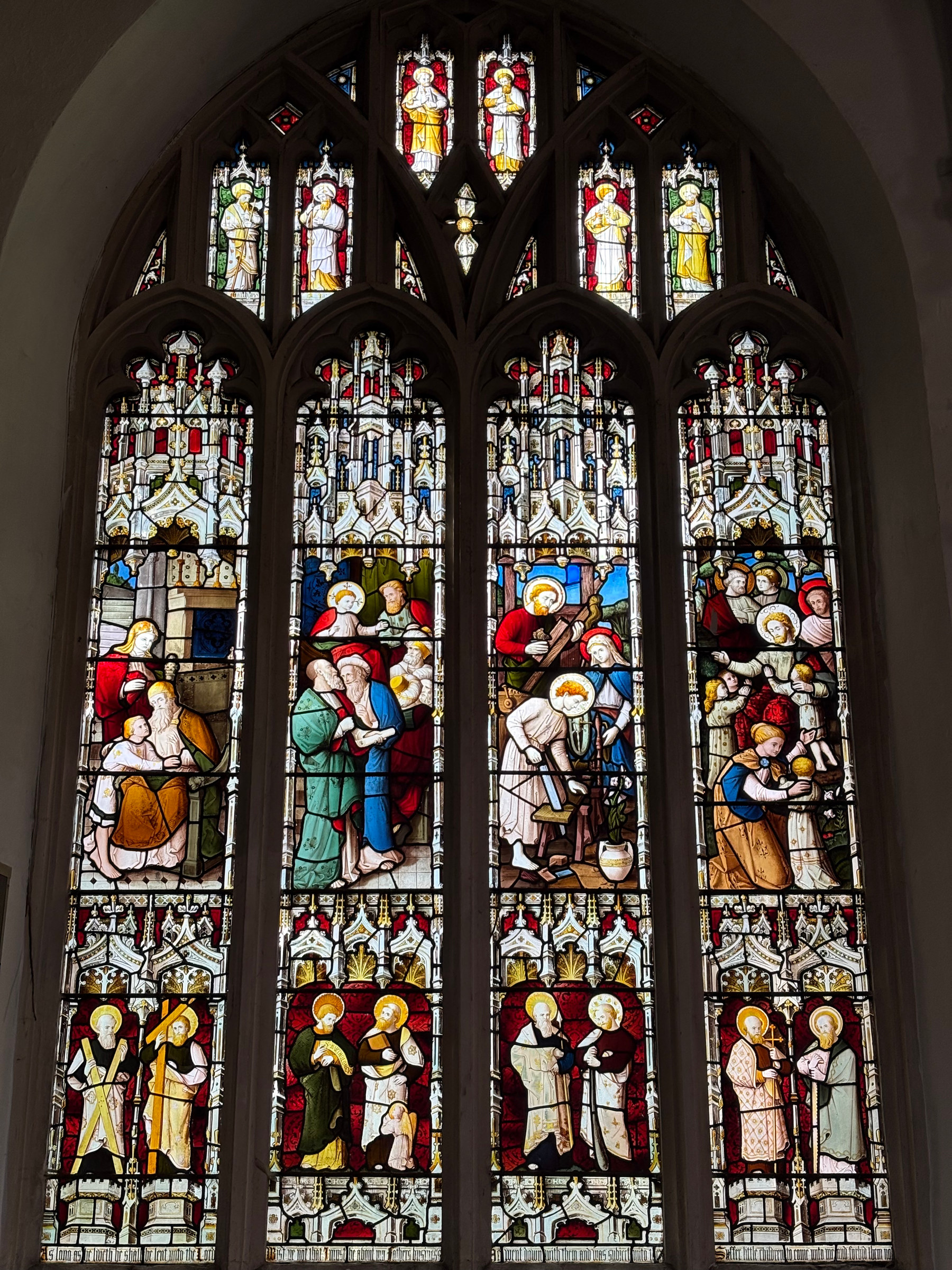
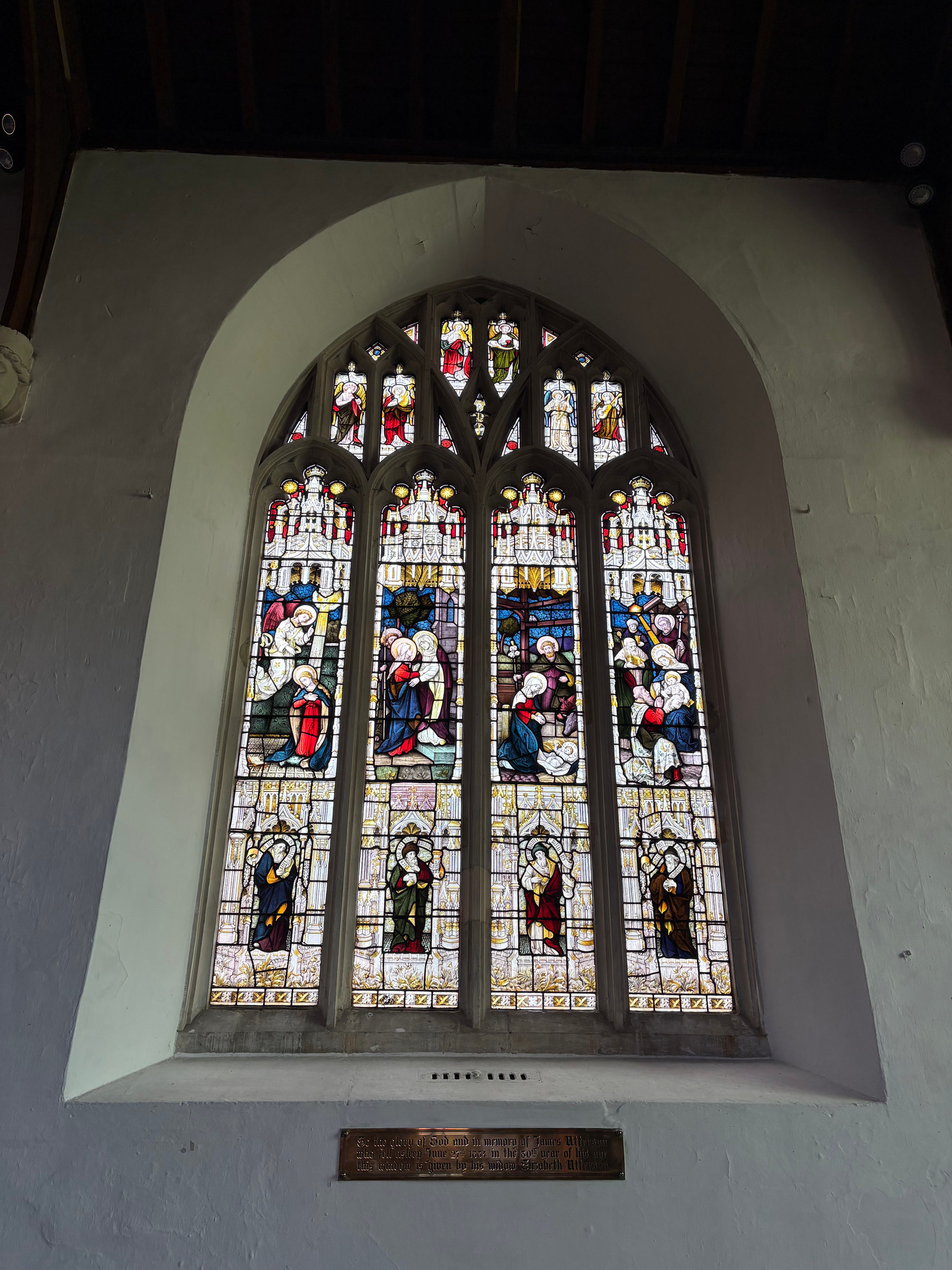
Its most personal window at St Andrew’s is in the south wall of the chancel, dated 1903, in memory of Sir Gabriel Goldney, baronet, Member of Parliament for Chippenham from 1865 to 1885. The main lights tell the Old Testament story of Joseph and his brothers, but the small panels beneath show two local buildings associated with him: the church at Bradenstoke and the Pickwick District School. Two further Lavers and Westlake windows light the south aisle. One, a memorial with a brass plaque beneath it, shows the Annunciation, the Visitation, the Nativity and the Adoration of the Magi, with prophets holding scrolls below; the other shows the young Samuel dedicated in the Temple and scenes from the childhood of Christ, including Christ disputing with the doctors, working in St Joseph’s workshop and blessing children.
Christopher Whall and the Wilson window
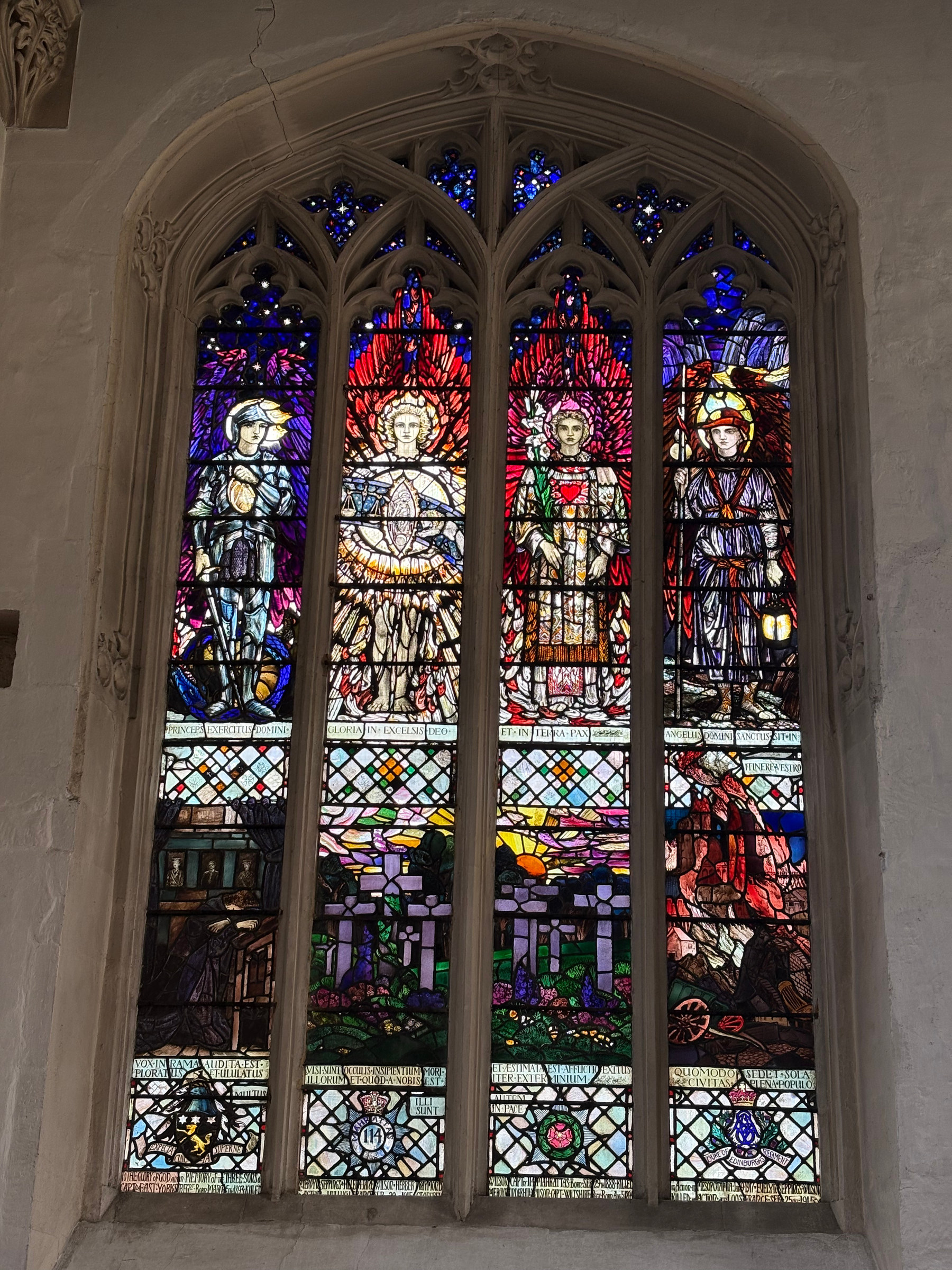
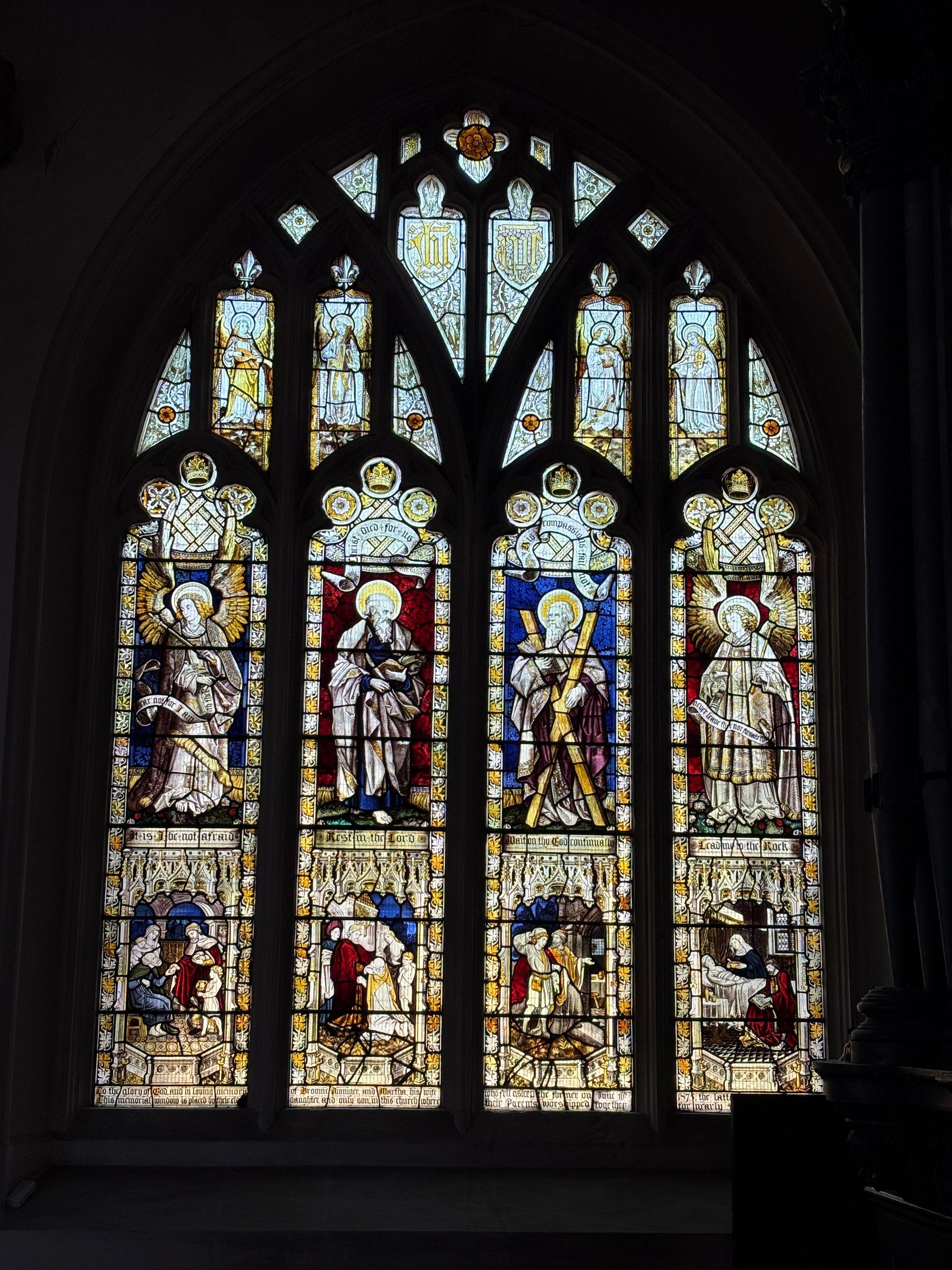
The most moving window in the church is in the south wall of the baptistry. It was created by Christopher Whall, the leading Arts and Crafts stained glass artist, in memory of the three sons of Dr Mervyn Seppings Wilson and his wife Helen Jane, all killed in the First World War. Evelyn Seppings Wilson of the East Yorkshire Regiment died at Hulluch in February 1915; Captain Geoffrey Mervyn Underhill Wilson of the Wiltshire Regiment was killed at Loos that September; and Captain Herbert Raymond Wilson of the 114th Mahrattas fell in Mesopotamia in January 1917. Four archangels in deep reds and blues minister to the sorrowful, while the lower panels show the landscape of war, with rows of crosses, and the badges of the brothers’ regiments. The contrast with the Victorian windows around it, in its colour and its expressive drawing, shows how far Whall had moved the craft. The parish also remembered its dead with a carved chancel screen of 1921, designed by F. E. Howard of Oxford.
A window still to be identified
One window is not described in the church’s published history. Three tall lights hold two armoured saints and a mitred bishop beneath gabled canopies; the centre light carries a shield of three black eagles on gold under a blue crest, with the motto Semper Paratus, and the outer lights carry regimental badges within wreaths. The heraldry and badges mark it as a family and military memorial of the early twentieth century, but its maker and the person it commemorates have not yet been confirmed.
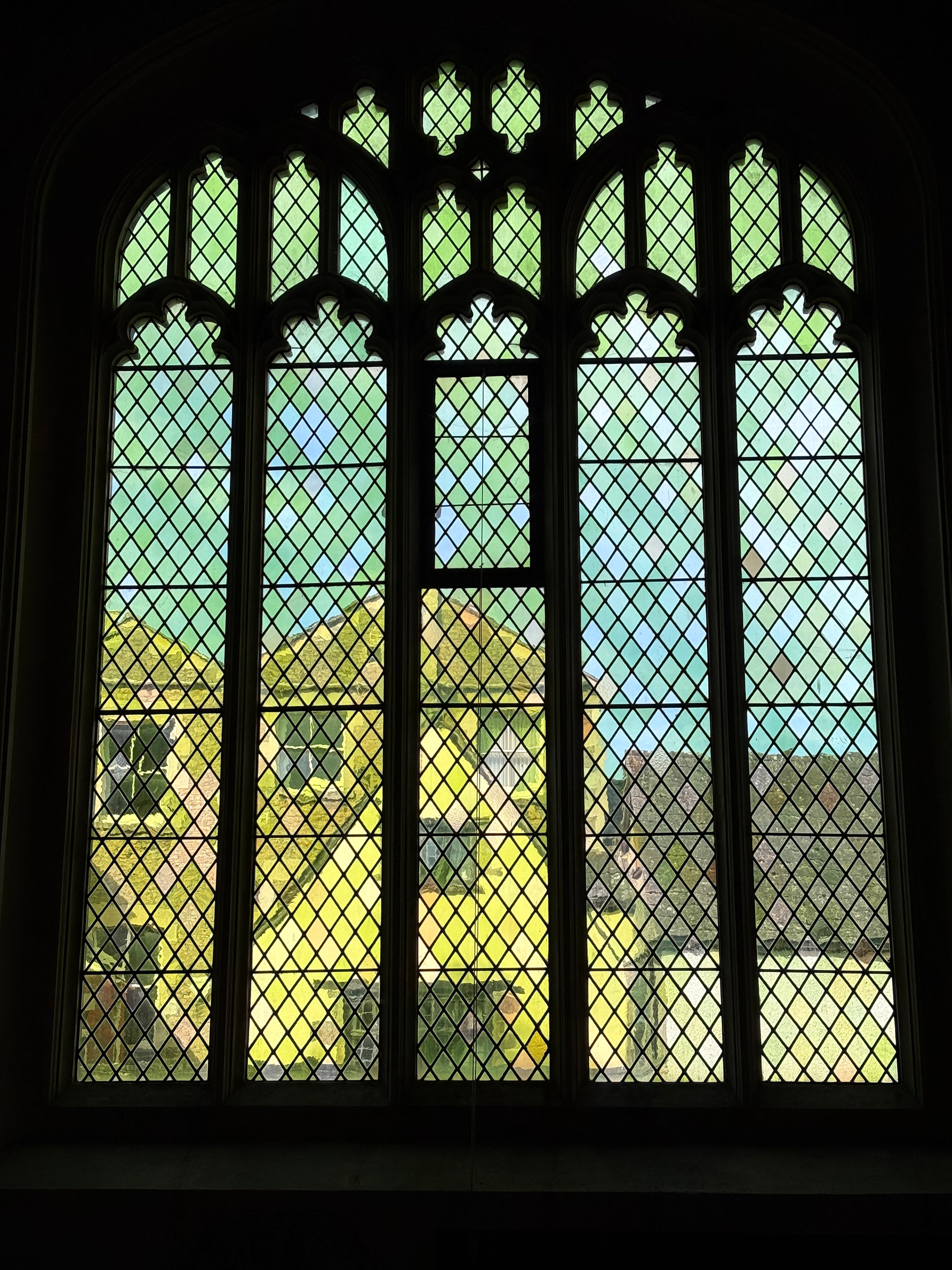
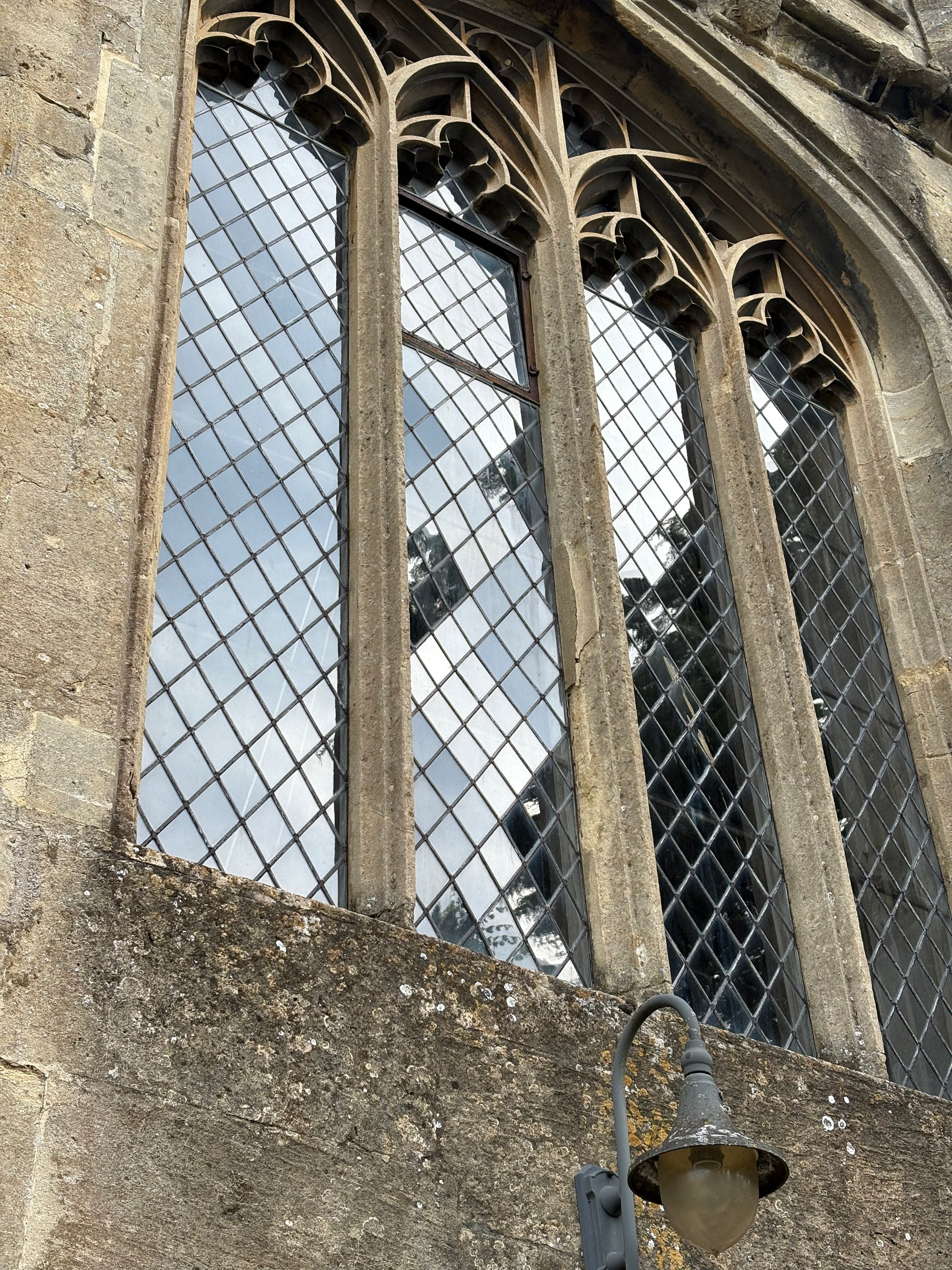
The records consulted do not give the cost of any individual window. The clear leaded lights with diamond quarries in other windows show how much of the church would have looked before the memorial glass arrived. Further information about the firms named here is given in famous British stained glass workshops and makers.
Windows
The church inside
Baptistry
Chancel and Lady Chapel
Aisle windows
Outside
In the same area
See all ecclesiastical stained glass photographs, or read about how ecclesiastical stained glass is made and dated. To interpret the figures, saints and symbols in these windows, see how to read a church window.
Sources
- Historic England: Church of St Andrew, Chippenham, list entry 1268018
- St Andrew’s Church, Chippenham: published church history (windows, makers and dates)
- War Memorials Online: St Andrew’s Church, Wilson family window
- Wiltshire Community History: Church of St Andrew, Chippenham
Published 16 October 2026 · Last updated