The Red Lion, Duke of York Street: Victorian etched, cut and gold glass
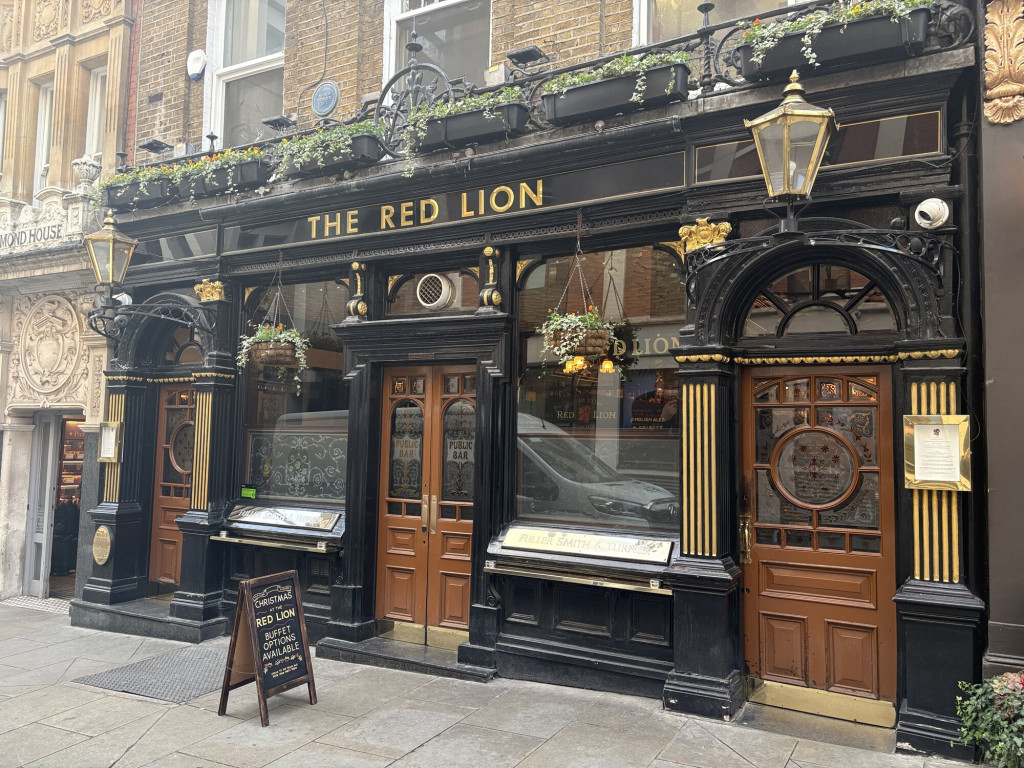
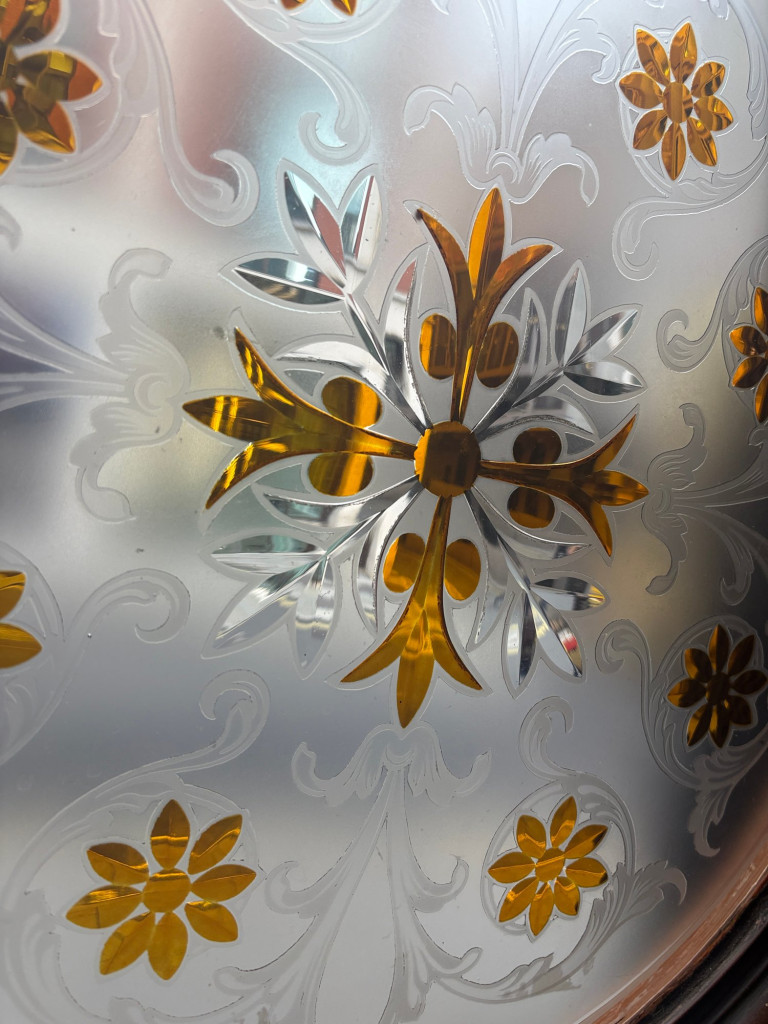
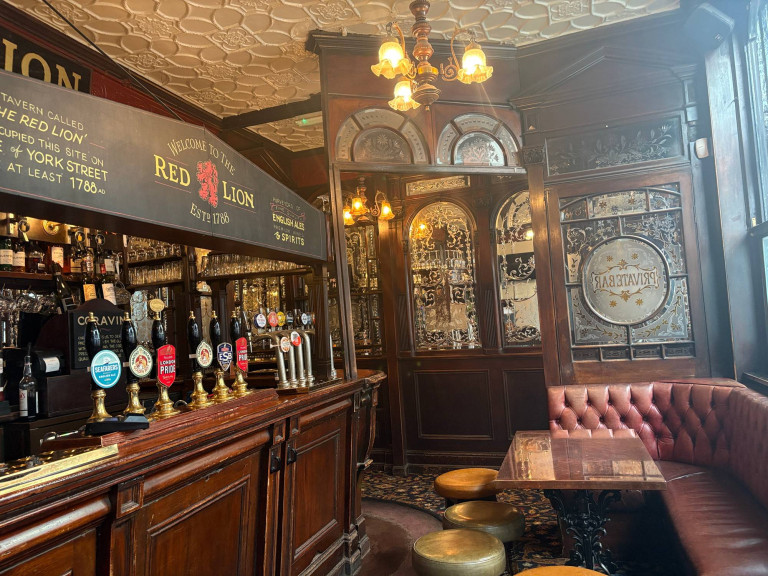
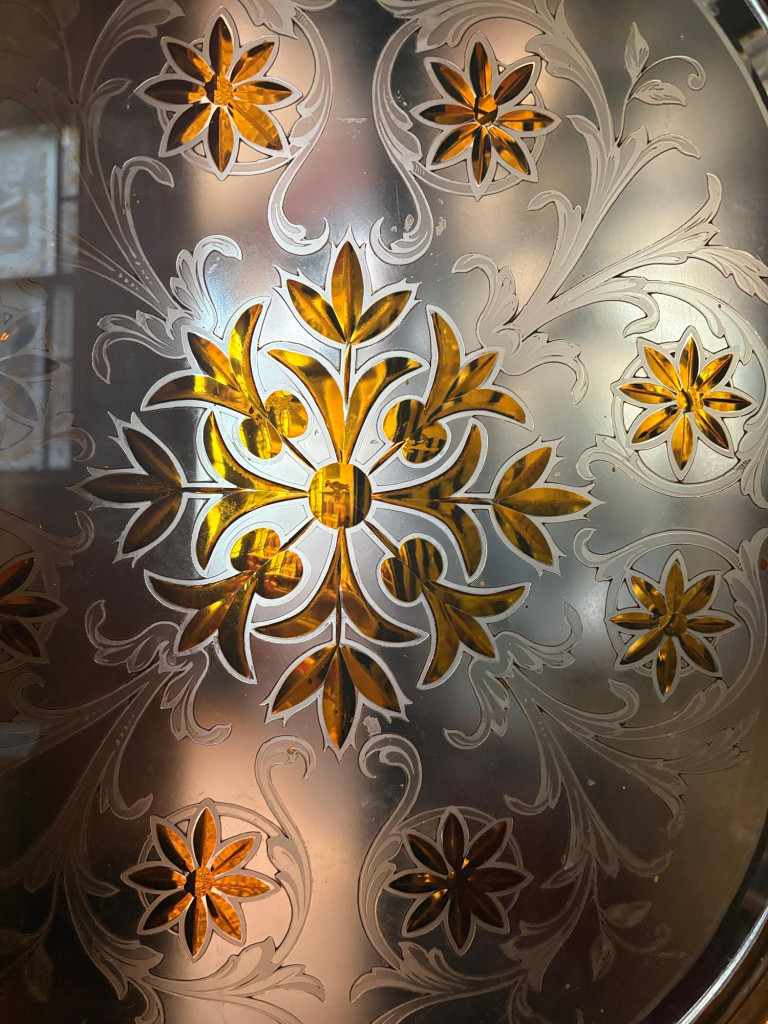
The Red Lion on Duke of York Street, St James’s, with its mahogany front and etched glass windows and doors. Inset: a gold floral roundel from the circular screen inside.
Visited and photographed by stainedglass.co.uk on 9 November 2026.
The Red Lion and its glass
The Red Lion stands at 2 Duke of York Street, a short street running south from Jermyn Street towards St James’s Square in the West End of London. Behind a carved timber front, a compact interior arranged around a central servery holds an unusual quantity of decorative glass: acid etched door panels lettered in gold, a circular light, frosted window panels and whole walls of brilliant cut and etched mirrors in mahogany frames. Historic England lists the building at Grade II, and CAMRA’s national inventory of historic pub interiors places it in the top, three-star category, reserved for interiors of exceptional national importance. Historic England describes it as a relatively rare survival of a late nineteenth-century pub decorated in the gin-palace manner, and much of its decorative glass is still in its original location.
From Georgian house to late Victorian pub
A public house called the Red Lion occupied part of the site by 1788. The Survey of London records that in December 1820 a victualler named Henry Watts took a 36-year lease of two houses here, undertaking to replace them with a single new house worth at least £1,000; the ratebooks show the rebuilding in 1821. That building survives above the ground floor as a plain front of yellow stock brick, with two tiers of three windows and a mansard roof lit by round-headed dormers.
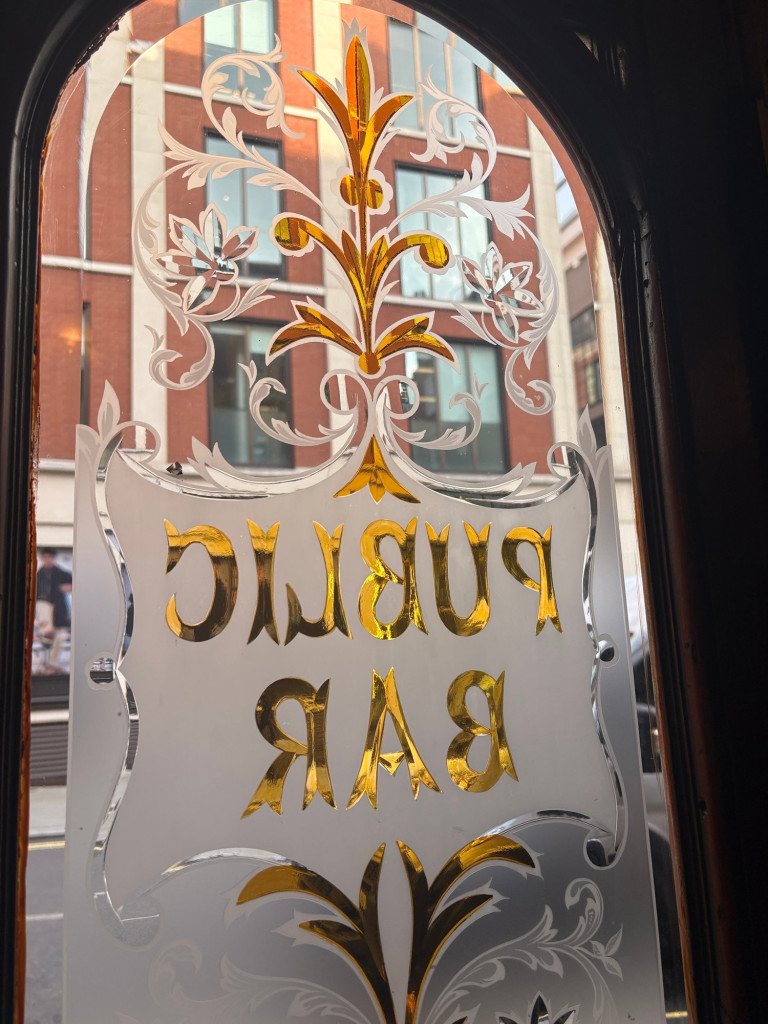
The ground floor was transformed in 1871, when the architect W. H. Rawlings gave the pub a new five-bay frontage with three doorways, Corinthian pilasters and an ornate iron railing above the fascia. Separate entrances served separate rooms, each with its own price and clientele, all supplied from a shared servery, and the lettering that survives in the door glass records that arrangement.
The phrase “gin palace” goes back to the London spirit shops of the late 1820s and 1830s, such as Thompson and Fearon’s on Holborn Hill, remodelled by John Buonarotti Papworth around 1829–30. Historic England notes that the term later attached itself loosely to any lavishly fitted pub, with the look of mahogany, mirrors, screens and frosted glass belonging chiefly to the decades either side of 1900. Cheaper glass made that look possible: the excise duty on glass was abolished in 1845 and the window tax in 1851, as the history of window glass explains.
The freehold passed to Meux’s Brewery in 1907. The building was first listed on 14 January 1970, and the list entry was revised in June 2022, singling out the mirrors among the fittings that justify the listing.
Door panels, lettering and the circular light
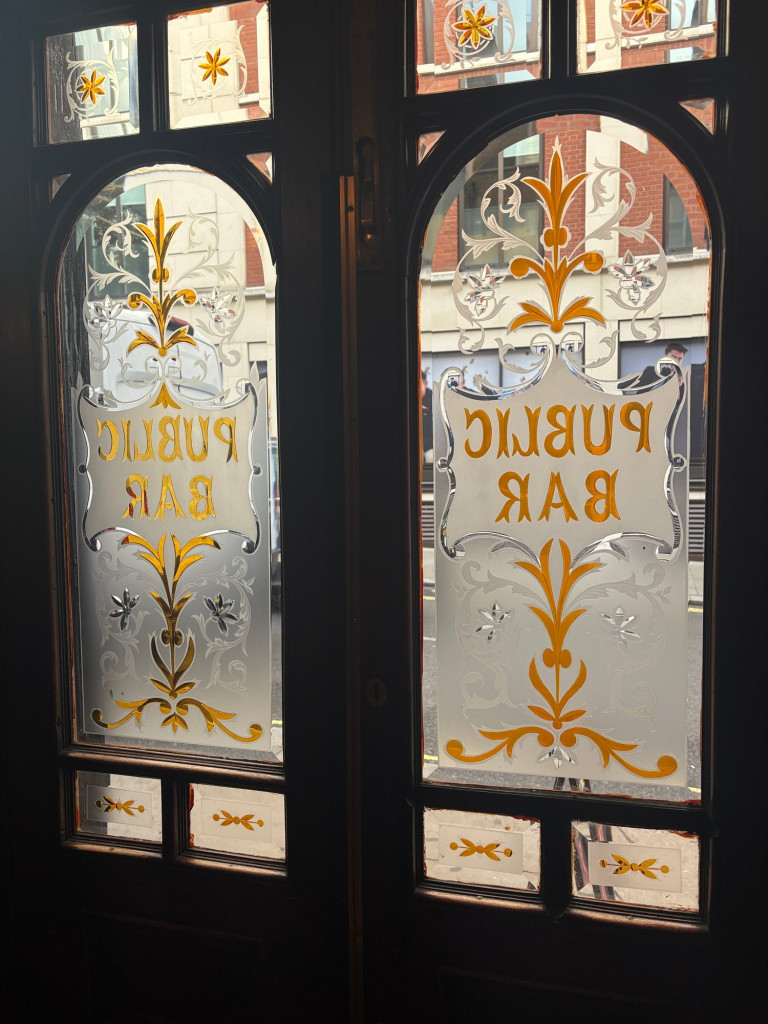
The pair of half-glazed doors lettered PUBLIC BAR each has a tall arched panel of frosted glass in which the two words sit inside a cartouche of cut scrolls, with a gold foliage stem rising above the lettering and a smaller spray below it. Small lights at the foot and head of each door repeat gold star flowers. Seen from inside, the letters read in reverse: they were designed for the pavement.
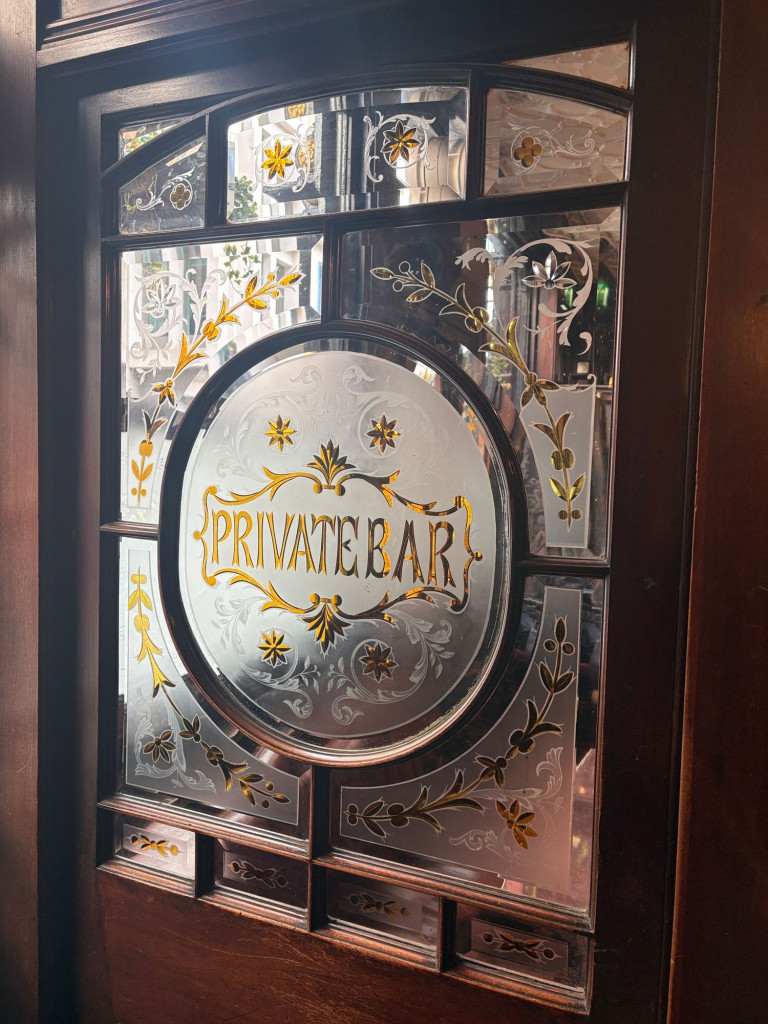
Beside the right-hand entrance, a surviving section of partition holds a large frosted sheet with an oval panel lettered PRIVATE BAR. The letters are tall and narrow, set in gold within a scrolled cartouche, with fan-shaped gold palmettes above and below and small gold star flowers in the surrounding frosted field. Clear cut scrollwork fills the rest of the sheet.
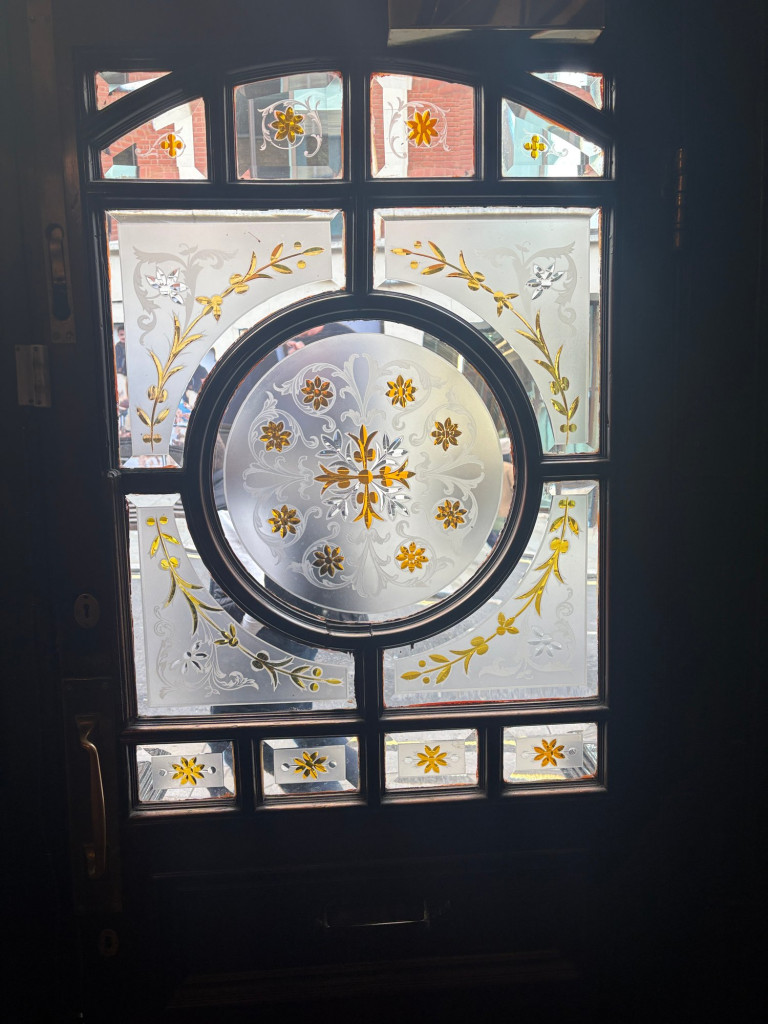
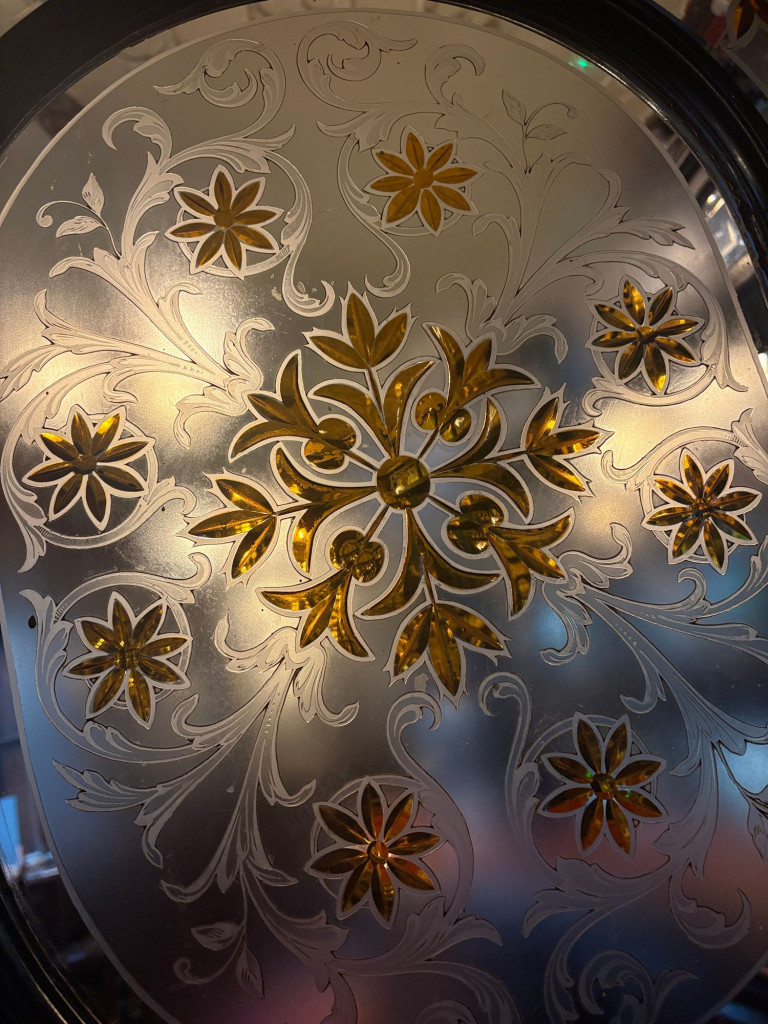
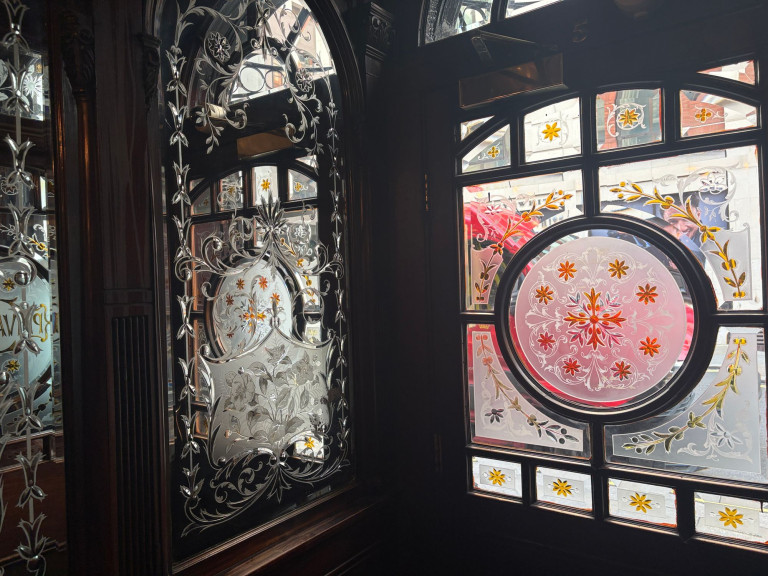
Another glazed door or screen frames a circular light. At its centre is a cross-shaped flower whose broad petals are gold and whose narrower petals are silvered and mirror-bright, ringed by eight star flowers, most of them gold, one tinted red and two partly silvered, on an etched ground of leafy scrolls. The four panels around the circle carry gold sprays of leaves and berries.
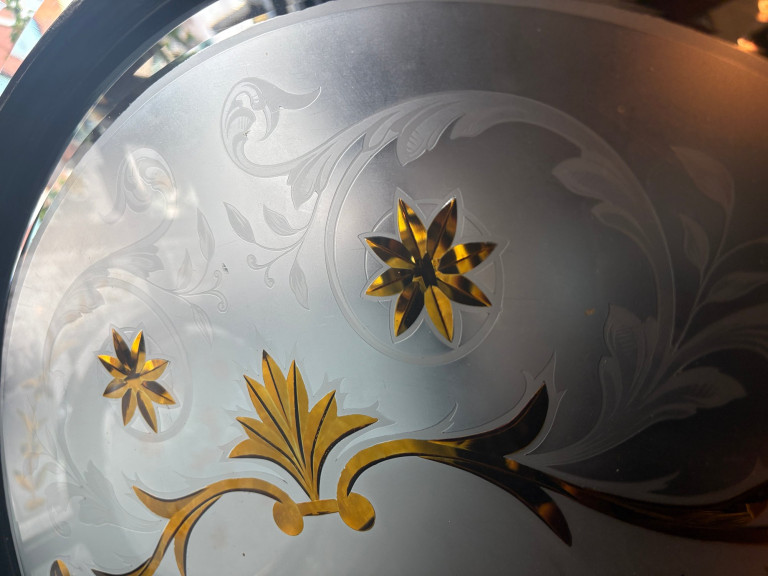
An oval panel in a further door or screen is worked in the same manner: a gold and silver centre flower, a ring of gold star flowers and acanthus scrolls etched into the frosted ground, finished with a brilliant cut edge that follows the curve of the oval.
Mirrors and screens
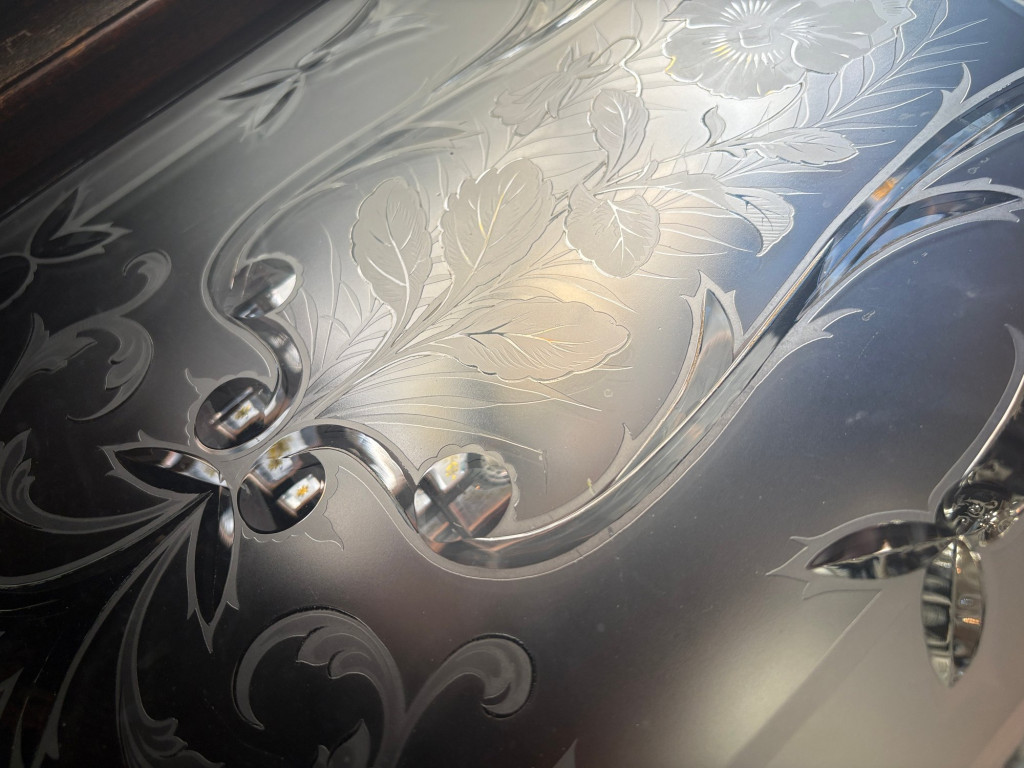
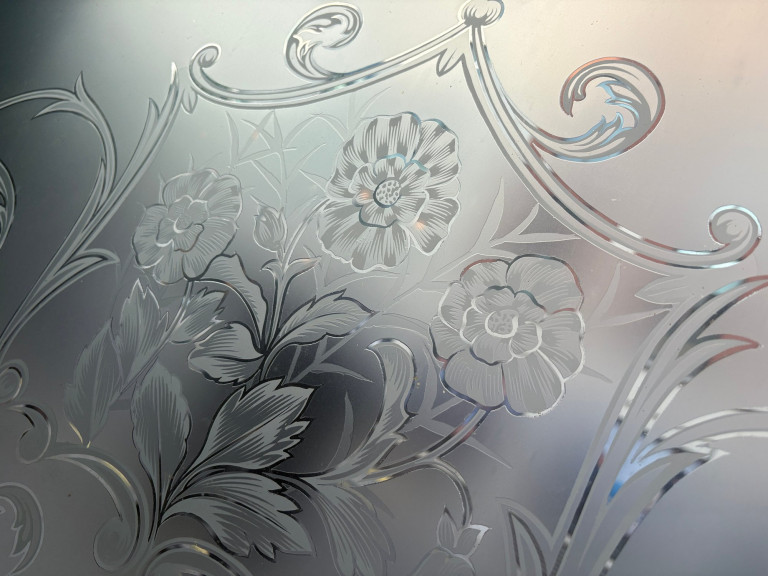
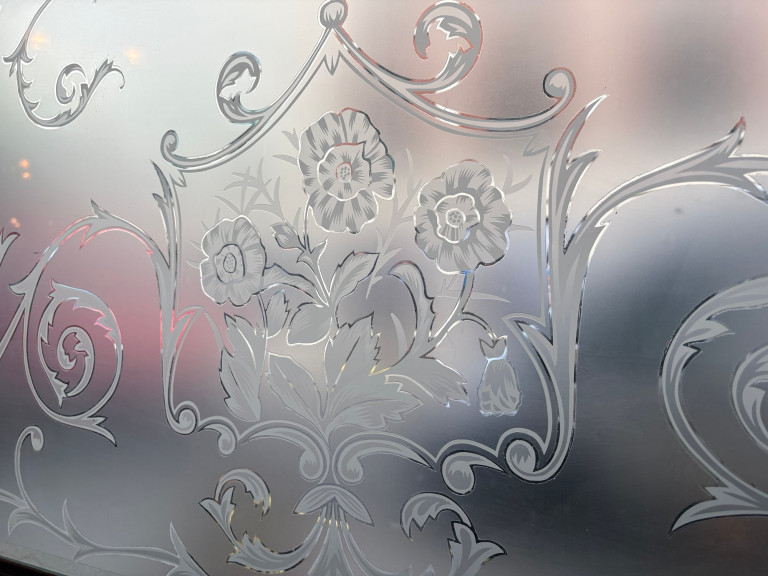
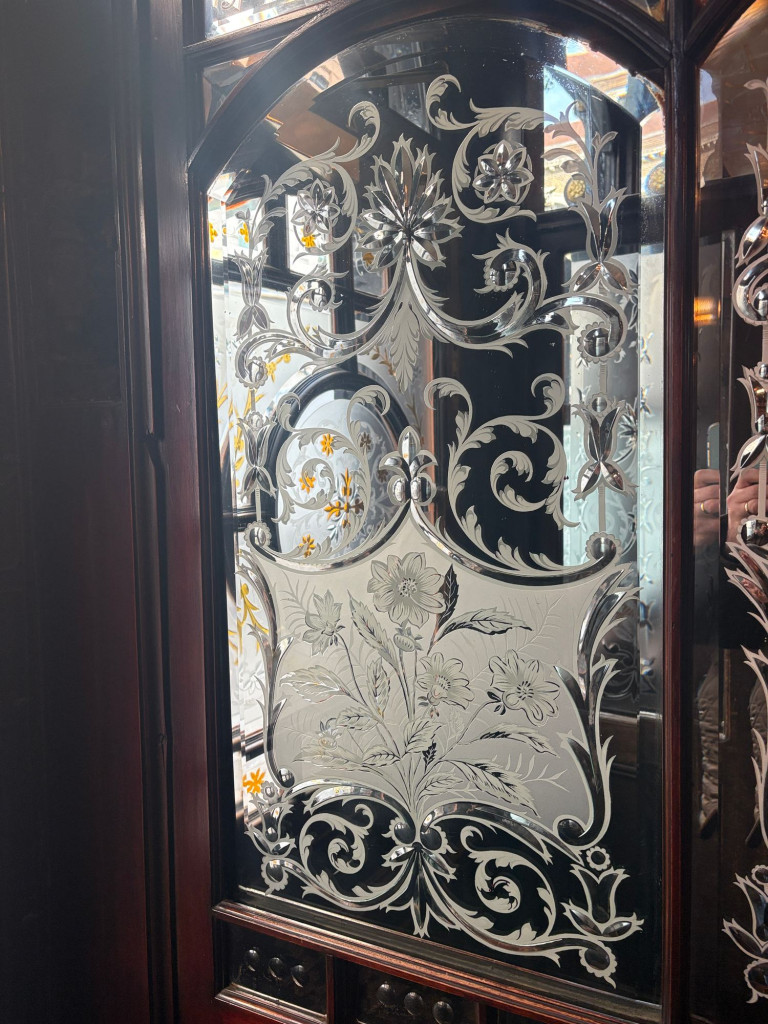
The finest glass lines the walls. On the bar back, etched and cut mirrors sit in mahogany surrounds carved with Corinthian pilasters and keystones. In the rear room the mirrors are set in arched mahogany surrounds carved with pilasters, above drinking counters and fielded panelling. Four tall arched bays stand in a row, each with a silvered plate on which cut and etched foliage climbs around a shield-shaped cartouche holding a spray of flowers. Narrow bevelled strips set with rows of small round hollow cuts divide the bays.
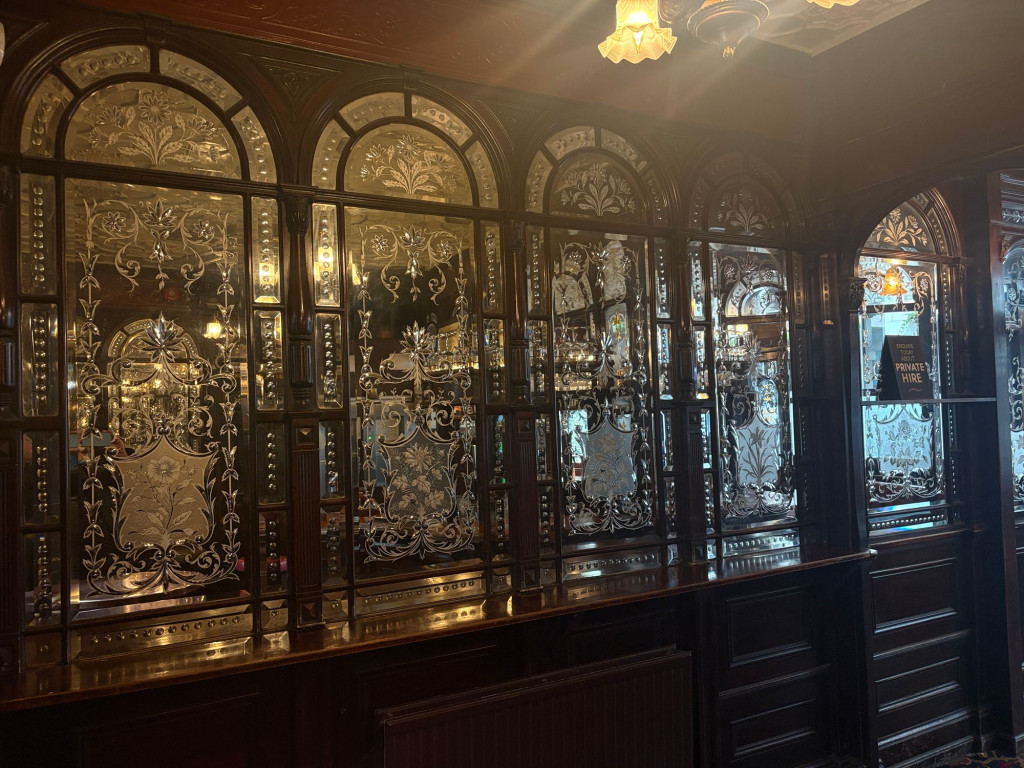
Across each panel, clear reflection, sparkle and soft white frosting alternate. CAMRA also records six etched panels with gold-tinted inlay along the top of the bar back, and one original connecting door with coloured patterned glass. Above it all is a dark brown ceiling of embossed relief decoration.
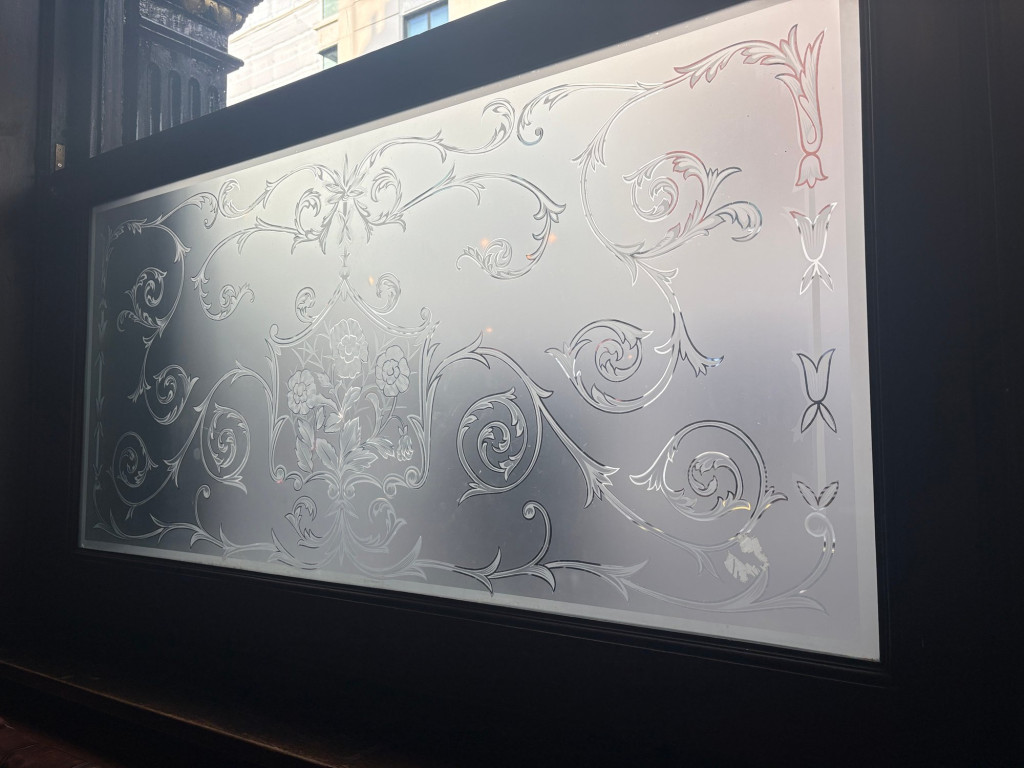
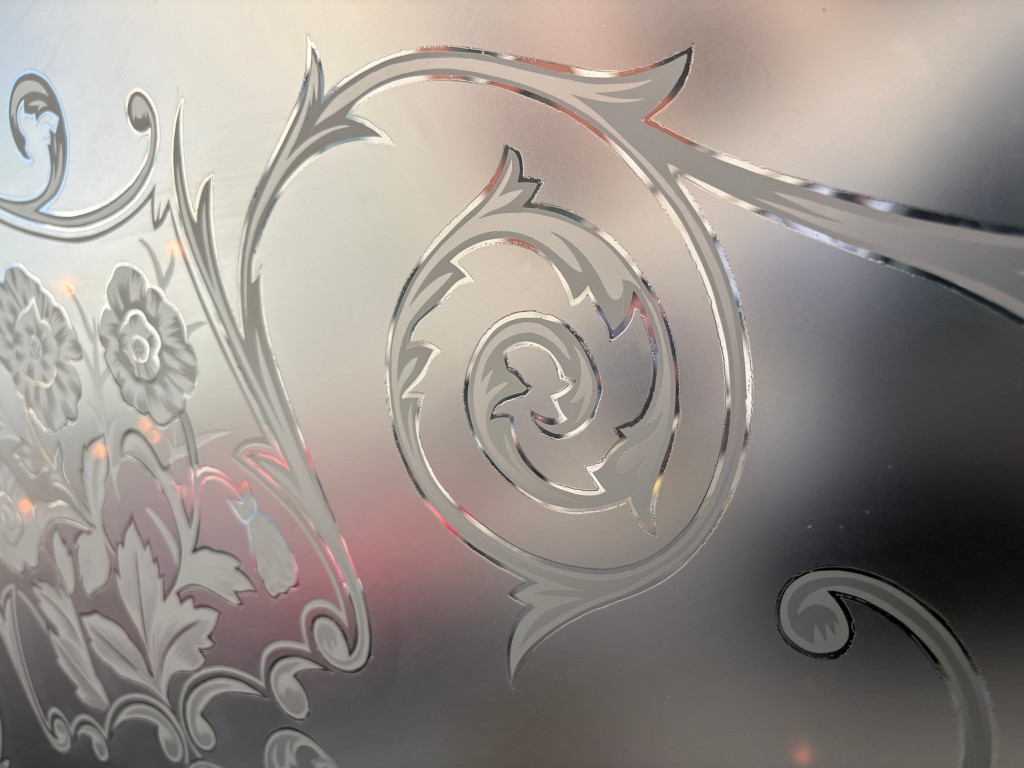
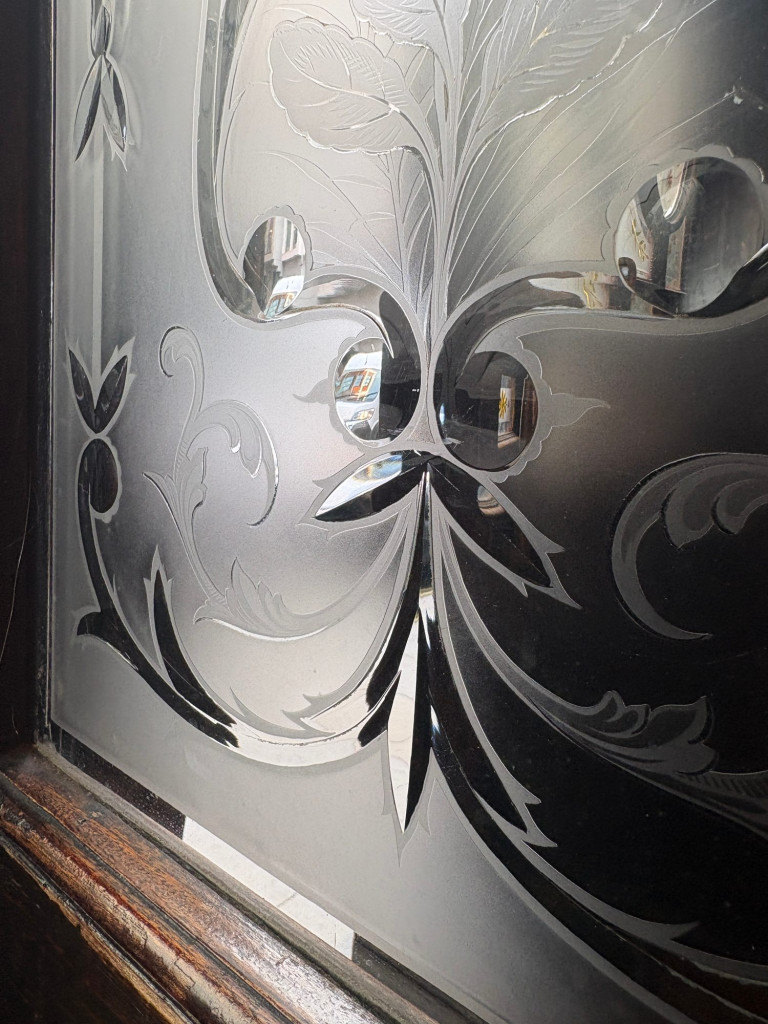
Lower in the windows, frosted panels screen the room from the street. Their designs are drawn in clear outline on a white ground: acanthus scrolls curl outwards from a central spray of roses set beneath a pointed canopy, and a border of stylised buds runs down each side. Other frosted panels carry single brilliant cut motifs, among them a fan flower of narrow radiating petals at the head of an etched stem, and a fleur-de-lis whose lobes are cut as round, polished hollows.
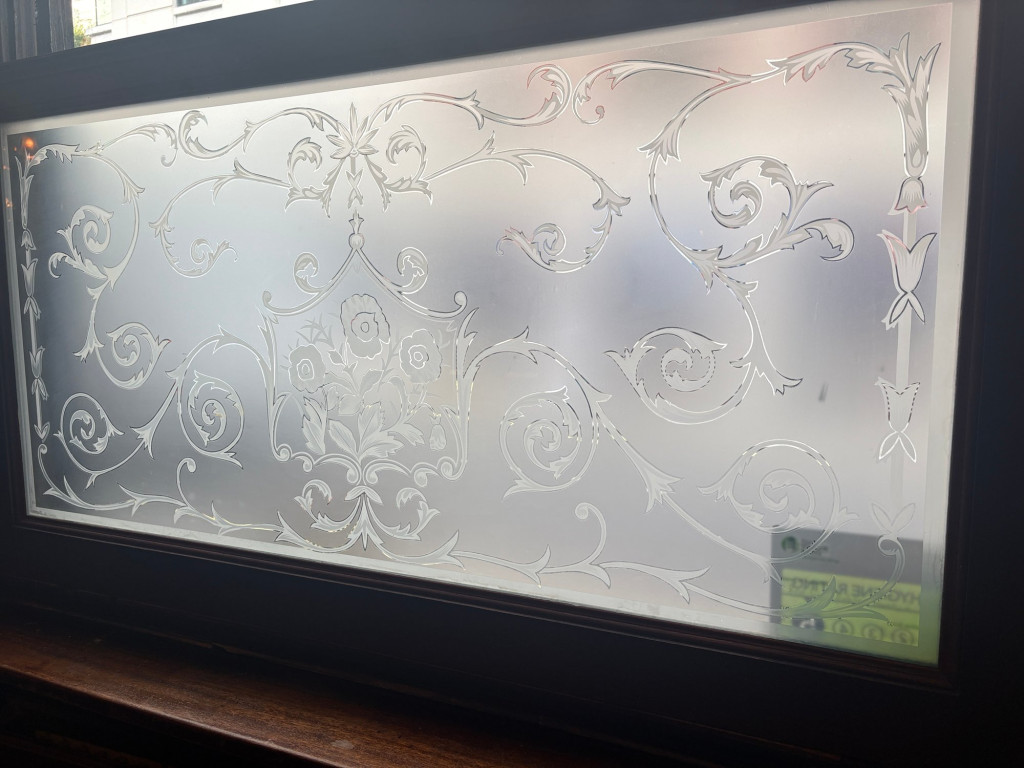
The glass had practical work to do. Mirrors multiplied the light of gas fittings and made a small room appear larger, while frosted and etched panels gave drinkers privacy from the street and from the other bars. The guide to decorative glass for pubs, shops and restaurants sets these functions in context.
How the glass was produced
Brilliant cutting was introduced to Britain in the 1850s by Mark Bowden of Bristol. The cutter worked against wet sandstone wheels of different profiles: rounded edges produced shallow hollows, flat edges cut lines and leaf shapes, and mitred edges produced V-shaped grooves. Each cut was then smoothed with wooden wheels and pumice and polished with brushes and rouge, which is why the cuts catch the light so sharply. Both main profiles are easy to recognise here: the fan flower is built from narrow V-grooves, the fleur-de-lis and the strips between the mirrors from round hollows.
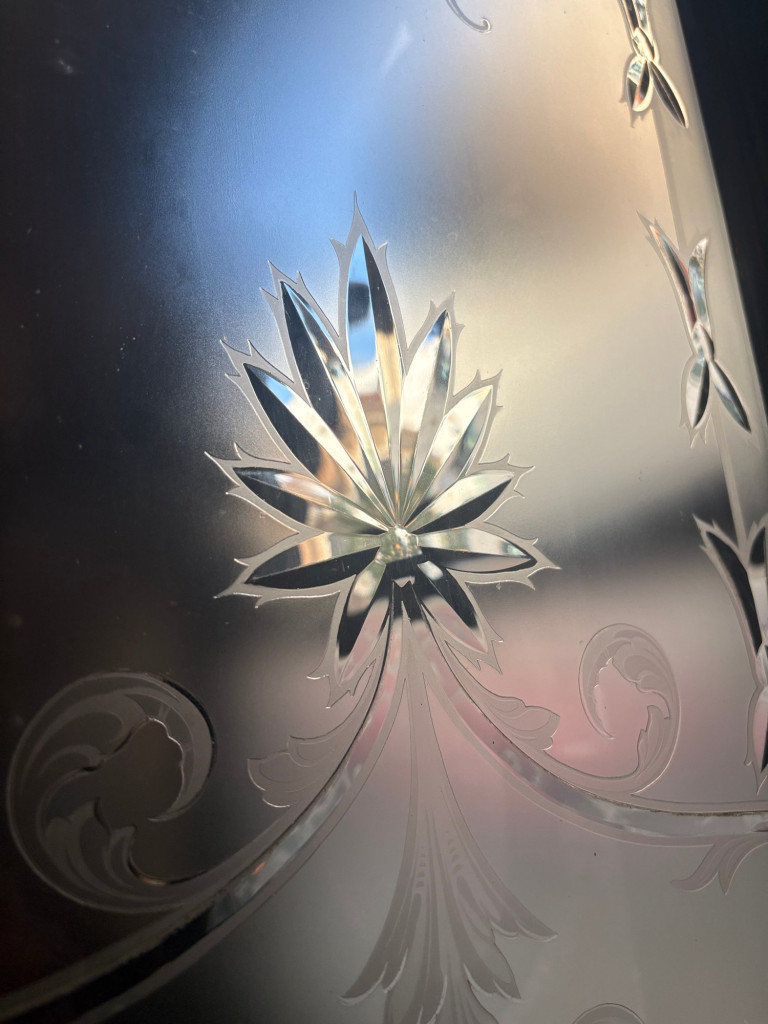
The frosted grounds were usually created by abrasion or by acid etching, using hydrofluoric acid with a resist protecting the areas to be kept clear. “White acid”, hydrofluoric acid mixed with an alkali, gave a dense white frost, and further stages in dilute acid added satin half-tones; this method, known as French embossing, became widespread in the late nineteenth century and was often combined with cutting. The Red Lion panels show the result: an even white ground, softer tones within leaves and petals, and clear polished outlines. Designs were sometimes gilded, and many finished sheets were silvered over the whole surface to become mirrors. The Red Lion glass combines cutting, etching, gold colouring and silvering in a single scheme.
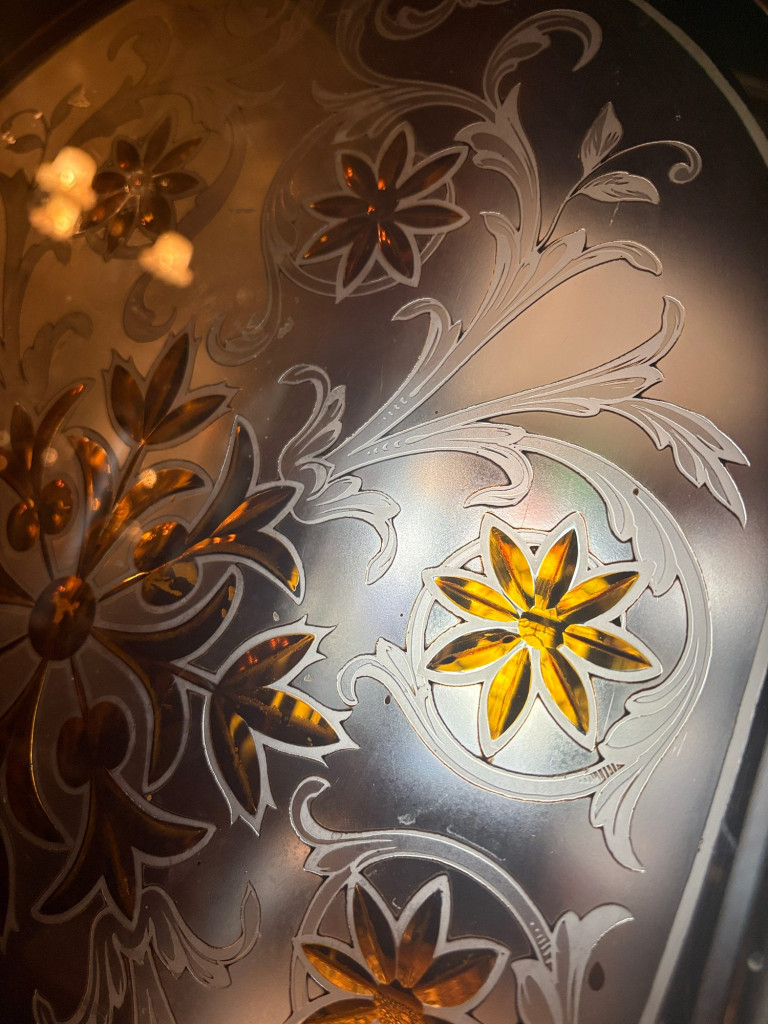
The gold needs careful description. In reflected light the lettering and flowers read as polished gold, but against daylight the same shapes glow a translucent amber, and the sprays around the circular light have faded unevenly to a paler yellow. Opaque gold leaf would block most of the daylight, and the colour stops at the edge of each shape, leaving the sheet clear around it. The gold therefore appears to be a transparent yellow or amber colouring laid into the cut shapes, with silvering behind some petals, which look dark against the light while the gold petals stay bright. No source consulted records the method used here, and only close examination by a conservator could confirm it. The short histories of brilliant cut and bevelled glass and acid etched glass and the timeline of decorative glass follow both crafts further.
Attribution, wartime and later changes
No signed panel or record of the commission has been found. The Historic England list entry attributes the mirrors, with some hesitation, to Walter Gibbs and Sons of Blackfriars; it spells the name in two ways and gives the attribution more firmly in its summary than in its history. A painted history board in the pub states that much of the glass is believed to be by Walter Gibb and Sons of Blackfriars. Neither CAMRA nor the Survey of London names a maker, so the attribution remains likely rather than proven.
The firm itself is well recorded. Walter Gibbs set up his own business in 1868 on Blackfriars Road, and in the 1870s it advertised embossed glass signs and show-boards. The business later combined with an older Blackfriars glass firm, and Walter Gibbs died in 1891, according to one account. The same firm is credited with the coloured and patterned windows at the Elgin in Ladbroke Grove, which give a useful point of comparison.
The date of the glass is also uncertain. The summary in the list entry associates the mirrors with the 1871 alterations, while its history section and the CAMRA description both say the fittings may be later; CAMRA considers the 1890s more likely, and the RIBA catalogue of a 1949 photograph of the saloon counter gives 1890.
The same history board states that the pub came through the Blitz entirely intact. The written record is less absolute: in October 1949 the Architectural Review held the Red Lion up as a model small Victorian gin palace but qualified the praise with a reference to bomb damage, and the Survey of London repeats that verdict. The district was certainly hit, and the Turkish bath at 76 Jermyn Street was destroyed in April 1941. No source consulted records what the damage at the Red Lion was or whether any glass was replaced, so the claim of intact survival cannot be confirmed.
Later changes are documented. Two connecting doors and most of the partitions that divided the front bar have been removed, although sections remain beside the side doors, and the gantry on the counter is a modern addition. Conservation guidance recommends recording decorated glass by photograph and rubbing before any work and leaving damaged panels to specialists; the pages on conservation and restoration and how to clean decorative glass cover this in more detail. The Red Lion glass also shows the range of cut and etched work that a new pub commission can draw on.
More of the glass
The photographs below show further details of the etched, cut and gilded glass throughout the pub, from the lettered door panels to the mirrors behind the bar.
All the photographs of the glass at the Red Lion are in the stainedglass.co.uk gallery.
Seeing the glass today
The frontage faces east onto Duke of York Street, so the lettered doors and frosted window panels face the street, as they were designed to. The mirrors are lit artificially and by daylight from the front windows. Photographs of the Red Lion glass appear in the photo gallery, and the guide to window styles by period helps place it among other Victorian work.
Every photograph of the glass at the Red Lion is in the stainedglass.co.uk gallery, with the details of each panel.
Sources and further reading
- Historic England: The Red Lion Public House, St James’s (list entry 1066873)
- CAMRA Real Heritage Pubs: Red Lion, Duke of York Street
- Survey of London, volumes 29 and 30: Duke of York Street (British History Online)
- Rodney Bender, Brilliant Glass, The Building Conservation Directory (1998)
- The Victorian Web: Walter Gibbs and the Gibbs firm
- RIBA Collections: the Red Lion saloon bar counter, photographed 1949