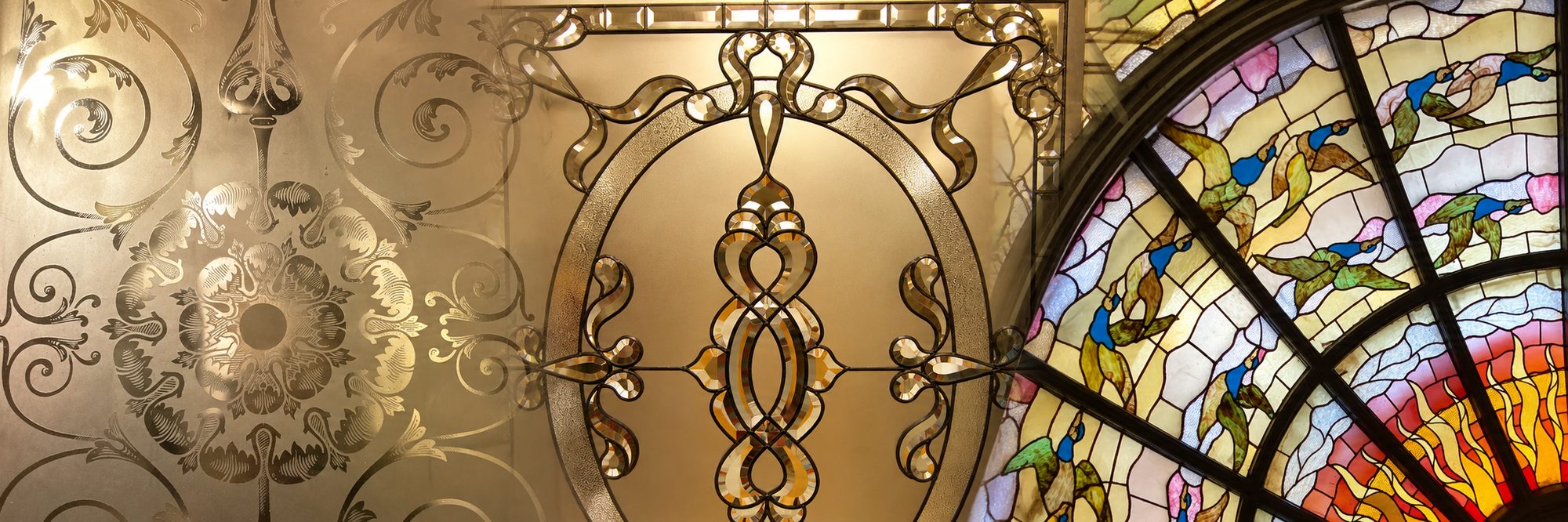

Brilliant cutting is the craft of cutting polished grooves into flat glass with rotating stone wheels. For about seventy years it was a standard form of decoration in British pubs, hotels, shops and grand houses. Today it is among the rarest glass skills in the country, and Heritage Crafts places it on its Red List of Endangered Crafts. This article traces how the trade grew, why demand fell and what remains of it. The cutting process itself is described on the Brilliant Cut Glass page linked above.
Wheel cutting before the flat glass trade
Cutting glass against a wet wheel is an old technique. For centuries it was used on drinking glasses, decanters and mirrors, where the wheel could be held against a small object. Applying the same method to large sheets of window glass was attempted only on a small scale until plate glass became affordable.
The 1850s: plate glass becomes affordable
Cast plate glass had been produced in England since 1773, but heavy taxation kept it expensive. The excise duty on glass was abolished in 1845 and the window tax in 1851, which opened a market for decorated flat glass. The background is covered in How Window Glass Was Made.
Brilliant cutting reached Britain in the 1850s, and the introduction is credited to Mark Bowden of Bristol. By the 1860s cut and acid etched glass appeared on shop fascias, advertising boards and the panels of tradesmen’s vans, as well as in the public houses and houses that became its main showcases.
The peak: 1870s to the First World War
Heritage Crafts dates the peak of the trade to about 1876 to 1920. Foot-treadle machines gave way to steam-driven lathes, which allowed deeper and more complex patterns to be cut. Stourbridge and London were major centres, and most towns of any size had cutters, gilders and sign writers working alongside one another. The Stourbridge Glass Museum page describes the glass heritage of the town.
Pubs were the greatest customers. The building boom of the 1890s produced numerous bars with etched and cut glass in doors, screens and mirrors, partly for decoration and partly for privacy, since the translucent panels let light in while keeping drinkers out of view from the street. In prestige houses windows combined etching, cutting and gilding, while smaller local pubs often had plain etched glass only. Cutting cost more than embossing, so it was usually reserved for the finest houses. The Crown Liquor Saloon in Belfast is a well-known surviving example.
Domestic interiors of the Victorian and Edwardian periods used the same techniques. Cut panels gave privacy while still diffusing daylight, often in restrained classical designs.
Gold in the cuts
Many surviving panels have a gold colour lying in the cut grooves, so that lettering, leaves and borders glow against the frosted ground. Two methods account for most of it.
The first is gilding. Gold leaf was laid into the polished groove, often by the water gilding method used by sign writers, then burnished. Gold lying outside the cut was cleaned away, and the leaf was protected from behind with a coat of paint or by silvering the whole panel. The two crafts were closely connected: sign writers worked as gilders, and an 1871 manual for sign writers and glass embossers gives a full chapter to burnished gilding on glass. A black outline, where present, was added after the gold.
The second is silver stain, a preparation of silver compounds that is applied to the glass and fired in a kiln, turning the surface a translucent yellow to amber. It belongs to the stained glass painter’s materials rather than the gilder’s, and some accounts report it on pub windows from about the 1880s.
The two can be told apart by close inspection. Gold leaf is opaque and metallic, and where a panel has aged it may show wear, small losses or flaking. Silver stain is transparent, forms part of the glass and looks the same from both sides.
Why the craft became rarer
Cheaper alternatives
Acid embossing, which needed no grinding and could give two or three tones in one panel, became established in the 1880s and was far cheaper than cutting. Cheaper moulded glass also took part of the market, and tastes changed after the First World War. In recent decades, computer-cut vinyl graphics have provided a fast and inexpensive imitation, so fewer clients commission hand-cut glass.
Changing taste and lost glass
Later generations judged Victorian decorative richness to be excessive, which reduced appreciation of the work. Pub refurbishments in the 1970s and 1980s removed translucent glass, and the largest losses came in the 1990s and early 2000s, when clear glass was fashionable.
Labour and training
A single cut passes through several stages: grinding, smoothing and polishing. Learning to control each takes years, and the work is slow. As workshops closed and apprenticeships ended, the skill passed to very few people. The point is reinforced on The History of Brilliant Cut and Bevelled Glass.
Equipment and materials
Cutting depends on a lathe fitted with stone wheels, kept wet and shaped to different profiles: a mitred edge for V-shaped cuts, a rounded edge for concave hollows and a square edge for leaf and line work. Wheels range from about 5 cm to nearly a metre across, and some were dressed for a single design. Large sheets hang from a counterbalanced sling so that the glass can be guided against the wheel. Sourcing suitable wheels was difficult for some years, according to Heritage Crafts, although a source of new wheels has since reopened access to the craft.
The craft today
The 2025 edition of the Red List of Endangered Crafts places brilliant cutting in the Endangered category. That category describes crafts that still have enough practitioners to pass skills on, but face serious concerns about their future. Heritage Crafts estimates that between 11 and 20 professionals earn their main income from the work, and training is offered mainly through short courses.
Machine and computer-controlled cutting is now used for reproductions, and diamond wheels are used for roughing out. Hand-cut work continues mainly for restoration, where a damaged pane must be matched to the original pattern. The Conservation and Restoration page explains how repairs are approached.
Where to see brilliant cutting
Pubs remain the best places to see it. In many, the surviving glass is the main protection against the original interior being stripped out, and some of it is recorded in the building’s listing. Examples also survive in hotel doors, bank counters, department store windows and Edwardian front doors. The gallery shows examples, and Decorative Glass for Pubs, Shops, Restaurants and Offices explains how the style is used today.
Sources
Heritage Crafts, Brilliant cutting and Red List of Endangered Crafts 2025. Rodney Bender, Brilliant Glass: Brilliant Cut and Acid Etched Glass Decoration, Building Conservation Directory, 1998. James Callingham, a manual for sign writers and glass embossers, London, 1871.
Related pages
- Brilliant Cut Glass
- The History of Brilliant Cut and Bevelled Glass
- The History of Acid Etched Glass
- Timeline of Decorative Glass
- Brilliant cutting in the Glass Glossary
Published 10 November 2026