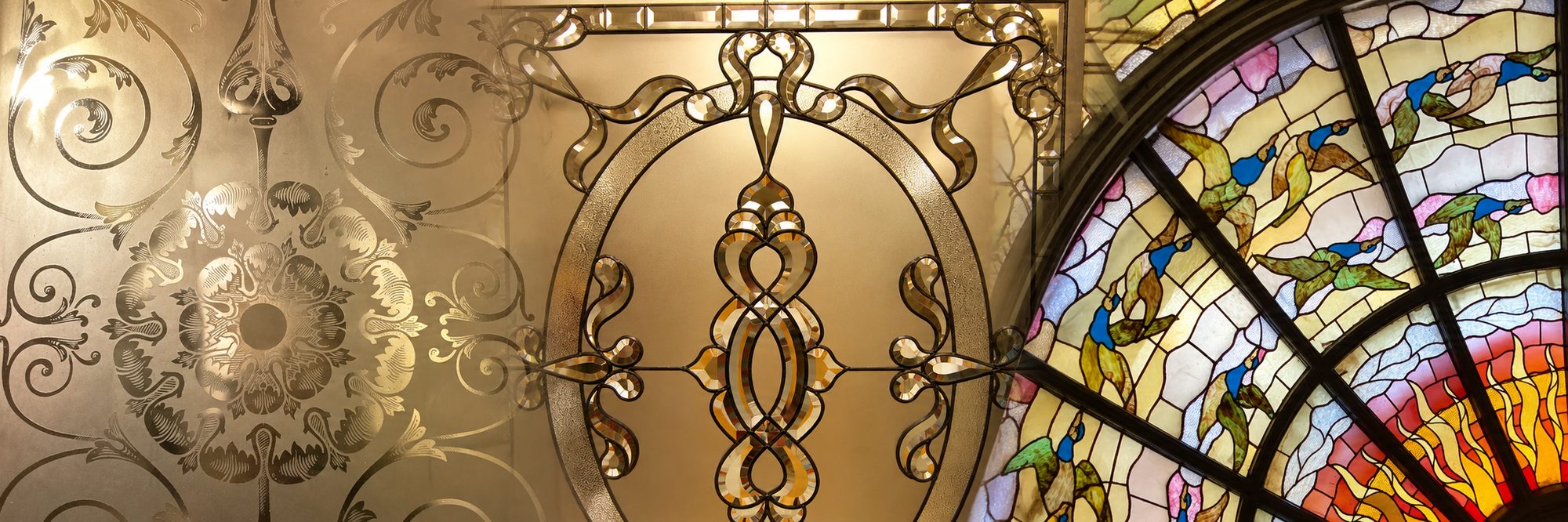

Cutting and polishing glass with wheels is an old technique, used for centuries on drinking glasses and mirrors. It became a mass decorative trade when large sheets of plate glass became cheap in the middle of the nineteenth century. The abolition of the glass tax in 1845 and the window tax in 1851 opened a market for decorated flat glass, and the first products were the brilliant cut and the bevelled panes.
Brilliant cutting
Brilliant cutting was introduced in the 1850s, and is credited to Mark Bowden of Bristol. Engraving glass was already an established craft, but applying it to large flat plate glass was new. Craftsmen worked with rotating sandstone wheels, from about 5 cm to 90 cm across, wetted with water. Wheels with a round edge cut a concave dish, square ones cut lines and leaf forms, and mitred ones cut a V-shaped groove. Large sheets were hung from a counterbalanced beam so that the glass, not the wheel, could be moved. The cuts were then smoothed with willow wheels and pumice and polished with a fibre brush and rouge.
The design was often set against a frosted, acid etched background so that the polished cutting glittered against it. Some brilliant-cut glass was also silvered to make mirrors. The result is common in Victorian and Edwardian pubs, where the cut stars, fans, leaves and flowers sparkle in the light. See acid etched glass for the background technique.
Bevelled glass
A bevel is an angled edge ground and polished around the border of a thick piece of glass. The angle refracts light and throws small spectra, which clear flat glass does not do. Bevels were traditionally ground by hand: the glass was pressed against a rough wheel fed with sand and water, then smoothed on emery, stone and pumice wheels and buffed with rouge. Machine bevelling replaced this, with silicon carbide grinding on rotating platters for straight and outside curves and wheels for inside curves. Hand-made bevels still have a crisper edge, which can help identify old work.
Bevels were assembled in leaded panels, with clusters of bevels forming geometric and floral patterns in doors, sidelights and fanlights. In the United States in the early 1900s, large bevelled oval door panels in thick plate with wide bevels were common, and each needed two craftsmen to make.
Today
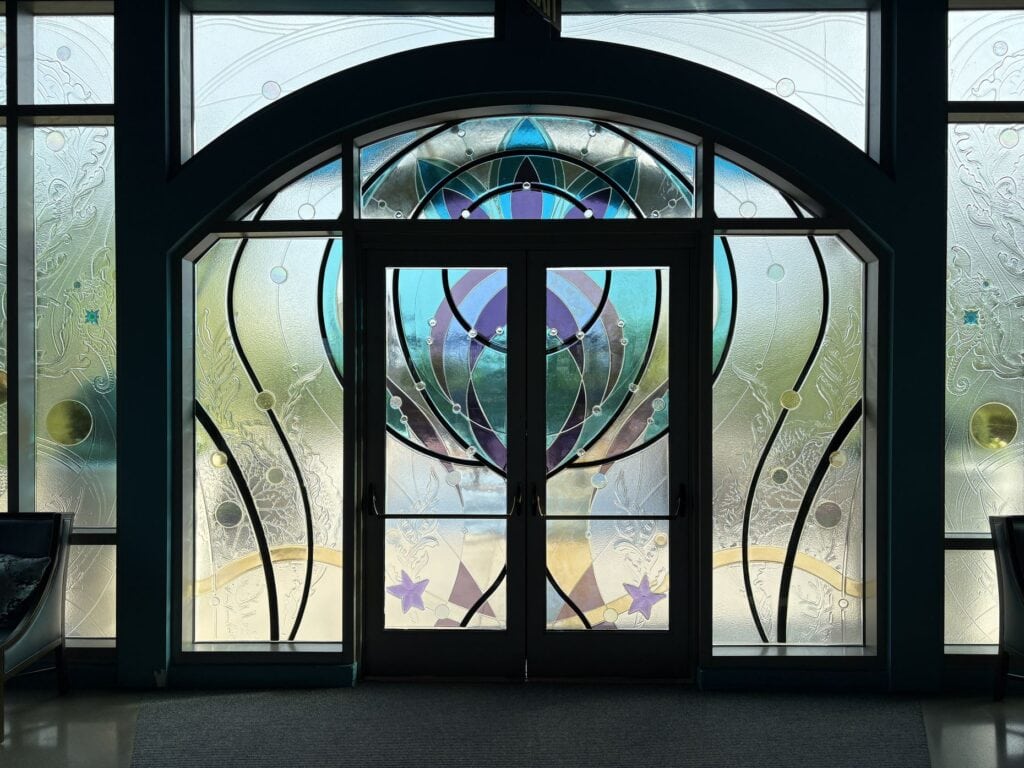
Hand-cut work and traditional leaded bevels are mostly restoration and specialist work. Bonded bevels appeared on the UK market in 1992. Modern bevelled panels are often made by bonding machine-made bevels onto a single sheet of toughened glass, which keeps the sparkle of a bevelled door and also meets safety glass requirements. Several examples are in the gallery.
Skills that have been lost
In Victorian and Edwardian Britain, many glass companies made brilliant cut and hand bevelled glass, and most large towns had a cutting works or a decorator who could supply it. As machine production and lower-cost imported glass grew, demand for handwork fell. Workshops closed, apprenticeships ended, and brilliant cutting and hand bevelling are now practised by very few people. Skilled glass artists are harder to find today and are in demand, especially for restoration, where a missing bevel or cut panel has to be matched by hand.
On this site, see the glass type page for Brilliant Cut Glass and Decorative Bevelled Glass.
More glass history
- A Short History of Stained Glass
- Medieval Stained Glass and the Origins of Leaded Lights
- How Window Glass Was Made: Crown, Cylinder, Plate and Float
- Stained Glass from the Gothic Revival to the Twentieth Century
- Opalescent Glass, Tiffany and the Copper Foil Method
- The History of Brilliant Cut and Bevelled Glass
- The History of Acid Etched Glass
- The History of Sandblasted and Deep Carved Glass
- The History of Fused and Kiln Formed Glass
- Where Overlay Stained Glass Came From
Terms are explained in the Glass Glossary. The tools and methods used today are covered in Glass Tools and Equipment, and the types of glass themselves under Glass Types.
How bevels are ground, and why the thin edge differs for came and overlay lead, is covered in How Bevelled Glass Is Made.