
By the early nineteenth century stained glass had been neglected for about two hundred years. The Reformation had drawn attention away from religious images, and decorated windows had become more domestic and more like pictures. The usual technique in the eighteenth century was enamel painting on clear glass, in which the picture is painted on and fired, not built up from coloured pieces. Pot metal glass had hardly been made since the late sixteenth century.
Gothic Revival
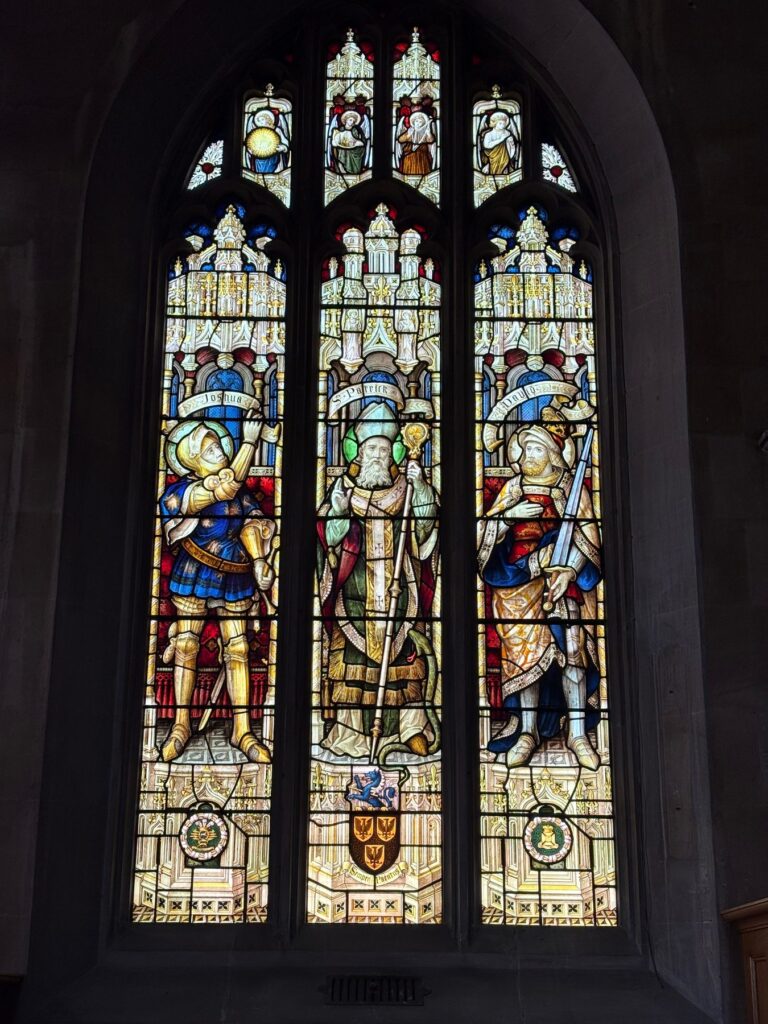
Industrialisation and mass production prompted a reaction in Britain: designers and reformers looked back to medieval craftsmanship. The Gothic Revival admired medieval architecture and the religious art that went with it, mostly the forms of about 1250 to 1500. A boom in church building created demand for windows to fill the new churches.
Pot metal glass was rediscovered and reintroduced in the early nineteenth century once makers had worked out how to make it again. Thomas Willement, an early pioneer who was appointed artist in stained glass to Queen Victoria, returned to medieval principles with coloured pieces outlined in lead. Later in the century Nathaniel Westlake combined traditional methods with more fluid composition. The method became again a mosaic of coloured pieces instead of a painted picture.
Morris, Burne-Jones and the Arts and Crafts
The firm of Morris, Marshall, Faulkner and Co, founded in 1861 and later called Morris and Co, produced windows with strong colour and bold composition drawn from historic examples, but without slavish imitation. William Morris relied on painters linked to the Pre-Raphaelites for the figures, notably Edward Burne-Jones. See the page on Burne-Jones and Morris.
Christopher Whall, a leading figure of the Arts and Crafts movement who taught at the Central School of Arts and Crafts, made use of slab glass. This thick, uneven glass was invented by E S Prior in 1889 to imitate the irregular thickness and colour of early medieval glass, and it gave a richness of colour and light that machine-rolled sheets could not.
Early twentieth century
Artists in the early twentieth century moved further from historic styles. In Ireland, Harry Clarke produced elongated, intensely coloured figures, and in Scotland Charles Rennie Mackintosh designed geometric and stylised floral glass, often using clear and lightly coloured glass in lead. In the United States, Louis Comfort Tiffany and John La Farge pursued opalescent glass; see opalescent glass and the copper foil method.
Dalle de verre
Dalle de verre, French for glass slab, uses thick pieces of coloured glass set in a matrix instead of lead. It was developed in Paris in the 1930s by Jean Gaudin, and came to prominence in the 1950s and 1960s. The slabs are chipped or faceted to catch light, and were originally set in concrete. Modern work uses epoxy resin, which is better matched to the movement of glass. The technique reached Britain when Pierre Fourmaintraux joined James Powell and Sons in 1956, and it appears in a number of modernist churches.
After the Second World War
Many bombed churches and cathedrals needed new windows. John Piper and Patrick Reyntiens moved towards abstraction, with major commissions at Coventry Cathedral in the early 1960s and Liverpool Metropolitan Cathedral in the mid 1960s. Window design after the war ranged from abstract work in thick glass to quiet, geometric glazing in clear glass.
Skills that have been lost
In Victorian and Edwardian Britain most large towns had stained glass studios and glass decorators, and the trade supported a great deal of skilled handwork. In the twentieth century demand fell, as machine production, changing taste and lower-cost imports reduced the market for handmade glass. Many workshops closed, apprenticeships stopped, and some skills fell out of use. Skilled glass artists are now harder to find and in demand, especially for restoration.
On this site, see the glass type page for Ecclesiastical Stained Glass and Conservation and Restoration.
More glass history
- A Short History of Stained Glass
- Medieval Stained Glass and the Origins of Leaded Lights
- How Window Glass Was Made: Crown, Cylinder, Plate and Float
- Stained Glass from the Gothic Revival to the Twentieth Century
- Opalescent Glass, Tiffany and the Copper Foil Method
- The History of Brilliant Cut and Bevelled Glass
- The History of Acid Etched Glass
- The History of Sandblasted and Deep Carved Glass
- The History of Fused and Kiln Formed Glass
- Where Overlay Stained Glass Came From
Terms are explained in the Glass Glossary. The tools and methods used today are covered in Glass Tools and Equipment, and the types of glass themselves under Glass Types.
Sources and further reading
- Victoria and Albert Museum: stained glass, Gothic Revival and beyond Decline, revival, Whall and slab glass.
- Victoria and Albert Museum: stained glass, an introduction