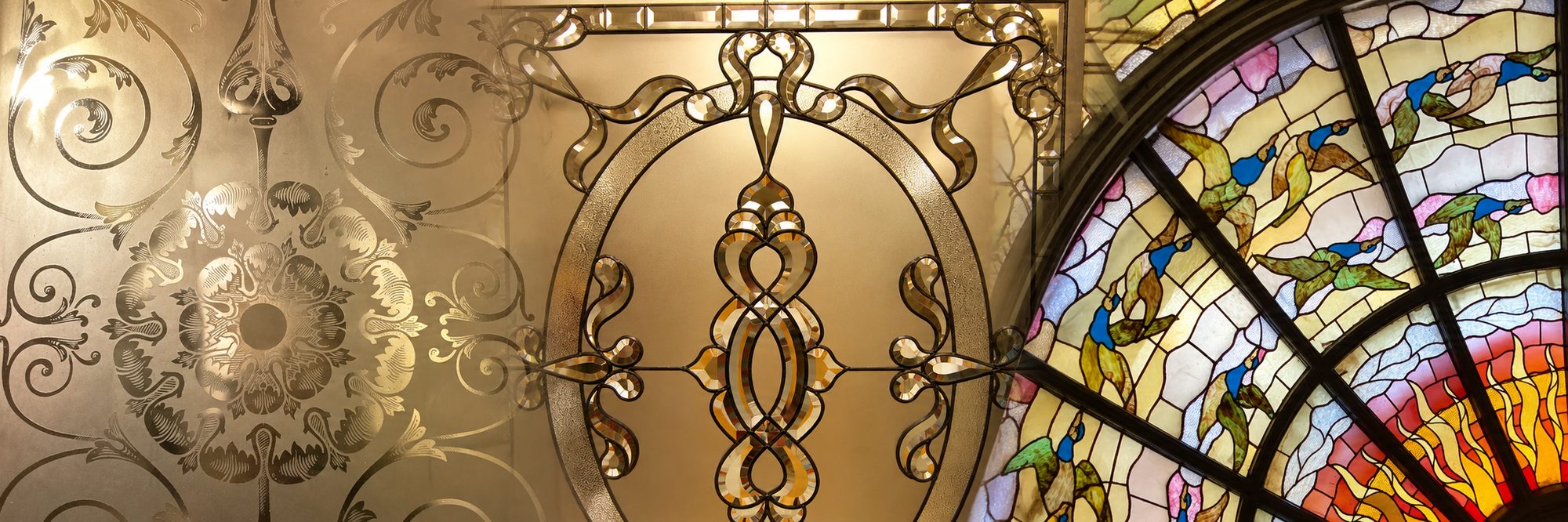

For most of its history stained glass meant lead came and transparent coloured glass. In the 1880s American artists changed both. They worked with opalescent glass, which is milky, semi-opaque and varied in colour within a single sheet, and they used copper foil, a different way of joining the pieces.
Opalescent glass
Opalescent glass is made with additives that make it translucent and cloudy. It had been made before as an effect, but in the late 1870s and early 1880s the artists John La Farge and Louis Comfort Tiffany each developed it, with patents following around 1880. The glass could show swirling streaks of several colours in one sheet. Instead of painting folds of drapery onto transparent glass, a maker could select a piece whose natural colour and texture formed the fold, and so cut the glass to the picture. Tiffany’s glass house later trademarked the iridescent glass Favrile.
Copper foil
In the foil method each piece of glass is wrapped round its edge with a thin adhesive copper tape, and the pieces are joined by soldering the tape. The method is generally known as the Tiffany method, but Tiffany did not invent it. A patent for using copper foil to join glass mosaics was granted to Sanford Bray in 1886. Tiffany Studios made much use of it, and around 1898 the designer Clara Driscoll developed leaded glass lampshades using it. Where lead came needed a groove and some width, foil left a very thin solder line, so far smaller pieces could be used, and the soldered seams made a rigid structure that could be bent into a domed shade.
Tiffany’s makers fitted foiled glass pieces to a wooden mould, soldered the seams, added brass rings at the top and bottom, and cleaned off the flux. The copper was often plated or patinated in brown or black. Early on, beeswax was used to hold the glass to the foil because suitable adhesive tape was not yet available. Tiffany also used lead came, often in the same window, as the foil method was not suitable for every shape.
Why foil spread
- The solder line is thin, which suits small pieces and fine detail.
- The result is rigid, so it works in three dimensions: lamps, boxes, suncatchers and sculptural pieces.
- It needs fewer specialist tools than leaded work, which suited hobby and studio makers.
- Lead is not needed for the structure, although lead-bearing solder is still normal.
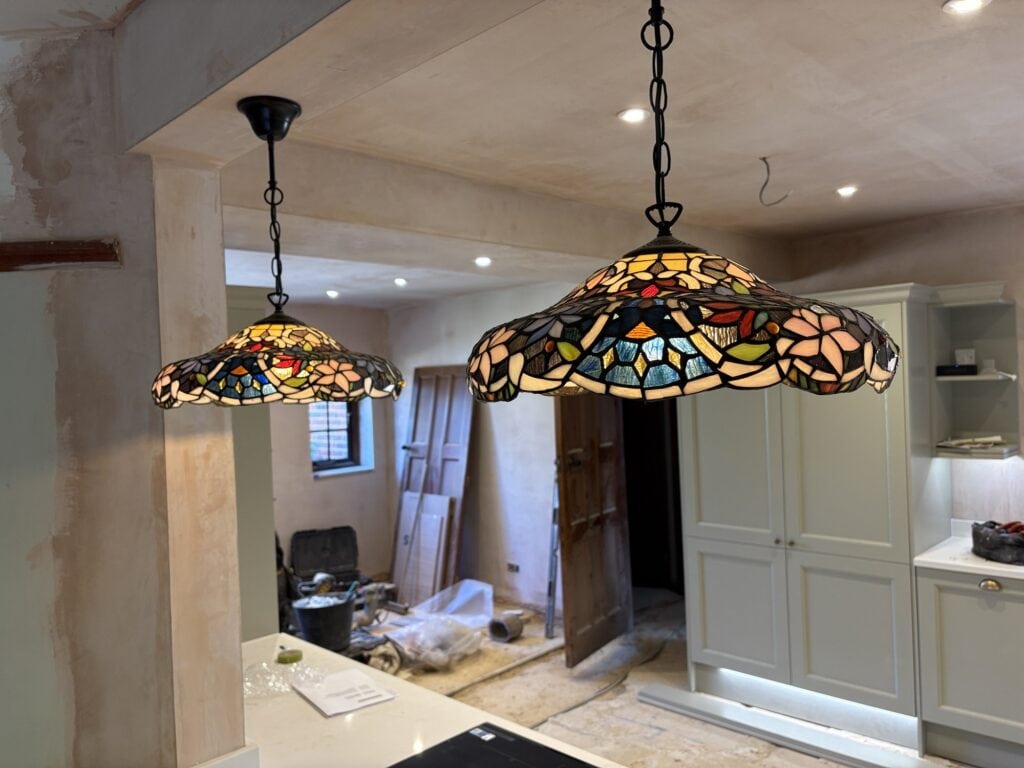
Today foil is the standard method for lamps and small panels, while lead remains standard for windows, particularly traditional ones. Both are described in Glass Tools and Equipment, including grinding and copper foiling and soldering. Some modern examples are in the gallery, including Tiffany-style lamps in a private house in Buckinghamshire.
More glass history
- A Short History of Stained Glass
- Medieval Stained Glass and the Origins of Leaded Lights
- How Window Glass Was Made: Crown, Cylinder, Plate and Float
- Stained Glass from the Gothic Revival to the Twentieth Century
- Opalescent Glass, Tiffany and the Copper Foil Method
- The History of Brilliant Cut and Bevelled Glass
- The History of Acid Etched Glass
- The History of Sandblasted and Deep Carved Glass
- The History of Fused and Kiln Formed Glass
- Where Overlay Stained Glass Came From
- The History of Stained Glass in the USA
Terms are explained in the Glass Glossary. The tools and methods used today are covered in Glass Tools and Equipment, and the types of glass themselves under Glass Types.
For how foil work is done and where it is used today, see Copper Foil Stained Glass.
Sources and further reading
- Copper Development Association: shedding light on the legacy of Tiffany The 1886 foil patent and the lampshades.
- Victoria and Albert Museum: stained glass, Gothic Revival and beyond
See also How Coloured Glass Is Made.