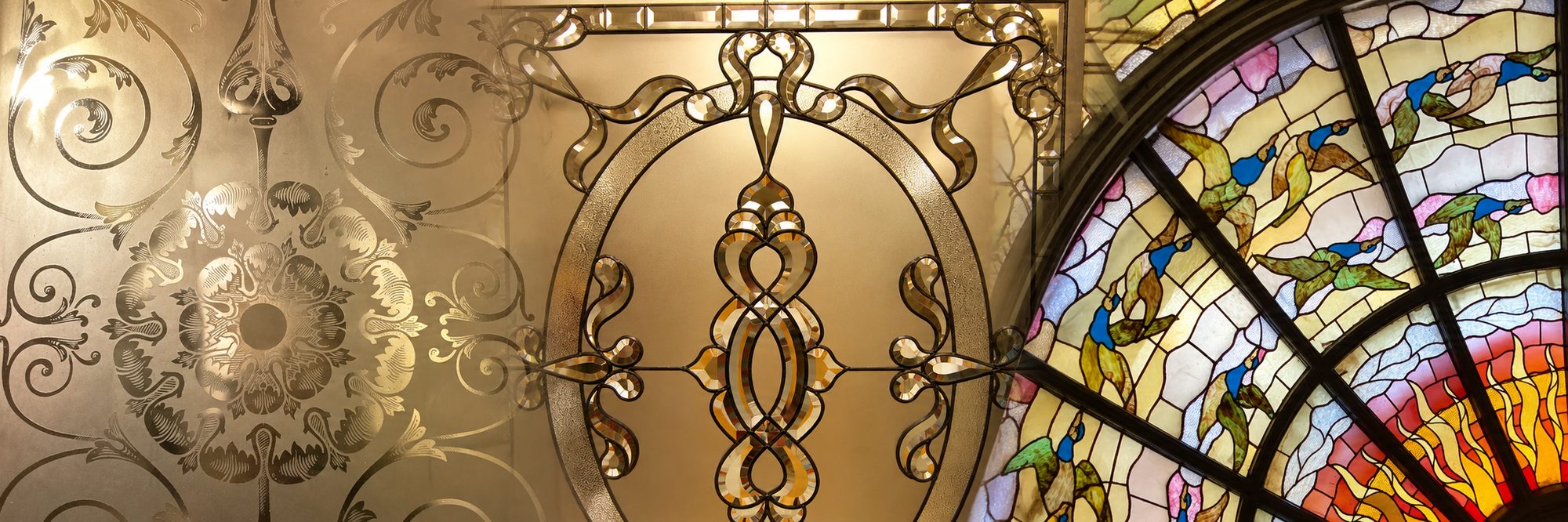
The Fitzroy Tavern, Charlotte Street: acid etched and brilliant cut glass
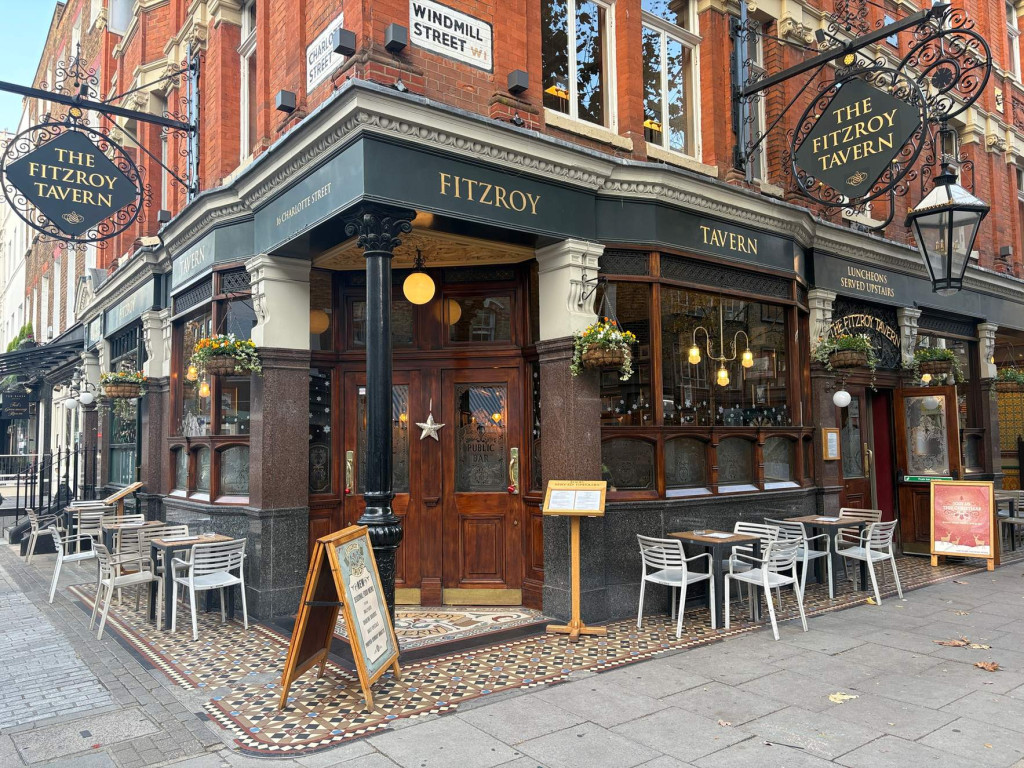
The Fitzroy Tavern on the corner of Charlotte Street and Windmill Street, with mahogany frontage, etched glass doors and bay windows. See it in the gallery.
Visited and photographed by stainedglass.co.uk on 9 November 2026.
The pub and its glass
The Fitzroy Tavern occupies the corner of Charlotte Street and Windmill Street in Fitzrovia, a short walk west of Tottenham Court Road. Red-brick upper floors rise above a ground floor of dark-painted pilasters and fascia with polished timber doors and window frames; the doors and the lower panes of the windows are filled with white frosted glass carrying clear cut ornament: door panels lettered Public Bar and Saloon Bar, low bay windows and, inside, tall panels set into the screens around the bar. The published accounts of the 2015–16 restoration describe this glass as new work, and none identifies any panel as surviving from the Victorian pub.
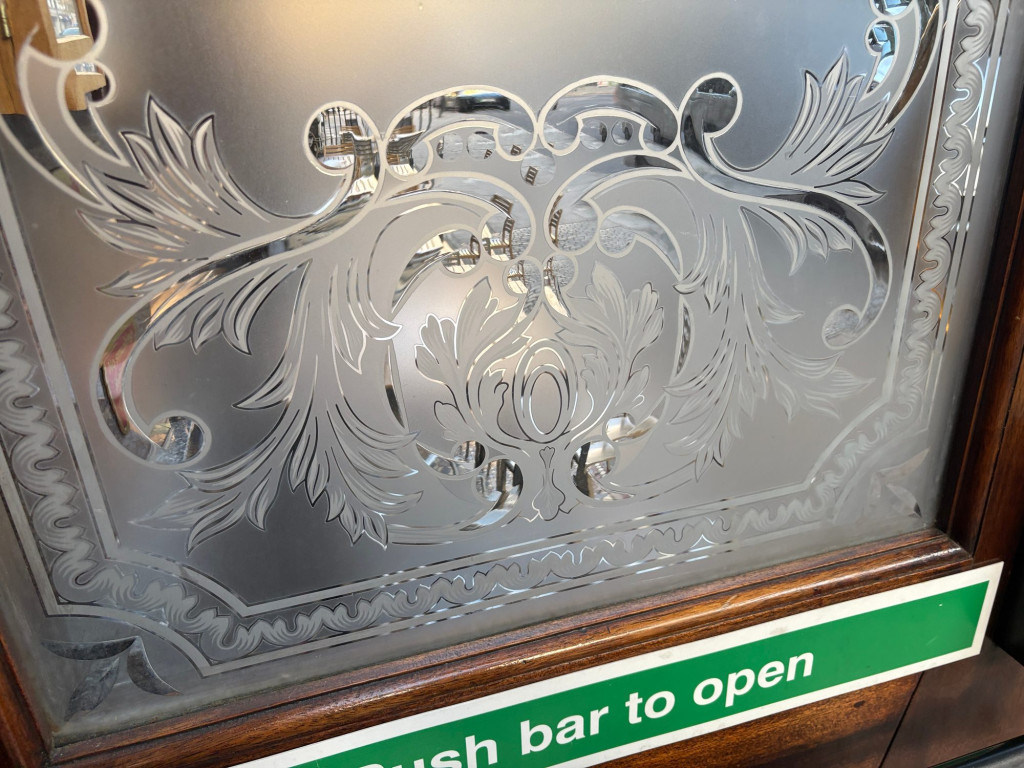
The interest of the glass lies in how closely the new work follows late-Victorian practice in acid etched glass and brilliant cut glass, and in the way it is used once again to divide a large ground floor into separate rooms. The wider use of such glass in licensed premises is covered in decorative glass for pubs, shops and restaurants.
History of the building
The sources disagree on the early dates. The building is generally said to have opened in 1883 as the Fitzroy Coffee House, with dwellings above. CAMRA’s pub records and most online accounts state that it became a public house called the Hundred Marks in 1887, while local reports and other histories give 1897 for the conversion or rebuilding; CAMRA’s own 2018 award announcement describes the restored interior as a return to its 1897 appearance. The architect named for the pub work is W. M. Brutton, a London architect who specialised in public houses.
Earlier records complicate the account further. The Pubology directory of London pubs lists a house on the site, recorded as the Fitzroy or the Queen Charlotte, from at least 1822, with the name Fitzroy appearing in street directories from 1856. The more familiar story holds that the Hundred Marks, a name variously explained as a reference to the German community around Charlotte Street or as a nickname taken from a landlord named Hundertmark, became the Fitzroy Tavern only in 1919, when the licensee Judah Kleinfeld renamed it after the First World War. Both versions are recorded here because the sources do not settle the question.
The pub was owned in turn by the London brewers Hoare and Co. and Charrington before passing to its present owner, a Yorkshire brewery. The building is not on the statutory list: CAMRA’s London Pubs Group records it as unlisted and absent from the campaign’s inventories of historic pub interiors, and no Historic England list entry was found. The Survey of London, describing Charlotte Street in 1949, dismissed No. 16 in a single phrase as entirely modern, in contrast with the Georgian houses along the street. The pub stands within Camden’s Charlotte Street Conservation Area, and CAMRA now includes it in a separate register of outstanding conversions and restorations, which recognises good modern work rather than surviving historic fabric.
The 2015–16 restoration
Most of the elaborate Victorian fittings were removed during twentieth-century modernisation. In March 2015 it was reported locally that the pub would close for about a year so that the whole building could be returned as nearly as possible to its late-nineteenth-century state. The scheme approved by Camden Council included new mahogany shopfronts, panes of acid etched and brilliant cut glass, wrought-iron hanging signs, a glass lantern restored to the corner, the division of the ground and first floors into snugs, and additional entrances on both streets.
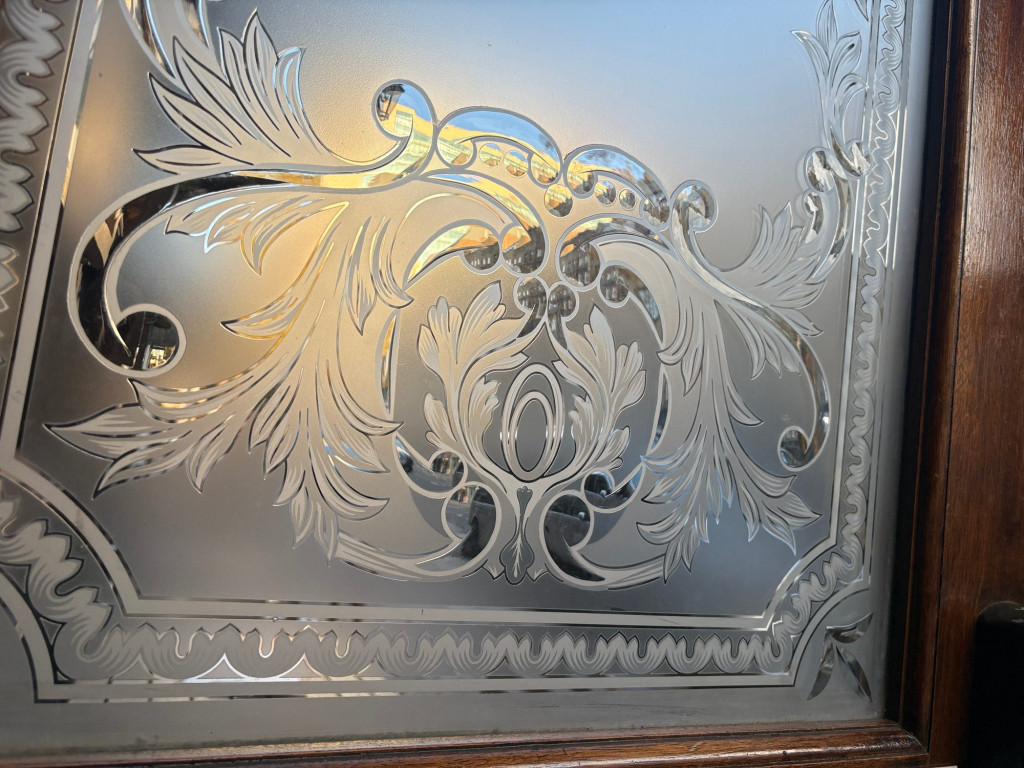
The pub reopened in 2016. New mahogany partitions glazed with acid etched panels recreate the separate compartments that once divided customers along class lines, and the surviving tiling was repaired rather than replaced. In March 2018 the work won the refurbishment category of CAMRA’s Pub Design Awards for 2017, run in association with Historic England. The award citations refer to new partitions and restored tiling, and none of the published sources identifies any etched or cut glass as surviving from the Victorian pub. The glass described below should therefore be read as a modern recreation, set within a Victorian building in which some original tiling survives alongside new tiling of the restoration.
The glass, room by room
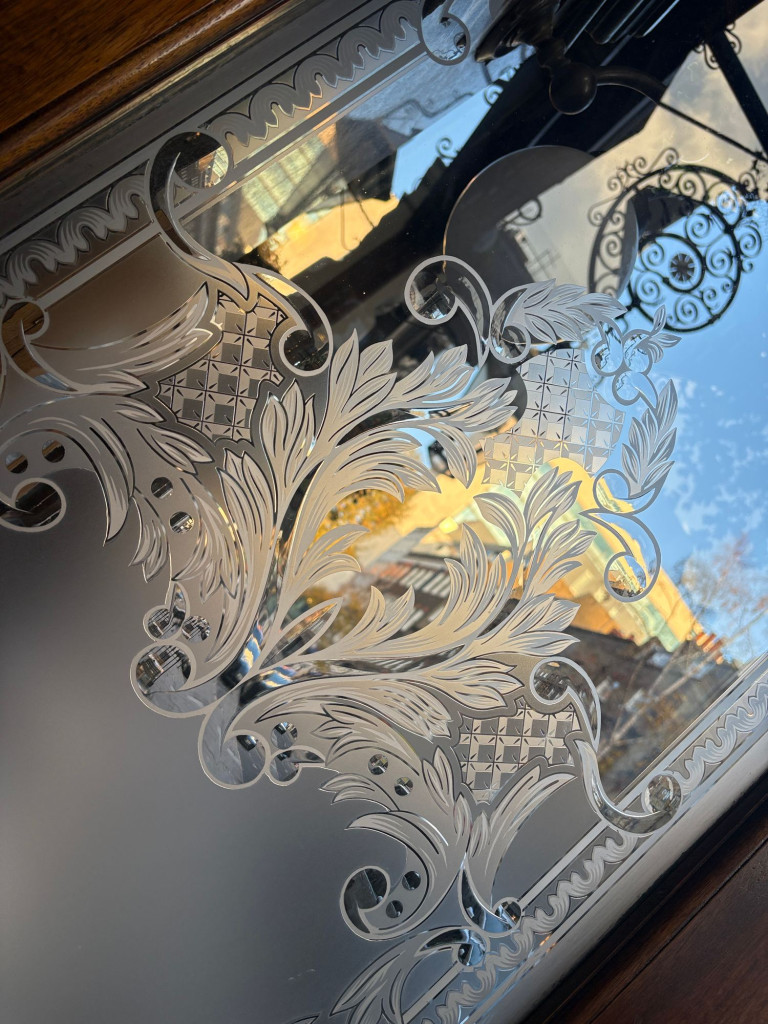
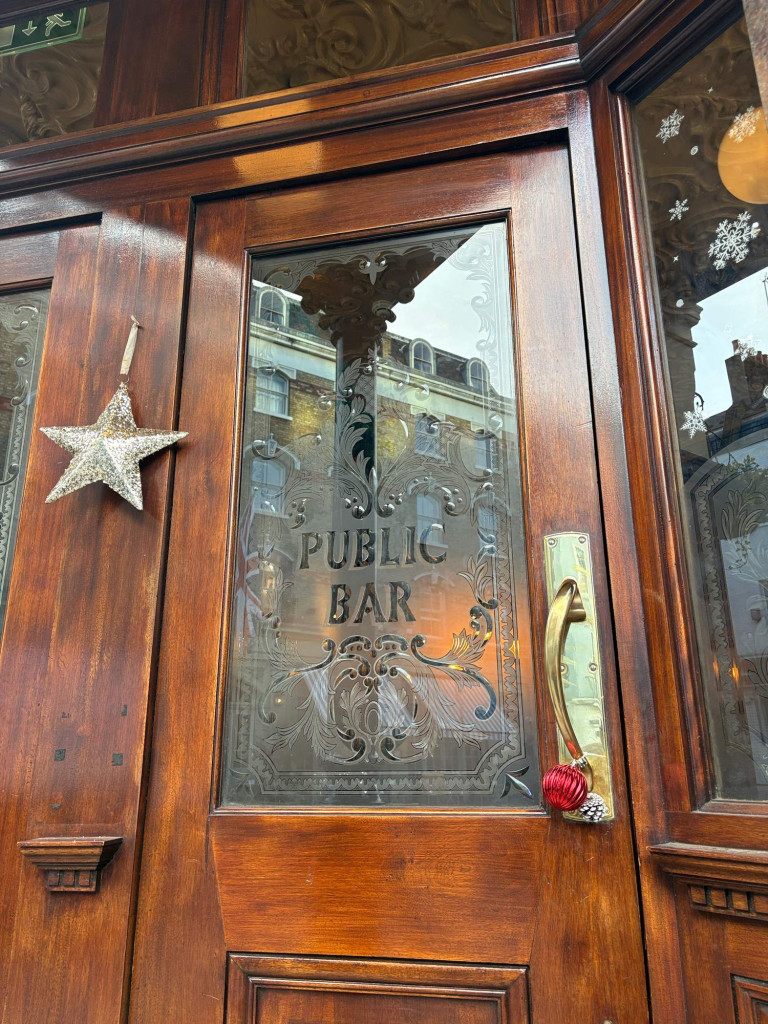
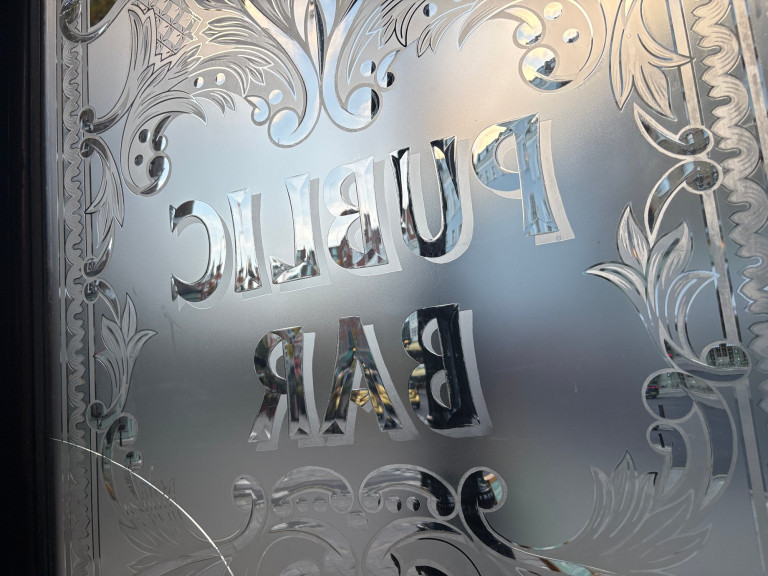
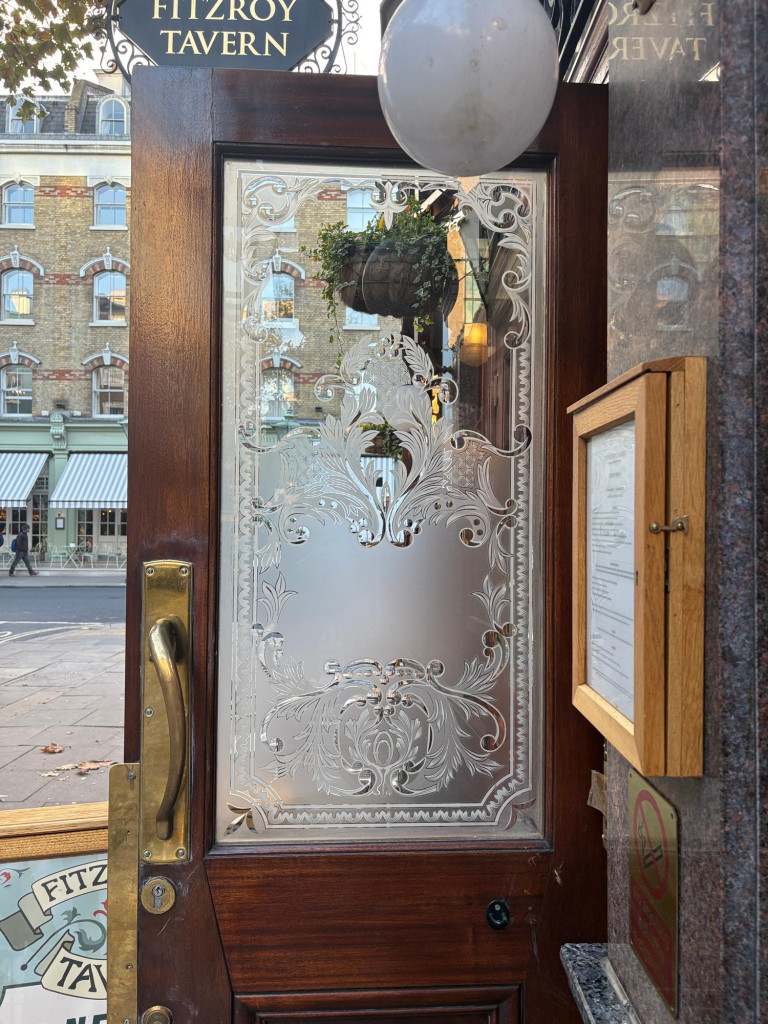
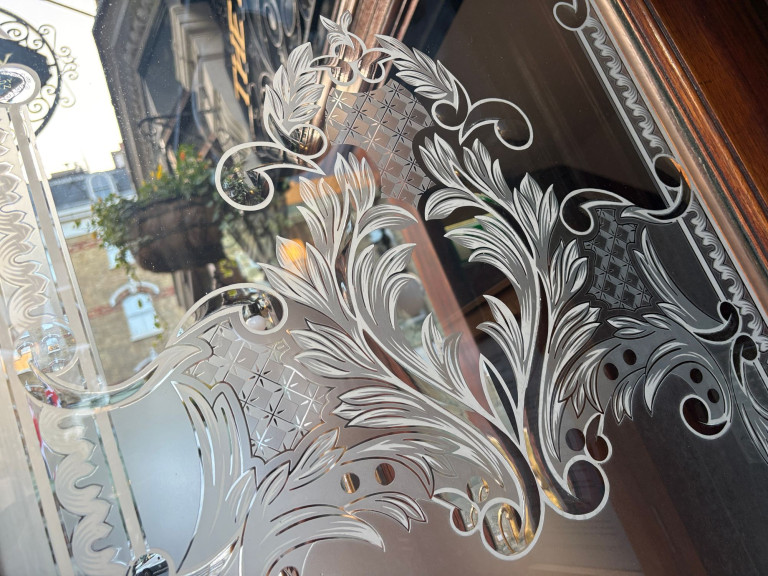
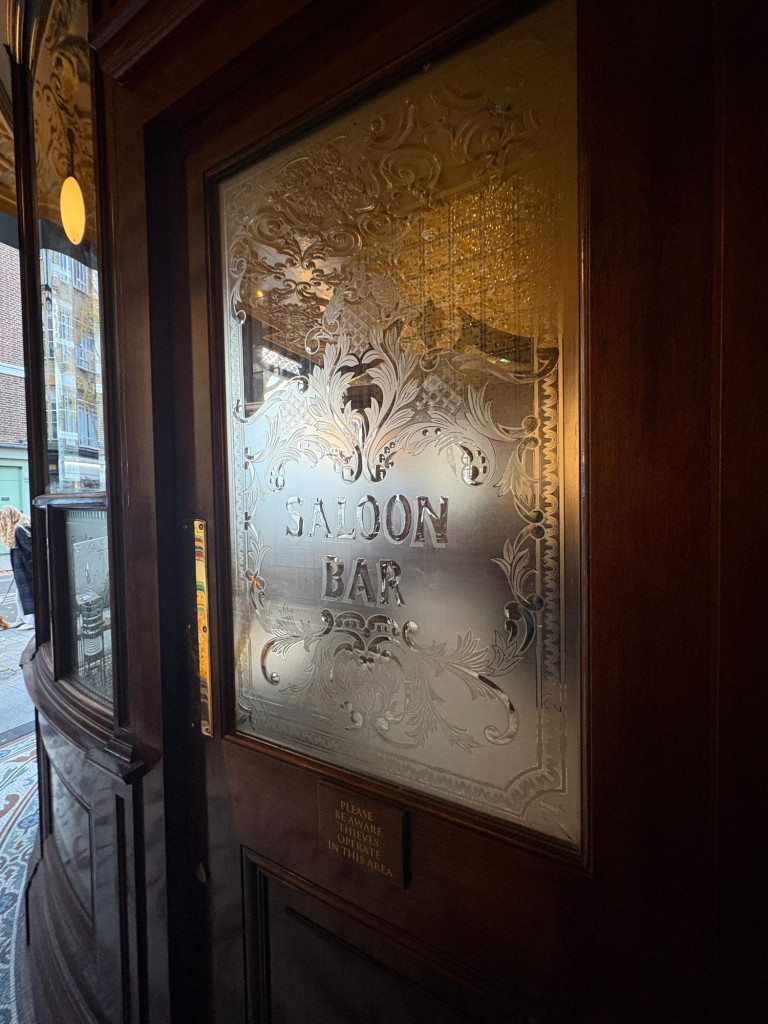
The street doors carry the most elaborate panels. On the public bar doors the words Public Bar stand in clear letters with cut edges against a white frosted ground, with a dense field of scrolling acanthus above and below. Within the foliage sits a lattice of small cut stars, a diaper pattern that catches the light as the door moves. The saloon bar door repeats the scheme with its own lettering, and the narrow border around each panel is cut as a running band of small notches and beads.
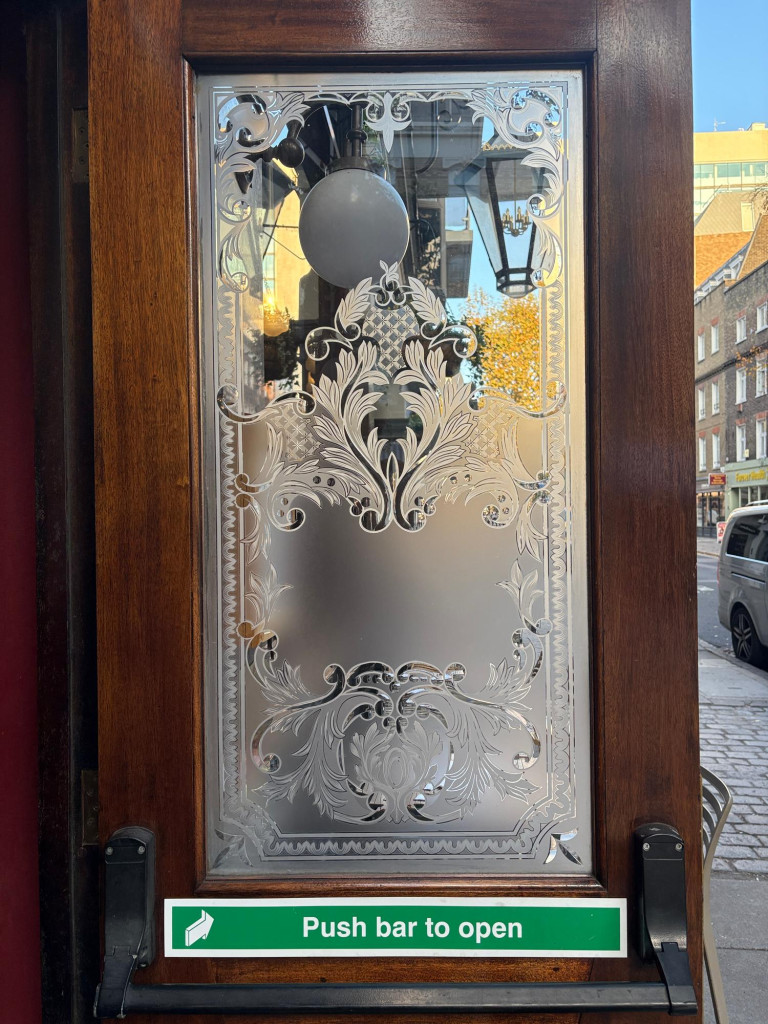
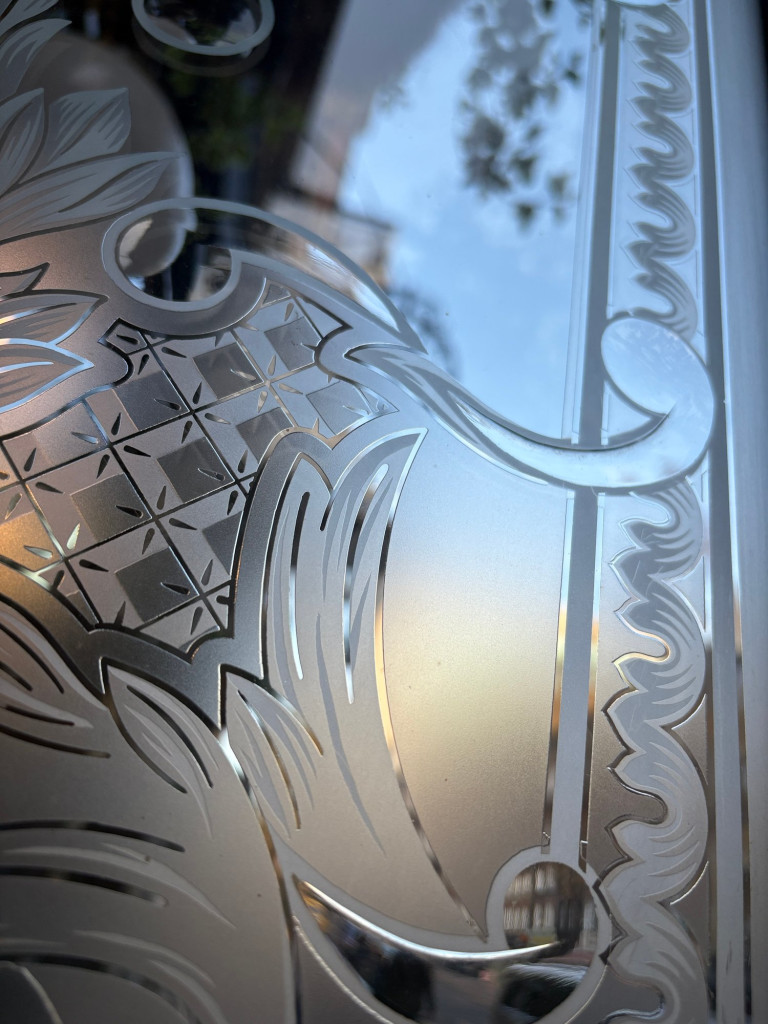
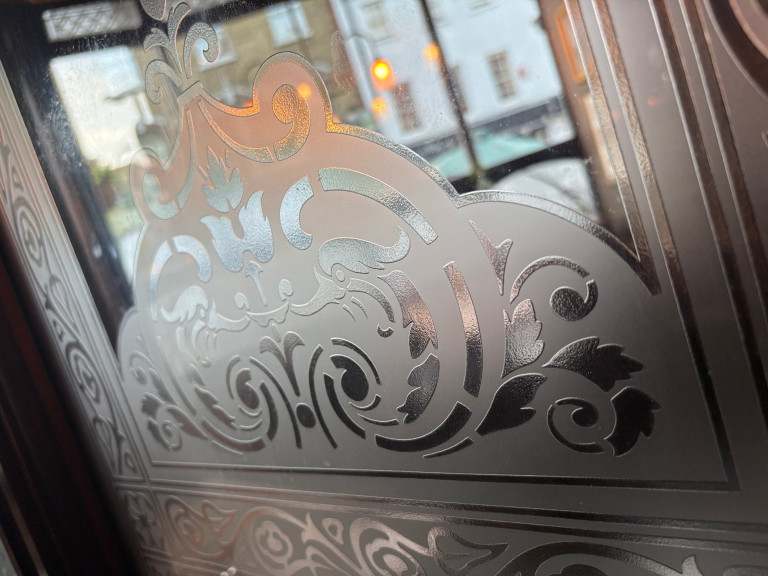
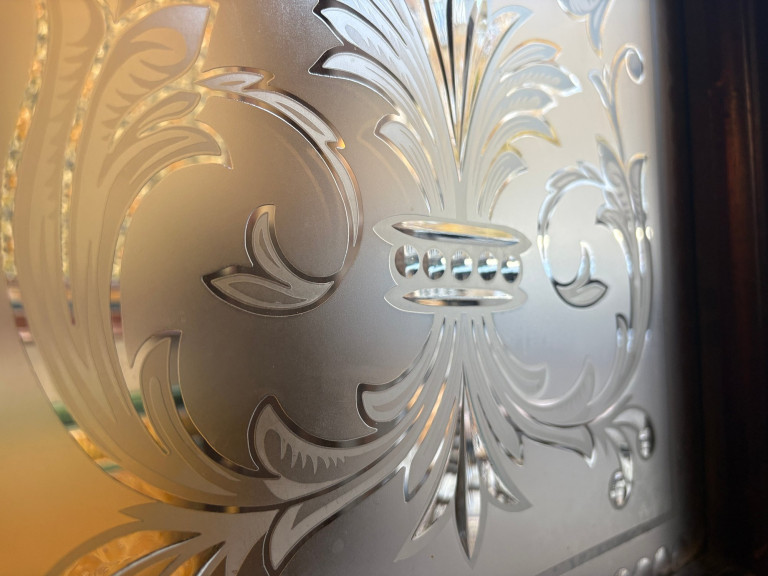
A further door panel without lettering shows the cut work most clearly. Broad scrolls are outlined in polished grooves, and a cut border encloses the whole design. Against daylight the clear lines read as bright strokes over the grey of the frosted glass; from the street the frosting conceals the interior while the polished cuts remain transparent.
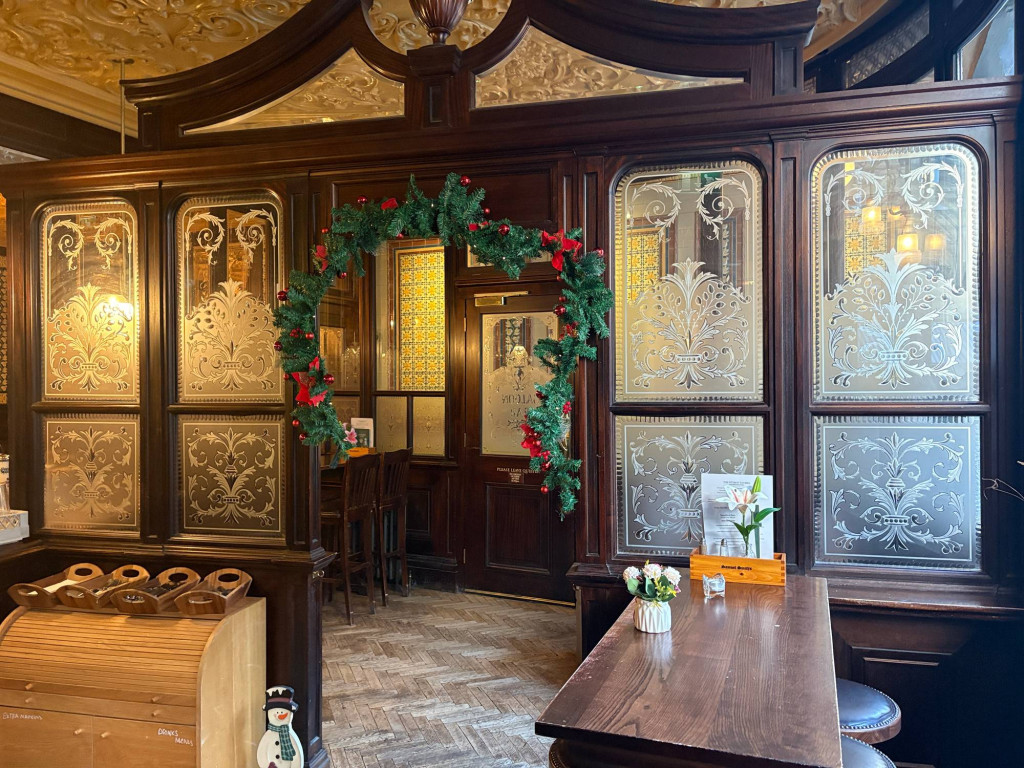
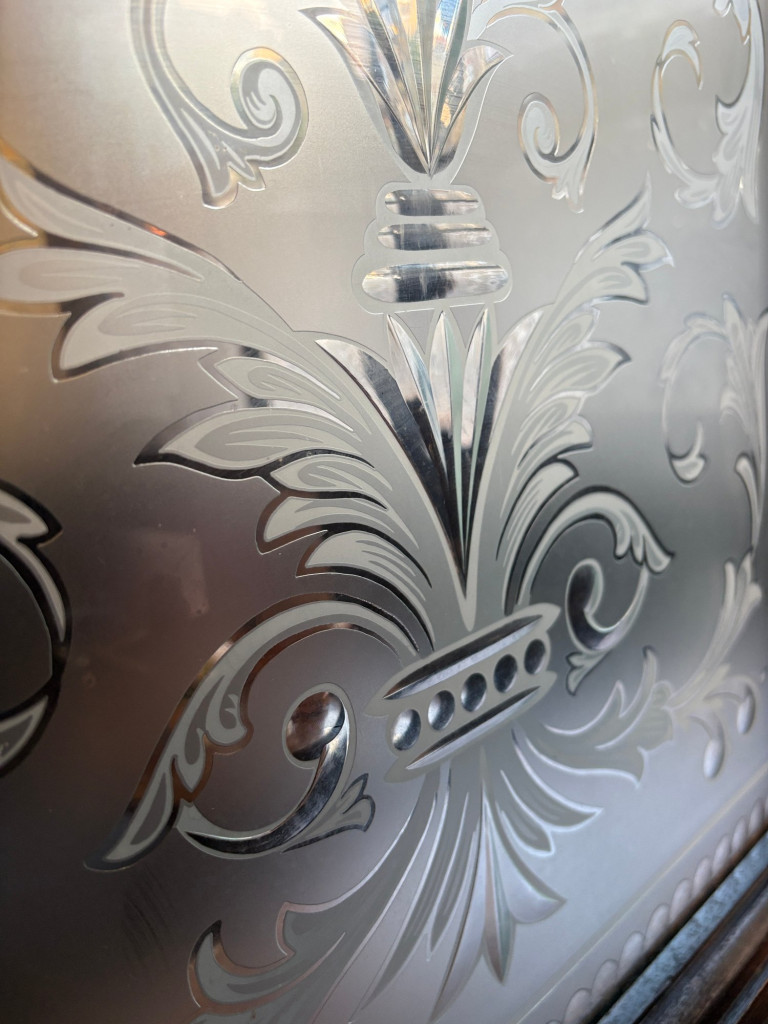
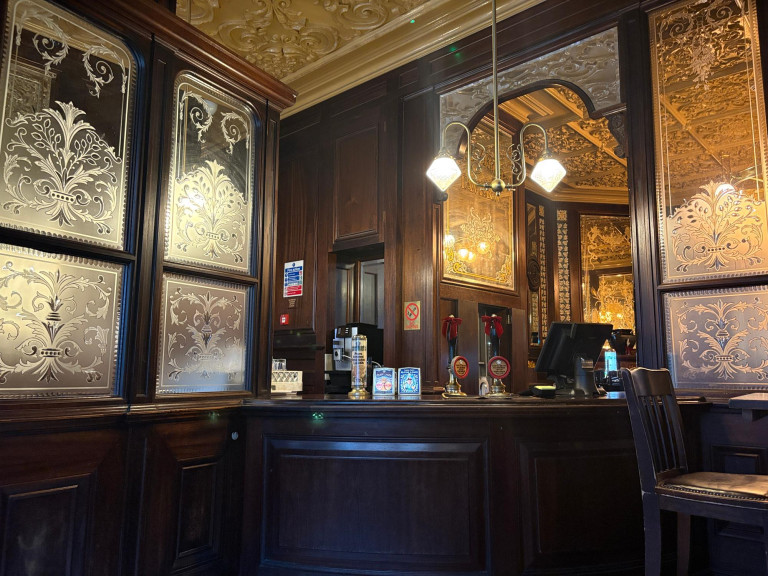
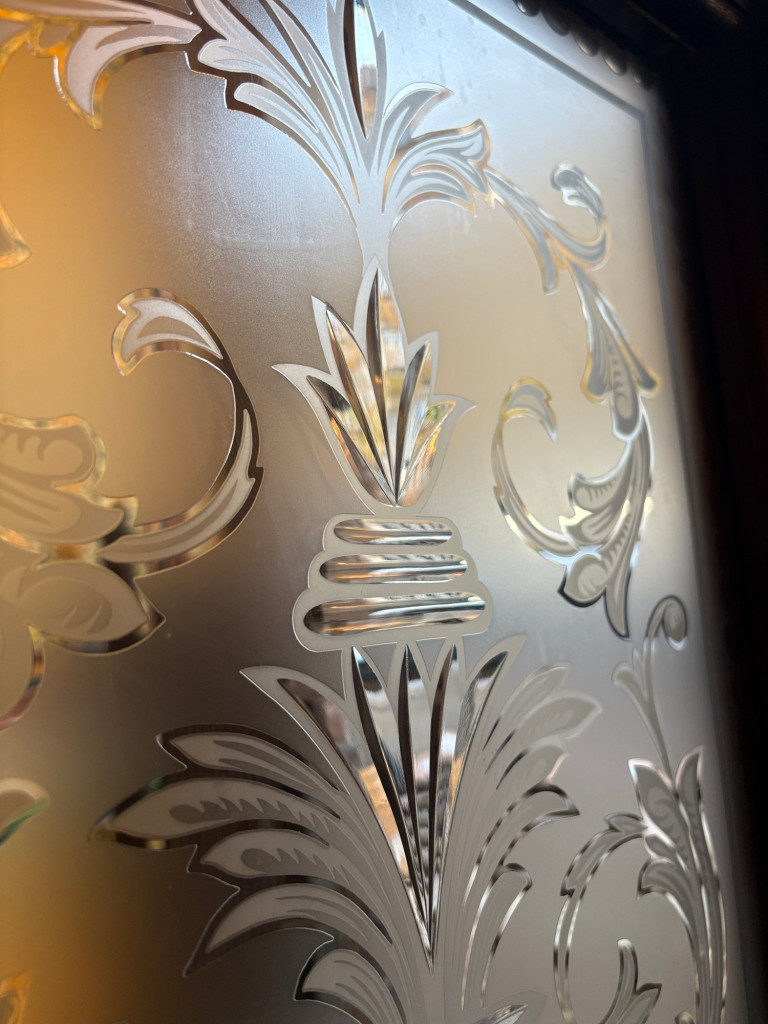
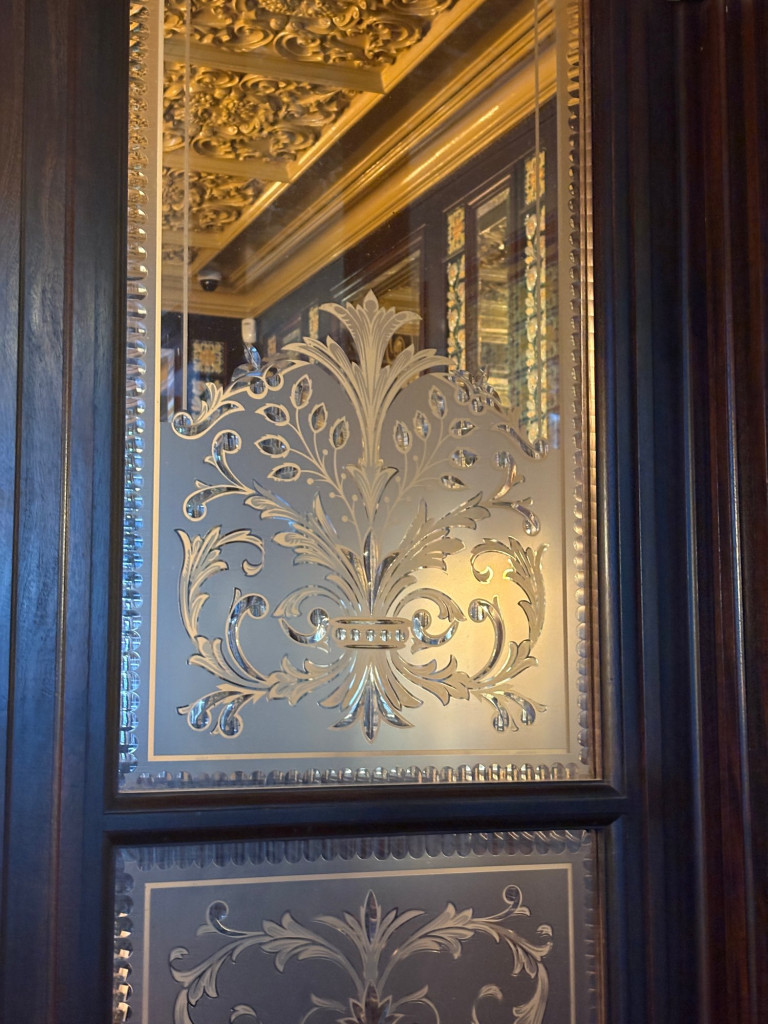
Inside, the mahogany screens around the bar are glazed in two tiers. Each upper panel shows a tall fleur-de-lis rising from a collar set with a row of small round cuts, flanked by curling leaves and enclosed by a beaded border. The lower panels carry smaller versions of the same motif; taller panels beside the windows, frosted only in their lower half, carry a whirling rosette of short curved cuts. Several panels add slender stems ending in oval tulip buds among the acanthus, each bud a shallow polished hollow that flashes as the viewer moves past.
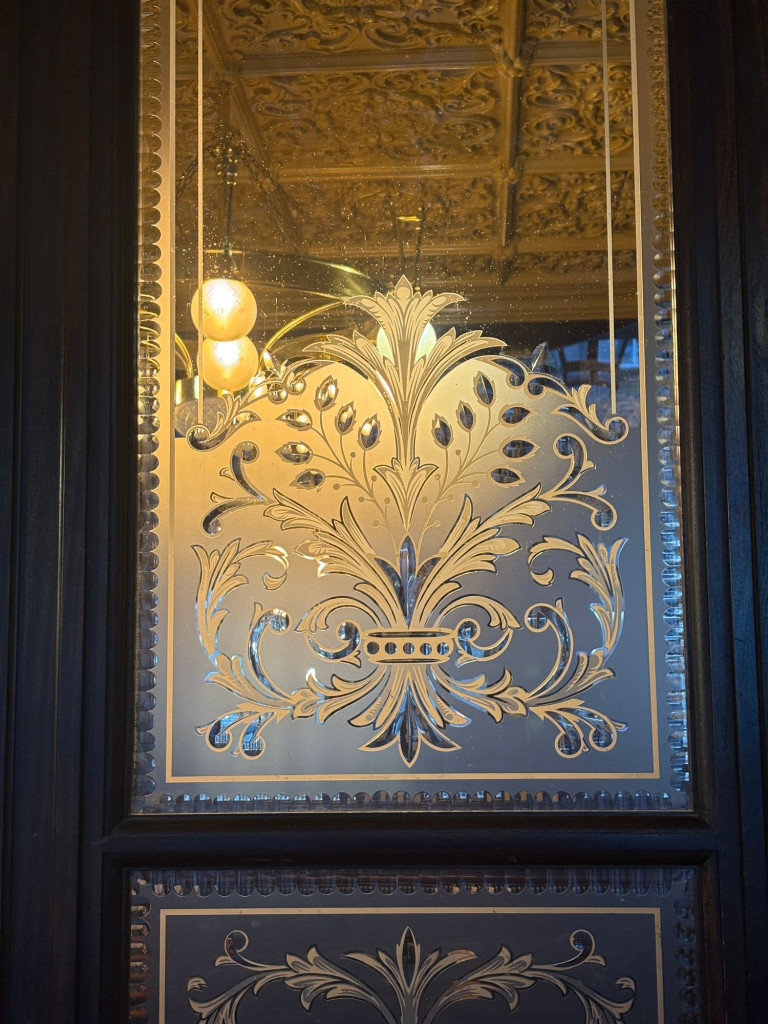
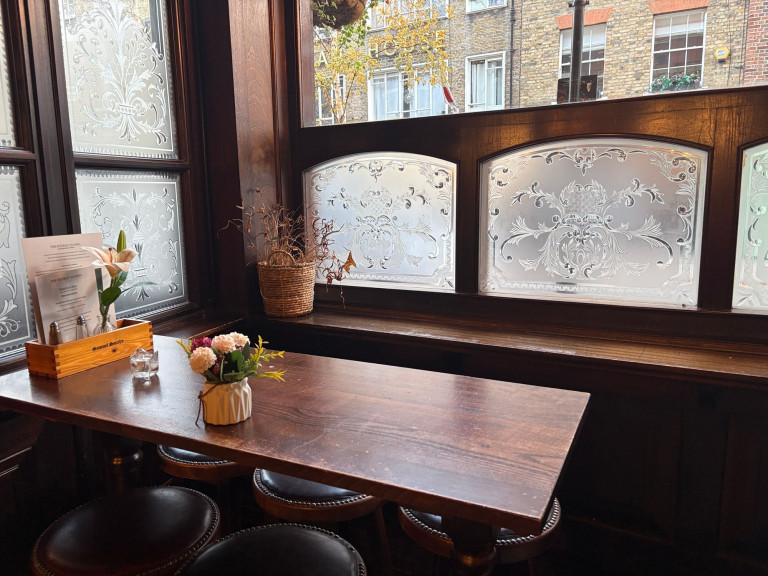
The snug compartments show how the screens work as architecture. Each small room is lined with dark panelling, and the etched panels above seat height pass light between compartments while blurring the view, so that customers in one space see only shapes and movement in the next. Under the interior lighting the frosted glass takes on a warm, golden tone against the dark wood.
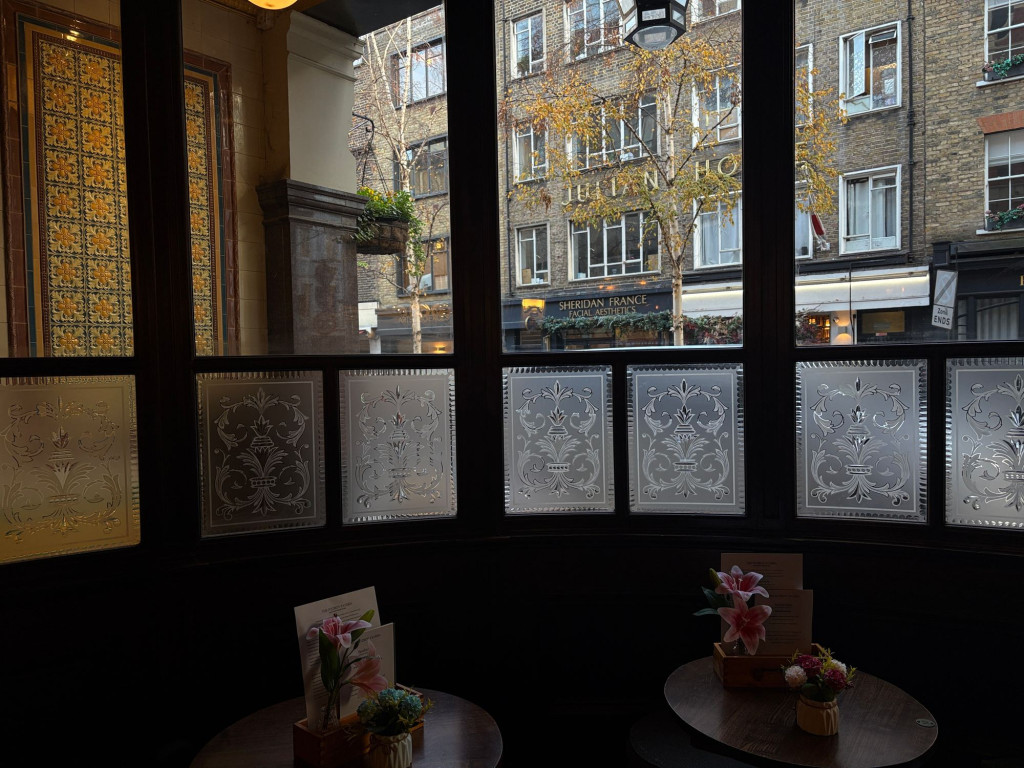
The bay windows facing the street have arched upper edges to their lower panels. These are frosted to roughly the eye level of a seated customer, with a central cartouche of scrolls and foliage, and clear glass above admits daylight. From inside they frame the terraces opposite; from outside they screen the tables from passers-by, the same purpose such glass served in the 1890s.
How the glass is produced
Both techniques visible here developed in the second half of the nineteenth century, after the abolition of the excise duty on glass in 1845, and of the window tax a few years later, made large sheets of plate glass affordable for shopfronts and pubs. In acid etching, the pattern is protected with an acid-resistant coating and the exposed glass treated with hydrofluoric acid, which dissolves the surface to a fine matt finish. Victorian embossers developed several grades of finish, from a light frost to the dense, even surface known as white acid, and could combine stages to give two or three tones in a single panel. The history of the method is set out in a short history of acid etched glass.
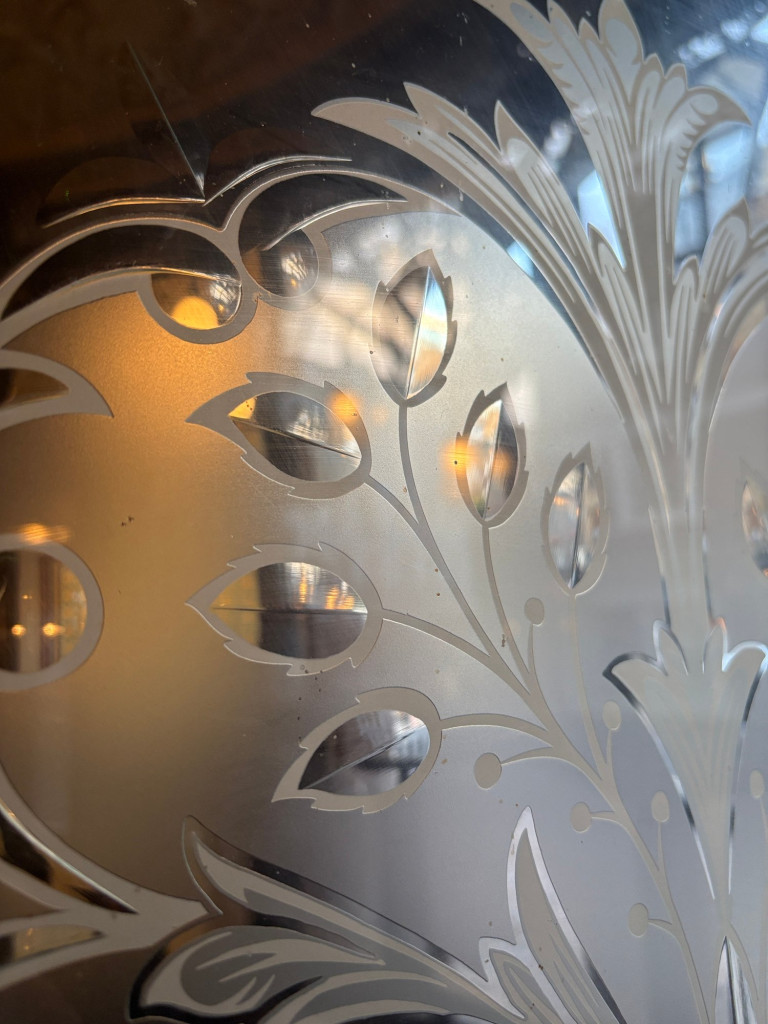
Brilliant cutting, introduced in the 1850s, works in the opposite direction. The sheet is held against a wet stone wheel turning on a lathe; wheels of different diameters and edge profiles were used: mitred wheels for V-shaped grooves, square-edged wheels for lines and leaf forms, and round-edged wheels for concave hollows such as buds and dots. The cuts are smoothed and then polished back to full clarity, which is why the cut lines at the Fitzroy look clear and bright against the frosted ground. Cutting was slower and more costly than etching, so it was often used to sharpen an etched design rather than on its own. The development of the craft is traced in brilliant cut and bevelled glass.
Modern recreations may use the same methods or combine them with sandblasted glass, which has a coarser frost. Conservation guidance notes that white acid and sandblasted surfaces can be told apart because the blasted surface is rougher and holds dirt more readily. The published sources do not state which methods were used for the Fitzroy’s new panels, and close inspection by a specialist would be needed to say.
Who produced the glass
No published source names the designer or the workshop that produced the 2015–16 glass, and no maker’s mark was recorded in the photographs. Nothing specific is known of the Victorian glass that preceded it, beyond the general statement that most of the original fittings were removed in the twentieth century. One specialist account of pub glass observes that the new public bar panels could easily be mistaken for Victorian work, which reflects how closely the motifs and layout follow late-Victorian models. For questions of repair or replacement in older pubs, the principles are outlined under conservation and restoration.
Fitzrovia and the tavern
The pub’s wider reputation rests on its customers. From the 1920s into the 1950s it was the best-known meeting place of a loose bohemian circle of painters, writers and drinkers; the painter Nina Hamnett, the sculptor Jacob Epstein, Augustus John, Dylan Thomas and George Orwell are among the regulars most often named. The journalist and politician Tom Driberg is usually credited with bringing the name Fitzrovia into print in a newspaper column of about 1940, for the district that gathered around the tavern, although the poet and editor Tambimuttu also claimed it and an earlier use from 1930 has been found.
Judah Kleinfeld, a Polish-born tailor, took the licence in 1919; his daughter Annie and her husband Charles Allchild later ran the house jointly. In 1955 Allchild was prosecuted for keeping a disorderly house and found guilty on nine counts, a verdict later overturned on appeal, and the family left in 1956. Annie’s daughter, Sally Fiber, later wrote the pub’s history, The Fitzroy: The Autobiography of a London Tavern.
More of the glass
Further photographs from the visit show more of the glass at the Fitzroy Tavern, from the details of individual panels to the way the windows and screens work together in the rooms.
Seeing the glass today
The Charlotte Street front stands on the east side of the street and faces west, so the street doors and bay panels receive the strongest light in the afternoon, when low sun picks out the cut lines from the pavement. From inside the effect reverses: daylight behind the street panels makes the frosted ground glow, and the polished cuts turn dark or sparkling depending on the angle. The lettering on the bar doors is designed to read from the street and appears reversed from within. The internal screens are best seen under the interior lighting, which shows the beaded borders and tulip buds most clearly.
The same combination of etching and cutting is still used for front doors and internal screens in homes and commercial interiors; etched glass for homes explains the options for anyone wishing to commission similar work, and how to clean decorative glass covers safe care of frosted and cut surfaces. Photographs of the doors, screens and bay panels are in the gallery, and the place of this style in the longer story is shown in the timeline of decorative glass.
Every photograph of the glass at the Fitzroy Tavern is in the stainedglass.co.uk gallery, with the details of each panel.
Sources and further reading
- CAMRA London Pubs Group: Fitzroy Tavern
- CAMRA Outstanding Conversions and Restorations: Fitzroy Tavern
- CAMRA: Pub Design Awards announcement, March 2018
- Survey of London, volume 21: Tottenham Court Road and Neighbourhood (British History Online)
- Building Conservation Directory: Brilliant Glass
- Camden Council: Charlotte Street Conservation Area appraisal