
Glass becomes soft enough to join and shape well below its melting point, and this has been exploited for thousands of years. Fusing joins pieces of glass by heating them until they bond. Kiln forming covers the larger family: casting, slumping and draping glass into or over moulds.
Ancient glass
The earliest glass objects, from Mesopotamia and Egypt in the second millennium BCE, were made by heating glass until it fused or flowed. Glass beads, amulets and inlays were made this way. In the Roman world, craftsmen made more complex fused and cast pieces: bowls and plates were cast in moulds, and mosaic glass was made by fusing together canes and slices of coloured glass. The invention of glassblowing in the first century BCE made glass cheap and plentiful, and kiln work declined in importance for everyday objects, but the techniques persisted.
A long gap
From the Middle Ages to the twentieth century, glass was made mostly by blowing and in the furnace. Kilns were used for annealing glass (slow cooling to avoid stress) and for firing paint and enamel on to it, but not for shaping it. Around 1900, craftsmen made cast glass sculpture in France, most famously with pâte de verre, where crushed glass paste is fired in a mould.
Studio glass
The modern revival began in the 1960s. In the United States, Harvey Littleton and others brought glassblowing into the art studio, and the studio glass movement followed. Artists took up glass as a fine art material, individually making work in small workshops. Glass courses at art schools spread across the world.
Murano and millefiori
Glassmaking in Venice moved to the island of Murano in 1291, and the island has remained a centre of decorative glass ever since. Murano makers are known for coloured canes and for millefiori, Italian for “a thousand flowers”. A cane is built up from layers of different coloured glass, heated and pulled out thin, so that a pattern runs through its whole length. When it is sliced across, each slice, called a murrine, shows the pattern in section. Mosaic glass of this kind was made in the ancient world, and Venetian makers revived and refined it. Murano glassmakers still make canes, rods and murrine in a very wide range of colours.
Murrine are used in kiln work by laying slices on a base sheet and fusing them in, or by arranging them in a mould for casting. They give a level of pattern that is hard to achieve any other way. There is one catch. Glass made on Murano is often made to a different rate of expansion from the tested fusing glasses used for sheet work, so it should not be assumed to be compatible. Always test a sample before using it, and buy glass sold as compatible with the system being used. See the compatibility section below.
The problem of compatibility
A practical problem limited fusing: different glasses expand and contract at different rates when heated and cooled. If two glasses with different expansion are fused, they crack as they cool. The answer was glass made to a controlled rate of expansion, tested so that different colours would fuse together reliably. A glassworks in Portland, Oregon began in 1974, making hand-rolled sheet glass for the stained glass trade. After a meeting with the artist Klaus Moje in 1979, the company developed a range of tested compatible glasses for kiln work. This made fusing reliable for artists, and many of the techniques below date from this period.
Changes in supply
The fusing glass available to studios depends on a small number of makers. In the United States, Spectrum Glass of Woodinville, Washington, was a major supplier for about four decades, and its 96 COE range was made to a different expansion rate from the Portland glass, so the two are not interchangeable. In May 2016 Spectrum announced that it would close, citing falling sales, spare capacity and a more difficult regulatory environment. The Uroboros lines, which had paused production for environmental reasons, were affected as well. Production of both ranges was taken over by another American company, and the glass has been supplied from there since. Many studios stockpiled glass during the changeover, and the episode showed how much of the craft rests on a few factories.
Techniques
- Fusing joins glass pieces. In a full fuse they melt into a smooth surface, and in a tack fuse they bond but keep their shapes.
- Slumping heats a flat sheet so that it sinks into or over a mould, as a bowl or a curved panel.
- Casting fills a mould with glass, either as frit or by melting a charge of glass into it.
- Kiln carving, pâte de verre and others extend the range.
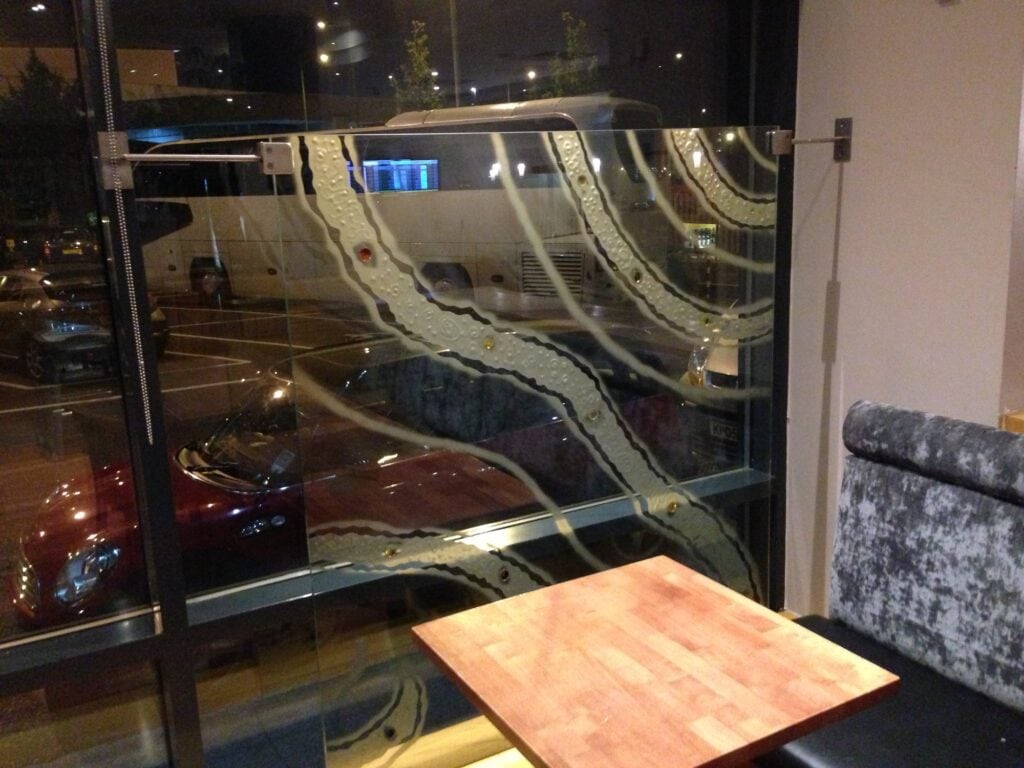
In decorative architectural work, fused pieces are often small glass shapes fired in a kiln and then applied to a glass panel, sometimes with an etched background; this is how the fused panels in the gallery are made. Fused tabletops, such as the three round fused table tops there, are an example of freestanding work. The page on glass types compares fused glass with other types.
On this site, see the glass type page for Fused Glass and Kiln Formed Glass.
More glass history
- A Short History of Stained Glass
- Medieval Stained Glass and the Origins of Leaded Lights
- How Window Glass Was Made: Crown, Cylinder, Plate and Float
- Stained Glass from the Gothic Revival to the Twentieth Century
- Opalescent Glass, Tiffany and the Copper Foil Method
- The History of Brilliant Cut and Bevelled Glass
- The History of Acid Etched Glass
- The History of Sandblasted and Deep Carved Glass
- The History of Fused and Kiln Formed Glass
- Where Overlay Stained Glass Came From
Terms are explained in the Glass Glossary. The tools and methods used today are covered in Glass Tools and Equipment, and the types of glass themselves under Glass Types.
Firing temperatures and schedules for each type of glass are in Firing Temperatures and Schedules for Fused and Kiln Formed Glass.